
Education
Help for the handicapped
A qualified audiologist and speech therapist, Gover Mubarakai has been assisting aurally and mentally disabled children in Dahanu taluka
"My school is as old as my younger son,” says 59-year-old Gover Mubarakai of the Anutai Wagh Karn Badhir Vidyalaya (school for the hearing impaired) in Dahanu that she has been involved with, first as teacher, then as principal and currently as consultant, trustee and treasurer, since its inception in June 1980. Speaking to Parsiana on March 8, 2016 over brunch at her home in 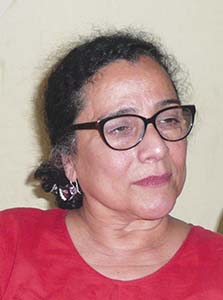 Dahanu, she reveals that she was expecting her baby when her family was approached by a group of people who were raising funds for a school for the handicapped. Recalling the zeal of Padma Shri awardee Anutai Wagh, the social worker who was instrumental in setting up the school that now has on its rolls 100 special students, Mubarakai states that Wagh "just held on to my hand, on hearing of my qualifications in audiometry and speech therapy (from Topiwala National Medical College, Bombay) and said ‘I cannot afford to let you go.’”
The nascent school with a handful of special children started in the Dherwada, one of the poorest areas of Dahanu, and Mubarakai recalls stomping determinedly through slushy areas, nearly full-term pregnant. "Then we moved to the beach,” she says, which was an interim location, before occupying a building 20 years ago, around the corner from where she now lives. En route to the school, Mubarakai explains that the institution achieved governmental recognition, having reached the required number of 25 students, within a year of starting, "which surprised us all,” she smiles.
Showing us around the classrooms which house about 15 children each, Mubarakai points out that each desk is fitted with personal audio equipment for the students. The institute employs 25 staff members in all, most of whom are drawn from the local communities, she states. All teaching staff members have undergone state approved training to qualify as teachers for the hearing impaired. Trained teachers are now also provided by the state government, she mentions.
Eighty percent of the students are from adivasi (aboriginal tribal) families, at any given point. Boarding facilities are provided for about 80 of the 100 students on its rolls at present. Tuition and boarding is free for all students. Diagnosis that a child is indeed hearing impaired is not easily accepted by parents, shares Mubarakai. "We have children as old as 18, in Class 5,” she points out. As the trustee-cum-treasurer shows us around the dormitories and the kitchen for the boarders, she lets on that government subsidy for the students is very slow to come, and they "have currently not received funds for the last three months.”
Madhumati Raut, secretary of Thane Zilla Stree Shakti Jagruti Samiti, under whose auspices the school was set up and continues to function, informs us that the co-educational school houses students till Class 5. Mubarakai clarifies that most students are made to repeat each class, to ensure that they have a firm grounding. "By and large, all schools for the hearing impaired follow this pattern,” she adds. After Class 5, the children directly appear for their school leaving examination through Dadar Vikas Vidyalaya in Bombay.
Dahanu, she reveals that she was expecting her baby when her family was approached by a group of people who were raising funds for a school for the handicapped. Recalling the zeal of Padma Shri awardee Anutai Wagh, the social worker who was instrumental in setting up the school that now has on its rolls 100 special students, Mubarakai states that Wagh "just held on to my hand, on hearing of my qualifications in audiometry and speech therapy (from Topiwala National Medical College, Bombay) and said ‘I cannot afford to let you go.’”The nascent school with a handful of special children started in the Dherwada, one of the poorest areas of Dahanu, and Mubarakai recalls stomping determinedly through slushy areas, nearly full-term pregnant. "Then we moved to the beach,” she says, which was an interim location, before occupying a building 20 years ago, around the corner from where she now lives. En route to the school, Mubarakai explains that the institution achieved governmental recognition, having reached the required number of 25 students, within a year of starting, "which surprised us all,” she smiles.
Showing us around the classrooms which house about 15 children each, Mubarakai points out that each desk is fitted with personal audio equipment for the students. The institute employs 25 staff members in all, most of whom are drawn from the local communities, she states. All teaching staff members have undergone state approved training to qualify as teachers for the hearing impaired. Trained teachers are now also provided by the state government, she mentions.
Eighty percent of the students are from adivasi (aboriginal tribal) families, at any given point. Boarding facilities are provided for about 80 of the 100 students on its rolls at present. Tuition and boarding is free for all students. Diagnosis that a child is indeed hearing impaired is not easily accepted by parents, shares Mubarakai. "We have children as old as 18, in Class 5,” she points out. As the trustee-cum-treasurer shows us around the dormitories and the kitchen for the boarders, she lets on that government subsidy for the students is very slow to come, and they "have currently not received funds for the last three months.”
Madhumati Raut, secretary of Thane Zilla Stree Shakti Jagruti Samiti, under whose auspices the school was set up and continues to function, informs us that the co-educational school houses students till Class 5. Mubarakai clarifies that most students are made to repeat each class, to ensure that they have a firm grounding. "By and large, all schools for the hearing impaired follow this pattern,” she adds. After Class 5, the children directly appear for their school leaving examination through Dadar Vikas Vidyalaya in Bombay.
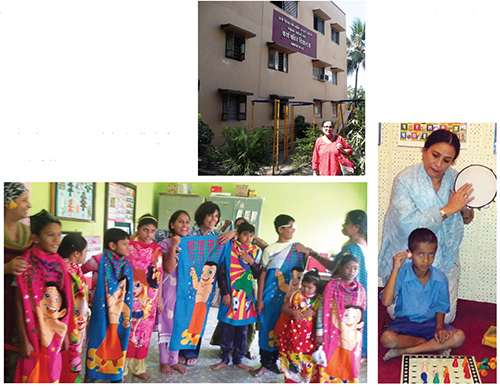
Top and center: Gover Mubarakai on the school premises;
Parivaz Irani conducting an activity with day-care members;
auditory conditioning prior to testing
The school teaches all subjects according to the Maharashtra State recommended syllabus, notes Raut who proudly produces statistics. "Ten batches of students, totaling approximately 200, have appeared for their school leaving certificate (SSC) examinations since the school started, and we have always had a 100% success rate,” she beams. About seven to 10 children appear each year for the exam.
Each April, after the academic year, the teachers fan out into the rural communities around Dahanu. With the help of gram sarpanches (village headmen), they identify children who need special attention. The school also interacts with local industries to lobby for employment for children who successfully complete their examinations and also assist in facilitating admissions to ITI (Industrial Training Institute) courses in a school in Ulhasnagar catering to people with special needs.
Ashakiran, a day care center for the mentally handicapped, functioning from the school, is currently occupying a significant portion of Mubarakai’s time. "I am doing this to fulfill Ashatai’s dream of having a full range of assistance for the handicapped,” she states. The center has 15 special children enrolled. The children are occupied for three hours where teacher Pervin Mallam, "whose compassion is unmatched,” takes them through a structured program starting 10.30 a.m. five days a week. Hard at work matching picture cards to make up a basic jigsaw puzzle, the children are in a cheery room under the watchful but helpful eye of Mallam. Activities include reading and writing skills, self help skills and directed tasks. Mubarakai wishes the organization had the funds to employ special educators. Ashakiran charges a nominal fee of Rs 200 per month and is funded by some donors and largely by Mubarakai and her friend Parivaz (‘Palli’) Irani, who was a school teacher, prior to marrying Ronnie, a restauranteer.
Recalling how supportive husband Bomi, a third generation agriculturist was about her decision to put her qualifications to use, Gover states that her father-in-law Soli gave his blessings too, but with one condition: that she should not accept any remuneration for her services at the school, a condition she has fulfilled till now. Gover says that she was a "migratory bird,” in the early years, having to commute between Dahanu and Bombay, where sons Sharom and Comron were studying in St Mary’s and living with her mother Villoo Pollard. Gover continues to practice speech therapy "with rich patients who can afford it,” from a clinic near her home. An avid national level scrabble player, the therapist found the time to complete her teacher’s diploma for children with special needs in 1982 from Bombay while her sons were growing up. Sharom, now married to Rhea (née Chinoy), with two children Aiyana and Zayden follows in his father’s footsteps as agriculturist in Dahanu. Comron and his wife Zara (née Engineer) and child Tyhaia live in Perth where he owns and runs a restaurant.
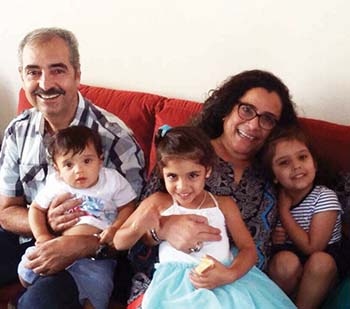
Bomi and Gover with grandchildren (left to right) Zayden, Tyhaia and Aiyana
Waving goodbye, Mubarakai leaves for a meeting of the trustees in a rural area away from Dahanu, where they were scheduled to commemorate an anniversary of the founding of the Thane Zilla Stree Shakti Jagruti Samiti. "The Samiti (committee) was set up in 1976, the year I married Bomi,” she beams.
◆ ◆ ◆
From the archive