
Cover Story
Countering the sounds of silence
The Education Audiology and Research Society has introduced sound and speech to countless hearing impaired children
The teachers covered their lips while talking to the young boy. "Tell the gentleman what you did today,” they said. The boy looked quizzically at the visitor uncertain whether to ask the stranger what he did or tell him what, he, the boy was doing.
After repeating the question a few times the boy spoke of his day’s program and on further questioning informed the guest as to which school he attended, St Mary’s and which class he was in.
"We kept our lips covered otherwise he would lip read,” said Pervin Mehta, honorary director of The Education Audiology and Research Society (EAR). The boy had been fortunate enough to receive a cochlear implant, a magnetic electronic device embedded in the skull bone. The implant conveys sounds to the brain through the auditory nerve.
"With this implant the (hearing impaired) child does not need to go to a special school,” says Mehta. Nor do such children have to depend on lip reading or sign language to communicate. "Why advocate sign language when you can have this?” queries Mehta.
With the cochlear implant, the voice quality also improves. The high and low pitch variations one hears from hearing impaired individuals lessen or are absent. Thanks to the implant the parents believe "my kid can be a regular kid. He can become a doctor or a lawyer. It’s like giving new life to a deaf child.”
"It’s very costly,” Mehta says referring to the device. "Around six to seven lakh rupees. Parents will sell off their jewelry… everything. It’s like an investment in the child’s future. It’s so worth it.” One parent present at the premises had "waited two-and-a-half years and is still waiting,” saving for an implant, said Mehta.
"The parent is our client. She (or he) is our partner,” Mehta observes. "A lot depends on the mother and father.”
If an implant is not within the financial reach of the family, "the children have to go to a special school” where they will be taught lip reading and sign language. "But their whole life they will be handicapped,” ending up in relatively lesser paying vocations. The EAR which used to be a special school now functions as a therapy institute thanks to the advent of the implants. Ear, nose and throat specialist doctors Milind Kirtane of Hinduja Hospital, Rajiv Nerurkar and Anand Shah both of Bombay Hospital have assisted EAR children considerably, says Mehta.
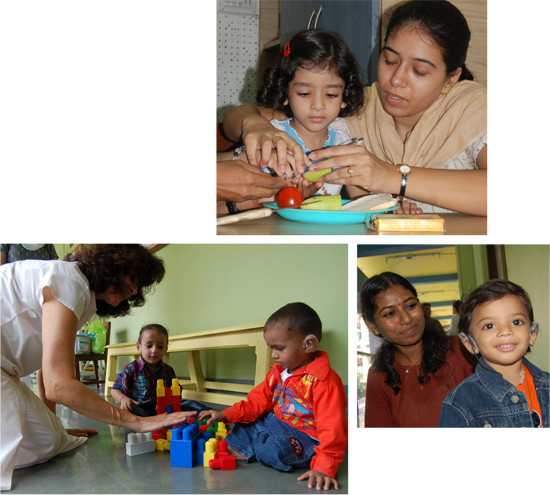
Above: Parent assisting youngster. Bottom right: Mother and child with cochlear implant.; Left: Pervin Mehta assisting child with word and object association.
Photos: Rahul Godse
Detecting hearing deficiencies at an early stage is crucial, says Mehta. First we thought four years was okay but now if someone comes at that age, we feel we have to catch up,” she remarks.
Between blindness and deafness, Helen Keller who suffered from both, considered deafness "a bigger drawback,” says Mehta. Without hearing sounds, the brain does not develop. The deaf individual "is stunted in development as a human being. How do you hear ideas? If I don’t have a language, I can’t read,” she observes. Children are taught word association by showing them common household items and then pronouncing the matching name.
Neonatal screening for hearing can be done as early as 48 hours after the baby is born, says the director. If any hearing impairment is detected at this stage, the parents are educated as to what is to be done. Bombay Hospital, J. J. Hospital and Cama Hospital are cooperating with EAR for the screening of newborns. "The mother has to work with the child after the implant so that speech and hearing ability are on par,” notes Mehta. "If the parent is too busy to help the child, progress is negligible,” she says.
For those who cannot avail of the cochlear implant, hearing aids are the second best option. "The more profound the deafness, the more expensive the hearing aid,” says Mehta. Digital hearing aids can cost up to a lakh of rupees while the cheapest aids cost around six to eight thousand rupees.
But the aids not only enable people to hear, they also help him/her to talk. "Nature has imposed one handicap, that of deafness,” noted Alexander Graham Bell, "man’s neglect has added another in ‘dumbness.’” He was quoted in a EAR brochure commemorating the Society’s 25 years of existence from l963 to l988.
Vakeel’s vision
EAR was the vision of Meher Vakeel whose child was hearing impaired, says Mehta. Since no facilities were available to assist such children, Vakeel took her baby to England. Vakeel realized that "everything we are doing (in England) is basically here. Why don’t we start something in India?”
"On April 5, l963 Meher Vakeel’s dream of meeting the educational needs of deaf children in the best possible way, became a tangible reality,” states an EAR souvenir commemorating 41 years of the institution.” The Education Audiology and Research Centre was established in Bombay and her strong commitment to provide deaf children the best education became the goal towards which EAR aspired.
"The Commonwealth Society of the Deaf, London gave her their full support and The Darasha Vakharia Education Trust founded and registered the organization under The Bombay Public Trust Act. The Centre later functioned as part of The EAR Society. The first donors were the Sir Dorabji Tata Trust, The Sir Ratan Tata Trust, The N. M. Wadia Charities, the Volkart Foundation, K. F. Vakeel and Sir Dinshaw Petit, and Meher Vakeel became the chairman of the EAR Society.”
Mehta refers to Vakeel’s "foresight and inspiration… that brought in top people… we owe her such a debt of gratitude. She lived for the institution.”
The school was started at Punam Apartments at Nepean Sea Road with l7 children aged from seven to l2 years. Subsequently an Infant Centre was opened at Gulmarg also on Nepean Sea Road. The present premises at Topiwalla Lane, Off Lamington Road in the Topiwalla Municipal School building was acquired through the intervention of S. S. Tinaikar, former municipal commissioner of Bombay, Mehta is grateful.
The Maharashtra government, however, has not been much help, she notes. In countries where the state has assisted hearing impaired individuals, such as Australia and Canada, they have "shown the biggest spurt in hearing” abilities.
Hearing impaired children are "highly prevalent in India,” says Mehta. "Very often genetics” is the cause, she notes, "it runs in the family.” But for 60 percent of the cases "the cause is unknown.” Sometimes the mother may have taken strong antibiotics during pregnancy or consanguineous marriages may result in "a lot of deafness” in the offspring. Only three Parsis have availed of the Society’s services during her tenure.
The EAR Society has a budget of around l7 lakh rupees annually and most of the education is imparted free of cost. The salaries of the teachers, secretary and office assistant are paid for by the government Social Welfare department while the Society pays for the principal and audiologist’s salaries, says Mehta. "It’s difficult to get teachers,” she notes. Those who train at the Ali Yavar Jung Institute in Bombay are snapped up by schools throughout the country.
As a matter of fact many of the people involved with EAR in its formative years went on to start schools of their own, said Mehta. Among the notable ones are Beroz Vacha (a former principal) and Dhun Adenwalla.
Mehta’s involvement with the deaf began while in college. A lecturer, Sarla Mukhi encouraged the students to visit various institutions for the disadvantaged so they would know more about the problems people face. Mehta came in touch with Margaret Moore at EAR. Moore and Mukhi set up a teacher training course, guided by ear, nose and throat specialist Dr Dara Anklesaria and speech therapist Saker Mistri, the present chairperson of the Society.
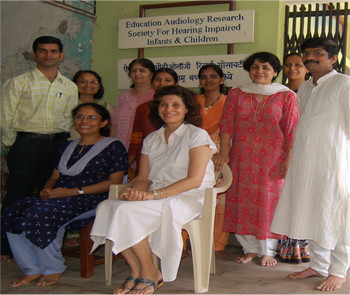
Pervin Mehta (seated right) and staff of EAR
Moore’s dedication moved Mehta to take up a diploma in speech therapy at EAR. She subsequently did a three-year Master’s degree in special education at Washington University in St Louis, Missouri.
Her businessman father, Dhunjisha Neterwala built a hospital and the Shirinbai Neterwala School in Maneknagar, a three-hour drive from Nagpur where his ferromagnesian refining factory was located. The School built in his mother’s memory has around 700 students and the hospital, 38 beds. Both institutions are supported by the family foundation.
Did she ever think of joining the family business? "It was never something I wanted to do… It had no attraction for me,” she replies.
Mehta, who tends the EAR five days a week, works in an honorary capacity. She took a four-year break when rearing her two children Jamshed and Tina. Her husband Russy runs one of the oldest boiler repair companies in Bombay. Coming from a "privileged” background she "wanted to do something meaningful… It’s wonderful to do something with your life, something worthwhile.”
Contact: EAR Society, Topiwalla Municipal School, Topiwalla Lane, Off Lamington Road, Bombay 400007. Phone: 23881425, e-mail: ear_society @yahoo. co.in website: www. earsociety.com Donations are exempt under Section 80G of the Income Tax Act.
◆ ◆ ◆
From the archive