
“More tolerant than any other”
The Sasanians permitted other religions to exist but with certain boundaries
Explaining that the empire was "nothing more and nothing less than a network of powerful Parthian families,” it was Zoroastrianism that forged an Iranian identity among the disparate aristocrats of the period. The ‘king-of-kings,’ as he consistently referred to the reigning monarchs during that era, "spoke to the people through Zoroastrianism.” Zoroastrianism provided a degree of stability to the Parthian nobility, continued the professor. "The aristocracy were aware of their vulnerability (to each other) and therefore depended on the religion” to remain a cohesive force, said Payne.
The literary works by the clergy of the period on religious aspects as well as on matters of inheritance ensured that every male aristocrat could pass on lineage to his natural and adoptive children, as a result of the institutions like substitute successors. Zoroastrian priests were behind scholarly works on jurisprudence, said the professor, referring to the Hazar Dadestan (thousand judgments) and other works on the topic of ritualistic purification. As an aside, the academic noted a connection between Hazar Dadestan and the KRCOI, mentioning that the work was published in India by Dr Sir Jivanji Modi, president and secretary of the Institute (1919 to 1931).
All images from Wikipedia
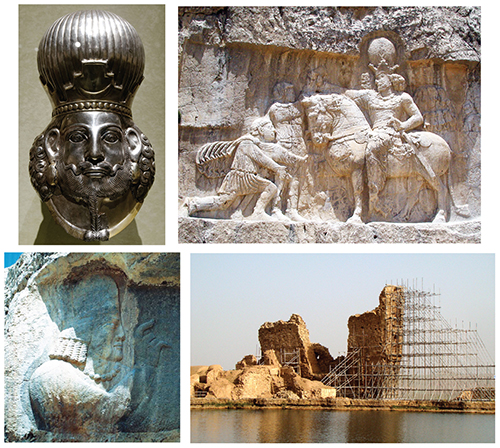
Fire temples were "endowed with lands both by the royal court and by the aristocracy in perpetuity,” and these could never be separated from the place of worship, said the professor. In his talk, illustrated with pictures including those of early fire temples at Nakhlakh, the professor explained that the foundation of Iranian rule was the fire temple.
Giving the example of Mobed Kartir, the priest who served as chief mobed to four successive Sasanian emperors between 240 CE and the 290s CE, Payne explained that he was one of the key figures responsible for the institutionalization of Zoroastrianism in Iran. He was behind the "legitimization of doctrines, he funded and performed most important ceremonies” for the royal court. The mobed was "invested with the power to sanction contracts, marriages, settle disputes” and had a monopoly for judicial power within the empire. Religion and empire were interdependent in a most concrete sense, the academician said.
 The second part of the talk centered on "the myth of Zoroastrian intolerance.” He referred to the Kartir inscription, a rock cut bas-relief discovered at the archeological site of Naqsh-e-Rajab near Persepolis, which describes the priest’s work in "expelling Ahriman and daevas” and the "destruction of idols.” The academician stated that the various kings-of-kings of the Sasanian dynasty did not "seek to eradicate other religions, only to suppress them in order to rule efficiently and create enduring institutions.” They created "different hierarchical models” and allowed other religions to propagate "as long as the boundaries (between religions) remained.” The professor revealed that the Zoroastrians were more tolerant of Christians and Jews but less forgiving of idol worshippers such as followers of Mesopotamian polytheism and Buddhism. Christian bishops, he reminded the audience, were present in every major city in greater Iran between 410 CE and 636 CE and were allowed to construct huge monasteries and build congregations. Zoroastrian authorities defined a process of subordination for people of other faiths to follow. Their place in the empire was secure as long as they respected Zoroastrian institutions. The Zoroastrian kings-of-kings were "more tolerant than any other” late antiquity empires of the time, the professor stated.
 "Persecution of non-Zoroastrians (in late antiquity in Iran) is generally written about from a Christian perspective,” he said. Payne revealed that Christian bishops were indeed executed, but that was for failing to pay taxes, not for religious reasons. He expostulated that at least as many Zoroastrians were executed as were Christians, for non payment of taxes and other acts of insubordination to the king-of-kings. The professor remarked that "dead Christians became martyrs, dead Zoroastrians were forgotten.”
Payne stated that early Christians were less tolerant of Zoroastrianism and aimed "to triumph over” the religion, which may have resulted in the destruction of some fire temples. Assaults on fire temples were treated as assaults on the state, said the academician.
Image from Wikipedia
The Church did not accept converts from Zoroastrianism, according to Payne. Those aristocrats who did clandestinely convert to Christianity were put to death by their families out of shame, he stated. "Expand, but keep to the boundaries,” was the message that the court sent out to other faiths.
In response to questions from the audience the professor said that there was no clear evidence that non-Zoroastrians were taxed at a higher rate than Zoroastrians during that period. Also, he stressed that "becoming a Zoroastrian was absolutely unproblematic.” Newcomers to the religion were treated like any other member of the faith.
The lecture was initially planned to be held over two days, but was condensed to one day on account of delays in Payne’s flights to Bombay. The session was chaired by Ervad (Dr) Rooyintan Peer, a past trustee of the Institute, who was introduced by honorary secretary of KRCOI Dr Nawaz Mody. Peer introduced Payne as the author of several books and papers on the topic of religions of the Near East.