
Welfare
Golvad’s gift
A small nursery school imparts education to the economically disadvantaged
The air is heavy with the promise of rain. As the rickshaw winds along the bumpy road, I can see the shoreline — spotted with palm trees and the occasional fishing boat. On our way to Golvad I notice a nondescript sign on the side of the road — ‘K. P. B. Nursery School.’
Located in this coastal town of Maharashtra, the Khushrooh Pheroz Byramjee Nursery was established in June 2005 and provides three standards of primary education — playschool, nursery, junior and senior kindergarten. With an approximate 10 students per class, the school hosts a total student body of 30 children. The school provides English medium education to local Adivasi and other children.
The school’s founder, Mahakhurshid Byramjee set up the school in memory of her late husband Khushrooh as she "loved children. I always wanted to start a school,” says the mother of three. The idea for an English medium institution came to mind when judging a beauty contest at the annual May Queen Ball at Rustom Baug. One of the contestants from Gujarat broke down and cried when asked a question in English. "It’s no fault of theirs,” if they are not conversant with the language, notes Byramjee. "They are taught English too late,” in their educational curriculum.
Why Golvad? "I had land. I did not have to go scouting for space,” notes the real estate developer who owns a farm in the coastal town.
The school is funded by the Byramjee Foundation which was started by her late businessman husband. Mahakhurshid and her son Rishad are the trustees, her two daughters Jahaneen and Kainaz residing in the USA. A percentage of the business profits are ploughed into the trust every year, she says.
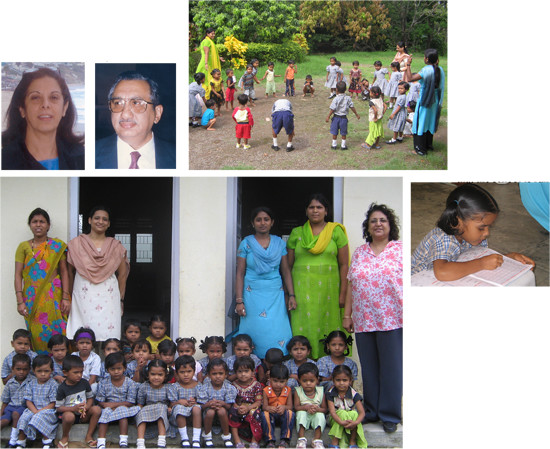
Clockwise from top left: Mahakhurshid and Khushrooh Byramjee, children at play, child studying, staff and students, principal Hutoxi Hodiwalla at extreme right
Photos of school by Rashna Kharas
The students are charged Rs 20 a month for tuition, uniforms, breakfast, books, etc. The idea of charging a fee was so they would not take the educational facility for granted, explain Byramjee. The trust incurs expenses of around one-and-a-half to two lakh rupees a year on running the institution.
Since this was the first time most of the children were introduced to formal education, some of them are as old as seven to eight years, while the majority range from ages three to six.
The modest school has three full-time teachers, one teaching assistant and is led by the principal Hutoxi Hodiwalla. A trained Montessori teacher and former Air India employee Hodiwalla explains that the school is run akin to urban mainstream schools. Each standard has a set syllabus that is subject to change if required. Well equipped with various educational toys, the school provides for all the students’ schooling needs. Everything, from the children’s blue and yellow checkered uniforms complete with socks and shoes, their books and stationery, to their morning snack of biscuits, is provided for by the Foundation.
The school also has an affiliation with the English medium Ataram Salve High School in nearby Bordi. Following their nursery education, parents are strongly encouraged to enroll their children in this school. "I take them across to get (them) admitted there,” says Hodiwalla. A young girl who is now in Bordi school is doing exceptionally well, the principal is happy to note.
The cost for sending a child to the primary school works out to 8,000 to 10,000 rupees a year. Byramjee would like donors to come forward and sponsor/adopt a child for this part of the education. "If we don’t look after them after the nursery level everything would go to waste,” she observes.
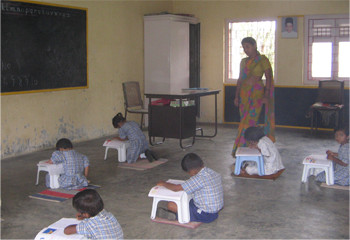
Classroom: models of good behavior
Byramjee would also like local Zoroastrians in Golvad to help out by volunteering their time. Bachu Contractor, her neighbor, for example gives free tuitions to the children who require assistance after joining the primary school.
After completion of their individual academic tasks, wide eyed and exceedingly well behaved, the children look forward to their play time. The teachers oversee group games of ‘Ringa-ringa-roses’ or ‘Oranges and lemons.’ Embodying the idea of a well rounded education, the students are made to say ‘please’ and ‘thank you’ for everything. Simple things such as not eating off the floor and putting things in the dustbin are also emphasized by the teachers.
As I rummage through my notes and pictures searching for quotes and other quips from the children, it dawns on me that I hadn’t been able to elicit a peep from the children. They had been told to behave and they were doing exactly that. Even during their biscuit break and amidst the flash of my camera, these children were the models of good behavior.
Contact details: Byramjee Foundation, Cassinath Building, first floor, 17 A. K. Nayak Road, Fort, Bombay 400001, e-mail: cassinath@vsnl.com
Based on a report by Rashna J. Kharas with inputs from Parsiana.
◆ ◆ ◆
From the archive