
Education
With sense and sensibility
Director Meher Banaji believes in grooming the children at The Happy Home and School for the Blind to face life's challenges
"Your handwriting is very good,” she encourages one of the primary school boys. "Why are you not writing?” she reprimands another who insists on using his braille equipment. Over the three decades she has been principal of The Happy Home and School for the Blind in Bombay’s Worli area Meher Banaji must have coaxed thousands of visually impaired boys to use the senses at their disposal to confidently face life’s many challenges. While vision is totally absent among some of the children in her care there are others who have residual vision and have to be goaded to use it even if it means reading or writing with the book barely an inch away from one’s face! Even those with multiple disabilities are not allowed to become objects of sympathy but trained to develop into contributing members of society. "The disabled don’t need pity, they need opportunity,” believes Banaji, presently the director of the School.
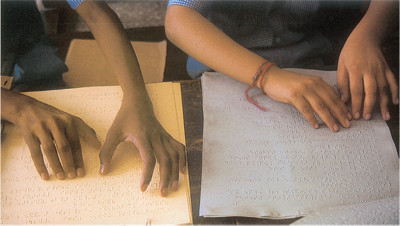
Braille is but one of the many lessons taught at The Happy Home and School for the Blind
When the list of Padma awardees was announced on India’s Republic Day on January 26, 2004 Banaji was the only Parsi to have featured therein. She was conferred the Padma Shri for her contribution in the field of social work. This is the second recognition she earns from the President of India. In 1996 she was conferred the National Award for Teachers for "outstanding contribution to special education (visually impaired).” The former chief justice of India and vice president of India, M. Hidayatullah, impressed with the functioning of the institution, had acclaimed it as "without doubt one of the best run schools in the country...the credit goes to the principal...and her organizing ability. In my opinion she is one of the finest teachers one can find in India.”
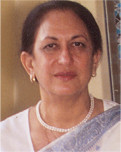
Banaji: single- minded devotion
Last year the School had left an indelible imprint on the Prime Minister (PM) of India Atal Behari Vajpayee who had come visiting them. To welcome him the School choir sang Kadam mila kar chalo, one of his poetic compositions set to music by Naushad. On being acquainted with the School’s different departments Vajpayee asked how he could help the School. The School management responded, "Hum soch ké bataaéngé (we will let you know).” After a few days they got a reminder from the PM’s office stating they had yet not received the School’s wish list. When Banaji conveyed their need for a mosaic training department where pieces of glass/tiles are aesthetically assembled to create beautiful images, the PM promptly sent a donation of Rs 15 lakhs which helped launch this new facility. Thereafter on his birthday the PM sent another gift of one lakh rupees stipulating that it be used to gift each student, currently 197 on their roster, a present on his behalf.
Three years prior to the PM’s visit it was then US president Bill Clinton who had fraternized with the children of the School en route to the airport. Clinton was presented with three Ganesha idols made by the children. "Since Americans record everything, the Ganesha idols and the circumstances in which they were acquired will be written in White House records as well as in various libraries across the US. The blind children of the Worli School and Ganesha have already become part of American history,” wrote columnist Dilip Raote in the Mid-Day of March 30, 2000.
Dignitaries may come and dignitaries may go but Banaji is one constant factor whose enduring presence has helped the School realize its goal of "Vision beyond sight.” The School was started in 1925 by Coomi Sohrab Bharoocha at the B. D. D. Chawls in Worli. The cramped premises served as classrooms by day and dormitory by night. Tragic events in her early adulthood made Bharoocha dedicate herself to the cause of the blind. "I have learnt from her the importance of singleminded devotion to one cause,” candidly admits Banaji who had seen the founder immerse herself in the School’s activities until the last week of her 90-year-old life, happily singing carols with the children on the occasion of Christmas. Bharoocha passed away on December 30, 1988.
Banaji had been appointed principal of the School in 1969. "My starting salary was Rs 250 per month,” she recalls. When she asked for an increment, she was sanctioned an additional two rupees! Being classified as a partially aided institution the School is supposed to receive grants from the government. "We wouldn’t get grants for years so we had to make provisions such that our teachers are paid on time,” mentions Banaji who is viewed as "an intrepid and effective fundraiser who makes sure that training programs and projects for education and pre-vocational skills do not founder for want of funds.” She is of the opinion that teachers at her institution should be paid as much or better than others in the profession on the rationale that you cannot expect the disabled to demand equal rights if you undermine their teachers. At their School presently in employment are 42 teachers and carestaff, with an additional 70-80 volunteers. The majority of their donors as also their office bearers are Parsis: honorary secretaries P. M. Maneckji, F. H. Sethna and S. S. Mehta, honorary treasurer A. D. Colah and joint honorary treasurer V. H. Unwala function under chairman Julio Ribeiro. Likewise there are many other Zoroastrians who come as volunteers to share their time and talents at the School. "One thing about Bombay is that people give of themselves — of their time, their wealth,” she recognizes.
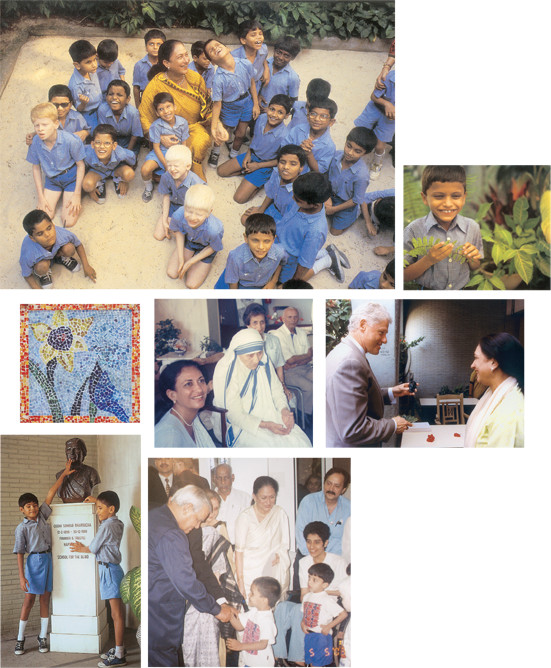
(From left) top row: Banaji and the School children enjoy the outdoors (Photo: Parsis); middle row: mosaic flower created by the School children, Banaji with visitors to the School — Mother Teresa and Clinton ; Bottom (left): Children realize the importance of School founder Bharoocha Right: Vajpayee greets the School children and enthused by their versatility rewards them with the mosaic department
Being the resident director Banaji is familiar with every detail concerning each of the 197 students in her charge, ranging in age from three to 20. Since most of the boys come from economically disadvantaged families, Banaji has not only to cater to their needs while they are in School, she has also to provide for their medication and transport costs considering that the boys are sent home every Friday to spend the weekend with their families and return to School on Sunday evenings. Having graduated in child psychology from Bombay’s St Xavier’s College (her schooling was at Queen Mary), Banaji realized that "family ties keep the children firmly rooted in their milieu while accelerating learning.” Since the School children keep her preoccupied during the week, it is only on weekends that Banaji is relaxed to interact with her family in Bombay that comprises mother Hilla and sister Farida Mogul. Her other siblings Mithi Daver and Persis are settled in Australia. Both her parents were educationists: her mother was a teacher at the Activity High School and her late father Jehangir at the Bharda High School.
Viewing her boys as differently abled, not disabled, she seeks to inculcate in them self-confidence and independence. As one group of adolescents was proceeding from one classroom to another, she noticed one of the partially sighted teenagers walking along the corridor with his head lowered, signifying that he was using his auditory senses for movement. He was promptly reprimanded and asked to retrace the same paces with his head erect. At lunchtime when a couple of boys trooped into the dining room instead of walking in an orderly, disciplined manner, they were forthwith asked to return to their classroom and proceed as per the rules. Realizing that the kitchen is shortstaffed on a particular day, she instructs the supervisor to take the assistance of the senior able-bodied boys who can help out with chores like filling water in glasses for everyone. "A lot of handicapped people believe that the world owes them extra concessions but such an attitude does not make for a happy, adjusted future,” points out the disciplinarian who is as stern with her seniors as she is gentle with her juniors.
Wednesdays being one day of the week when visitors are permitted at the School with prior appointment, she encourages her tiny tots to interact with others. When the children of one of the Muslim schools came visiting, Banaji encourages her children to sing them a song, to feel their uniform, the typical Muslim attire complete with caps on the heads of the boys and rida draped by the young girls. While some of the students are addressed in English, she may converse in Hindi, Marathi or Gujarati too depending on the child’s mother tongue.
During all these years there have been only three Parsi visually impaired students who have benefitted from this institution, reveals Banaji. Blindness is rare among Parsis except when it is precipitated by consanguineous marriages, she notes. In one case an Irani girl was permitted to be educated here because Hidayatullah, then chairman of the Trust, felt she should be helped. When the time came for her family to take her back, the father refused to comply and it was ultimately learnt that he himself was suffering from brain tumor and feared for her future after his demise. When columnist Bachi Karkaria met this girl and wrote about her winning ways in the English Press, a couple came forward to adopt the Irani girl.
There are some families who prefer to send their differently abled children to schools offering integrated education but Banaji believes that the quality of education offered there is not the same as they would get in special schools. Of all the children with special needs, a visually handicapped child is the easiest to teach because his/her concentration is intense, devoid of distractions, maintains Banaji. "The quality of education offered here is very high. Our facilities are on par with those available abroad because of which our children often fare better,” says the director who has studied special education at the University of Birmingham and subsequently underwent training in Hongkong for effective use of low vision aids. Slow learners as also those with behavior and maladjustment problems benefit from the presence of the counsellor at the School.
Every child at Happy Home is diligently taught braille in addition to the regular school subjects which would systematically prepare him for his Secondary School Certificate examination. Additionally, they are exposed to a gamut of co-curricular activities: in their pottery section where even a visitor is encouraged to feel the therapeutic experience of holding/molding clay, the weaving and woodwork department, the mosaic department where murals, trays, tabletops are infused with color and character when the glass splinters and pieces are arranged on tiles under the direction of stained glass artist Jasmine Jehangir. The public too gets to see these wondrous creations at the School’s annual exhibitions. Additionally the boys have the facilities of a gymnasium which is well equipped with treadmills, a trapezium, a rock climbing wall and mattresses to cushion the falls as they practice their judo, swimming which they get to do at the Breach Candy Pool, and music where they render and create soulful vocal and instrumental tunes.
In fact their School choir has created quite a few sound waves! Besides winning prizes at different interschool competitions, they are invariably invited to render songs at Mani Bhavan on Gandhi Jayanti. Last Christmas they sang carols before the directors of The Taj Mahal Palace and Tower and were treated to a luncheon at the Crystal Room! At a function at the Cricket Club of India on Republic Day, January 26, 2004, they were asked to render Vande Mataram set to music by A. R. Rehman. Taking pride in the musical talents of her children Banaji insists that we be treated to a few of their songs. The well rehearsed group who get accompaniment on the keyboard or the flute or the tabla from one of their co-students even seemed to know that one particular music piece commenced on a F sharp scale!
Banaji herself too enjoys attending music concerts, whether western or Indian music. Equally fond is she of reading and traveling. Monday evenings she likes to visit the Banaji Atash Behram as "it makes me feel good.” Though not too keen to comment on the controversies facing the Parsi community, she states, "In this day and age we have to be more broadminded and tolerant. As it is we are becoming a tribe. Since the Government considered one Parsi from this tribe to receive one of the Padma awards, it is quite something that they have not forgotten us!”
◆ ◆ ◆
From the archive