
Welfare
Aseema’s aspirations
Recognizing a child’s inherent love for learning, Aseema introduces disadvantaged children to formal education
"Every child has a right to education. By education we mean not only literacy but an all-round growth: value education where a child learns to think for himself, to care for others, to respect nature and environment,” emphasizes Dilbur Par-akh, chairperson and trustee of Aseema, an organization committed to providing disadvantaged street children with a nurturing and stimulating educational environment that helps them recognize their potential. Just because these "nowhere” children are poor it does not mean that it is sufficient to give them non-formal education. "If you are not providing them quality education at formal schools where are you taking the children?” she asks rhetorically.
With a grant of Rs 60,000 from the Concern India Foundation, Aseema was able to start its Education Centre for Street Children in 1997. The children under their care were enrolled at St Joseph’s Convent, St Stanislaus High School or the municipal school. But when they realized that their children in the municipal school were forgetting many of the concepts they had learnt earlier with the Aseema teachers they decided in 2001 to "adopt” the Pali Chimbai Municipal School, a two-minute walk from the Aseema center at Bandra. Besides running a pre-primary center (comprising Montessori, Balwadi and Balvikas) at Pali Chimbai Municipal School, every class up to Std VII now has a dedicated Aseema teacher coordinating the students. Activities like art, music, yoga, judo and sports have enriched learning and so too have facilities like a library, art studio, computer and multimedia center. Field trips and outings create a new awareness among these children. They hope to gradually raise the level to Std X by which time the first set of their children would appear for their school leaving examination.
One of the strong support pillars for Aseema has been Tina Ambani who impressed with the creative work produced and sold at their activity center gives them a platform to showcase their talent at the Harmony Shows organized by Reliance Industries at the Nehru Centre. She bore the costs of renovating the toilets and drainage system at the School, appreciates Parakh, relieved that "teaching children about cleanliness and hygiene has become more relevant now.” The mothers of the children, most of whom are domestic workers, help out in the School by keeping it clean or cooking the midday meal which is shared by all — the teachers, students and staff members of Aseema. Knowing that these children come from a different environment, often with emotional problems, the student-teacher ratio is crucial to ensuring their good performance, realizes Parakh who has deployed paid staff and volunteers "to help teach in small groups and bond with the children.”
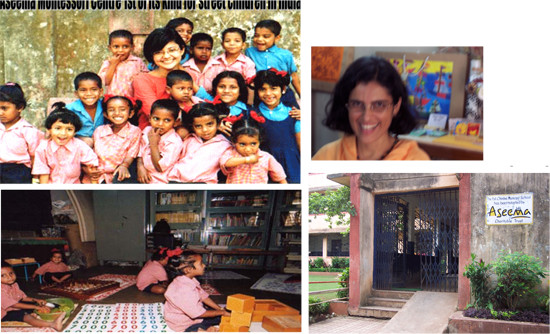
Clockwise from top left: Dilbur Parakh, Pali Chimbai Municipal School and display of children’s creativity
With the teachers recommending that some of the children can only be taught if they are distanced from their family, Aseema explored the possibility of starting a center with residential facilities. Land being unaffordable in Bombay, they bought a 14-acre tract in Igatpuri, and have launched into yet another sphere of meaningful work with the Rural Education Centre for Tribal Children serving the educational needs of the poor children from the neighboring Awalkheda village and surrounding hamlets. The Rural Education Centre would, in the first phase, establish a Balwadi, and eventually educational and vocational training to empower students with independence and a livelihood. Once the Centre starts its residential facility, it would be able to cater to some of the children from Bombay who need to be separated from their families.
The successful transformation of the Pali Chimbai Municipal School gave them the confidence to reach out to other municipal schools. Beginning July 23, 2007, Aseema was to take charge of the Khar Danda Municipal School and soon thereafter, the Guzder Park Municipal School at Santacruz. While initially Parakh found time for teaching, as Aseema’s horizons keep expanding she has necessarily to look after the organizational work, oversee the fundraising, provide for the meals, uniforms, socks, shoes, raincoats…
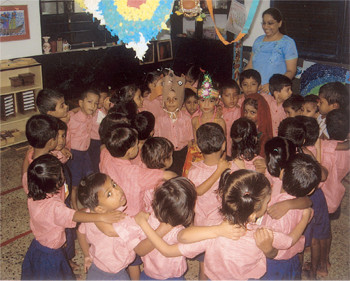
Aseema applies Montessori approach at their Balwadi and Balvikas
Their film Raju and I on child rights won The National Award for the Best Animation Film in 2005 plus 13 other national and international awards. This film has been made by Aseema primarily for children studying in private schools, sensitizing them to the rights of underprivileged children and describing ways in which every child can do his bit to help the less fortunate children.
A case study on "How Aseema seeks business success without selling its soul” published on October 31, 2006 in Knowledge@Wharton refers to Aseema starting out of a single room at a local school with a corpus of Rs 5,000 and how its organizational structure has changed over the years. "Aseema has decentralized its decision making process and hired professionals to manage its administrative functions and the product business…Last year Aseema managed donations worth Rs 36 lakh and the…products division added three lakh as revenue…”
"Give gracefully, not grudgingly. Giving should never be to ease your conscience or out of a sense of guilt,” Parakh would like to impress on the donors. When big companies and rich ladies seek discounts, Parakh finds it "very hard to accept.” The motive for donating to Aseema should be the recognition of "the right of every child to education,” says the chairperson. Barring a couple of large Parsi donors, others from the community give on an ad hoc basis. "We are such an educated community, we need to open up. Our Parsi children are getting a very good education in most cases. Only the right kind of education for other children can bring about a change in this country,” she is convinced.
Religion to this self-effacing worker means "being a good, balanced, rounded human being.” Although she feels the need to wear the sudreh-kusti regularly and say her prayers at least twice in a day, a visit to a temple means a retreat to a quiet place, whether it is a fire temple or a church. For the last nine years, the practice of yoga has made a difference to her life, yoga as propounded by Yogoda Satsangha Society founded by Paramhansa Yogananda. "It has made me realize that problems will come but how we tackle them (can help us progress),” she mentions. "Never give up. Things may not happen at the time when you want them to because there’s a reason to that,” she has learnt, and the most important lesson: "Happiness does not depend on any external factor.”
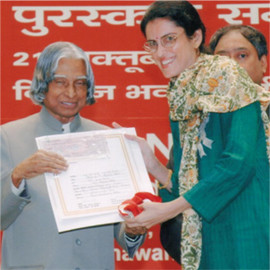
Dilbur Parakh receiving award from Dr A. P. J. Abdul Kalam
Before Parakh immersed herself in social work she was legal officer for Asia and the Pacific of the International Commission of Jurists for five years, based in Geneva, Switzerland. An advocate with a human rights background, her education started at St Joseph’s Convent, Bandra after which she graduated in economics from St Xavier’s College and in law from the Government Law College. She practiced in the High Court of Bombay when working for the solicitors firm, Rustomji and Ginwala, and the noted counsel Rafique Dada. During one vacation, Rafique Dada asked his juniors to assist the Legal Aid Centre at the S.N. D. T. University where they were required to guide social workers. Enjoying the useful work she was doing there she decided to leave Rafique Dada and to obtain a Fellowship from the International Human Rights Internship Program conducted by the Institute of International Education based in Washington. She spent two years in Thailand working for the Union for Civil Liberties which sought to protect the rights of tribals, farmers, fisherfolk… When deputed to a commission on the rights of a child she knew she had to work at the grassroots level and thus chose to return to Bombay.
Seeing the child beggars at Bandra traffic signals in the vicinity of her residence, prompted her and some likeminded friends to tackle the issue. She approached their families staying at Bandra Reclamation and then sought to improve their lot by providing them quality education through Aseema. Her co-trustees on the organization are documentary filmmaker Neela Kapadia and advocate Snehal Paranjape. Daughter of the late Framroz, a solicitor, and Sheroo, a teacher, 48-year-old Dilbur who is single says she derives her support from her family, including brother Sorab and sister Arnavaz Kapadia, and her "amazing staff” that includes the 47 full-time and part-time paid employees and 30 volunteers. While she spends some days in Bombay, the rest of the time she is in Igatpuri defining the educational plans until some sponsors come forward to propel the three crore rupee project in phases. Aseema means limitless — signifying there are no boundaries to a child’s potential nor to our commitment to provide quality education.
Aseema welcomes donations in various forms whether it is the purchase of their creative artifacts or Rs 500 towards the purchase of two sets of uniforms or Rs 30,000 for a picnic, sports day or annual day or the construction of a classroom or library named after a benefactor. A public charitable trust, exempted under Section 80G of the Income Tax Act, cheques in the name of Aseema Charitable Trust may be sent to their registered address at G3 Josephine Apartments, ground floor, Chimbai Road, Bandra (W), Bombay 400050, tel: 26407248, e-mail: contact @aseema. org, website: www.aseema. org
◆ ◆ ◆
From the archive