
Found in translation

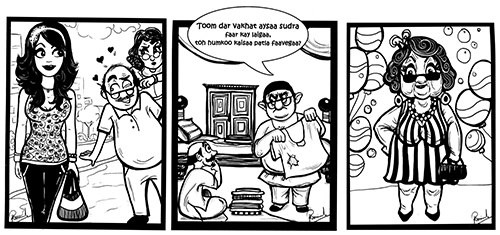
Lest future generations growing up in the West forget, Roshan Rivetna and Dinaz Kutar Rogers have brought out this compendium of Parsi quotations and vignettes, appealingly illustrated by Kaizin Pooniwala. The migrant often longs for her motherland and survives on a staple diet of nostalgia. She quite desperately wants to share the memories and culture of the community she has left behind with her children, and this collection of anecdotes and recollections is to be viewed from such a perspective.
Another concern that Rivetna has tried to addresss is the matter of identity. In the North American milieu where Zoroastrians from India and Iran meet and mingle, she was told, "We should not call ourselves Parsis or Iranis; we are all Zarathushtis.” While her mind tells her that this is the right approach and she must detach her ethnicity from her religion, she is sad at the thought of "giving up the Parsi appellation.” She describes herself as "a slightly confused Parsi-Indian-Iranian-North-American Zarathushti.” And the children born in North America, will they be another breed of "North American Zarathushtis?” she wonders. Hence she felt the need to preserve the Parsi Irani heritage.
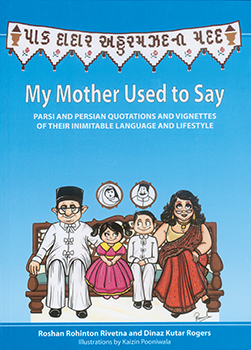 When Rivetna was editor of FEZANA Journal she asked Rogers to write a regular column, "Lest we Forget,” in the Journal, featuring stories and essays about the Zoroastrian, Persian and Indian Parsi heritage. She also suggested a companion feature called "My Mother Used to Say,” comprising Parsi Gujarati and Persian sayings. The latter was of great interest to those who had grown up in India and Iran and were steeped in their respective mother tongues. The Foreword notes that "in this publication we have tried to capture and record… an eclectic mix – from nonsensical ditties we used to sing in the playground and oftentimes insulting nicknames, to timeless and priceless words of wisdom from our holy scriptures.” Also included are vignettes and memories of growing up in Parsi baugs.
To judge the publication by professional standards would be unfair. It claims to be nothing more than a compendium of Parsi miscellanea for the benefit of generations which have not had an opportunity to experience it. The editors lay no claim to this being a book. Hence, its mish mash, rambling and disorganized style is actually quite cute. The translation from Gujarati is of a decent standard, with few errors. It is also an easy read which can be browsed through in a couple of hours. Published from the USA, it is somewhat sanitized and omits that which is politically incorrect. Perhaps, hard core Dadar Parsi Colony (DPC) stuff would be difficult to digest in Detroit.
We did come across some original nuggets though. A rather hirsute Aloo aunty is termed "Ala, bugal ma jala (cobwebs in the armpits).” The DPC penchant for giving nicknames is listed. "God and Fraud” refers to brothers, one good, the other bad; "Napoleon Pona-panch” is a Bonaparte lookalike, whose height is under five feet. This reviewer can empathize with the editors who were, in their childhood, force fed castor oil every week, designated by them as the "Castor Oil Police.” Also listed are some unusual desi (ethnic) cures for common ailments (for whooping cough, smell the bottom of a camel. We recollect having heard this one in Navsari: "Oont ni gaan ma, hing no vaghar,” literally, sniffing hing (asafoetida) smoke underneath a camel’s bottom. Guaranteed to open blocked sinuses!
The compilation highlights the linguistic idiosyncrasies of our community. Under "Repeating with a ‘b’ or other consonant” are these examples: Daaktur bhi nahin, ne baaktur bhi nahin; tarkaari barkaari. Here is an authentic one that we had ourselves overhead: two Parsi ladies on the upper deck of a double decker bus: "Aapoon ne to, dikra, luck bhi nahin, ne fuck bhi nahin” (untranslatable).
Several inclusions in the compilation are not really Parsi or Persian, but originate from Saurashtra and Kathiavad in Gujarat. Of course, over the decades, they have all become inextricably intertwined.