
Education
The pride of Pardi
Under the guidance of Tehmina and Ratan Damanwala, the Pardi Education Society is gearing for its centenary
"From KG (kindergarten) to PG (postgraduation) there is a big rush of students” keen to avail of the facilities offered by the Pardi Education Society (PES), mentions Ratan Damanwala who after serving as president for 10 years retired in 2003 and now supports his wife Tehmina in her presidential role. In their 12 buildings with 90 classrooms they have 6,000 pupils studying under the tutelage of 120 staff members, reports Ratan who is the third generation from his family to guide the workings of this Society founded by his grand uncle Dr Kavasji Tehmulji Pardiwalla. There are four principals who share the responsibilities of the Dhunjibhoy Cowasji Oomrigar Sarvajanik High School (started in 1906), and its offshoots, the Jamshedji Framji Secondary School (since 1928), the Jehangir Pestonji Pardiwala Arts and Commerce College (since 1981), Dhanmai Jehangirshaw Damania Bal Mandir (the kindergarten school in Gujarati and English medium (since 1988), Bai Ratanbai Jehangirji Pestonji Pardiwala School (in English medium since 1996).
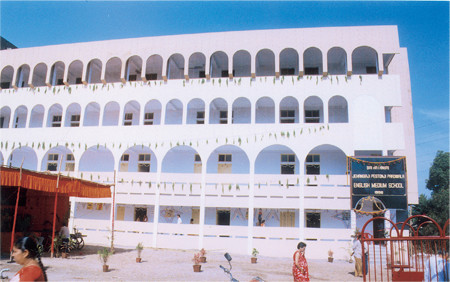
Above: The English medium Bai Ratanbai Pardiwala School in Pardi
For the residents of Pardi and the surrounding villages this co-educational institution is a boon. Unfortunately for the past several years there has not been a single Parsi student enrolled here. "The last Parsi girl who studied here was like a jewel,” reports Tehmina. The Damanwalas feel obligated to shoulder the responsibilities as a mark of "gratitude and duty” to their alma mater. Even whilst professional commitments have made the couple set up base in Bombay, Ratan, a chartered accountant by profession, had served as auditor of the Society for several years. After working with Kalyaniwalla and Mistry for a few years Ratan joined C. C. Choksi and Company, Bombay and continued there until his retirement. Tehmina has been lending her expertise on the managing committee for the last 15 years. Being the home science teacher and supervisor at Bombay’s Byramjee Jeejeebhoy Parsee Charitable Institution (BJPCI) in an honorary capacity for the last 30 years Tehmina’s school time-table is set such that Mondays and Fridays she is not required to take any classes leaving her free to plan her weekend trips to Pardi.
"Our non profit-making institutions are committed to eradicating ignorance and illiteracy. We do not charge fees beyond covering the expenses.” Having Parsis at the helm of the Society inspires confidence: the grants from the Gujarat government, donations from trusts and individuals, especially the largesse of non-resident Indians have benefited the Society which has been able to expand its reach, explains Ratan. Realizing the prevailing emphasis on information technology, in 1995 they started the College Computer Centre. A year later they introduced the School Computer Centre. They have 50-60 computers in their four computer laboratories for the use of all age-groups. "Imagine the progress we have made in this small town where a bullock cart is still a mode of transport,” reinforces Ratan. With the vocationalization of education recommended by the University Grants Commission the PES has introduced a course in taxation after graduation which has helped students to find immediate employment in tax practice, the former president refers to his brainchild.
Warming up to the subject of the Jehangir Pestonji Pardiwala Vatsalya Shala where Tehmina plays a key role, she explains that although it is not a part of the PES, the handicapped in the locality are taught vocations depending on their abilities. A social workers’ van picks up the differentially abled individuals, treats/teaches them, and again leaves them at their doorstep for the convenience of the family. The meticulously maintained record for each child may run into 50 pages, Tehmina gives the details. The couple support the Manav Arogya Vikas Kendra too which organizes medical facilities like blood and eye care for the needy.
The PES has a vision plan which hopes to start a new campus for their English-medium institutions on a plot of land purchased for Rs 30 lakhs. They hope to raise a further Rs 70 lakhs for the new construction to house the High School in English which is in the offing. The buildings thus vacated on their existing campus would be used for the expansion of their College, to have a separate library and research wing, a gymnasium and other such facilities. For the residents of the town they hope to construct a library and for the local children, a well equipped playground.
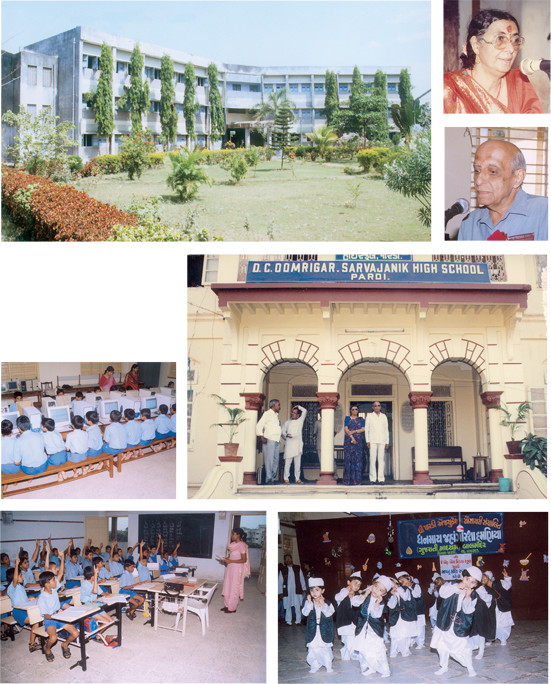
Top: Jehangir Pardiwala Arts and Commerce College with Tehmina and Ratan Damanwala; (alongside and below) portals of D. C. Oomrigar Sarvajanik High School and students engaged in different activities
"Three generations from our family have been serving this institution,” reported Ratan who for years was the vice president before the president’s mantle fell on him. Tracing the genesis of this Society, Ratan went back in time to the early 20th century when there were no facilities for higher education in Pardi. It was Kavasji Pardiwalla [Ratan’s mother’s kaka (paternal uncle) who had a medical practice in Pardi as also Dharampur where he was physician to the Royal family] who took up the responsibility of starting an educational institution by seeking financial and land donations. Fortunately for him Sohrabji Oomrigar gave him a donation of Rs 50,000 in memory of Dhunjibhoy Cowasji Oomrigar to start a school in Pardi. This Anglo-vernacular school came into existence in 1906 with Kavasji as the first president of the PES.
He was succeeded by Vicaji Pirojshaw Bhiladwalla, the founder of the Pardi People’s Co-operative Bank (later renamed the Sardar Bhiladwalla Pardi People’s Co-operative Bank) which is today a prominent financial institution in and around Pardi. Equally eminent was Vicaji’s son Jal who unfortunately died at a young age in a tractor accident in Pardi.
The next president of the Society was the well known solicitor Savaksha Cursetji Pardiwala (Kavasji’s son-in-law). He remained president for 50 years and after him when Ratan stepped in as president he introduced an upper age limit for members, similar to the one introduced by Ratan Tata for the directors of the Tata group. Thus, on crossing 75, Ratan Damanwala voluntarily retired.
In 1981, then vice president Bomanshaw Pardiwala pursued his dream of establishing an arts and commerce college. In 1988, Ratan Damanwala as vice president expressed his wish of establishing a kindergarten school in Gujarati and English which resulted in the three-storeyed Bal Mandir.
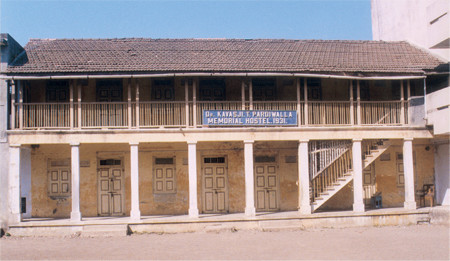
Dr Kavasji T. Pardi-walla Memorial Hostel established in 1931
"There is an unwritten clause which expects a Parsi to head the PES,” notes Ratan "even whilst they expect the president to address the audience in shudh (pure) Gujarati,” adds Tehmina. Having taken over as president in 2003, she will remain in office till 2006, the centenary year of the School, until she reaches the upper age limit. Registered under the Societies, Income-tax and Charitable Trust laws, membership of the PES is restricted to 100 with different categories — patron, vice patron, life, ordinary, honorary and member emeritus. Their 24-member managing committee constituting four lawyers and three doctors includes six office bearers — a president, two vice presidents, one treasurer, two secretaries, 10 members elected at the annual general meeting and eight members nominated by donors.
Finding another Parsi successor to the presidential seat is top priority for the Damanwalas but they know their task is difficult for presently in Pardi there are barely six or seven resident Parsi families with not a single school going child. "Those residing there are highly respected... in the town, in the Lions and Rotary movement...The anjuman has big funds but there are no beneficiaries,” conveys Ratan. When Tehmina was a student in Pardi there were 18 Parsi families resident there, she reminisces. Since no Parsis wanted to stay back, even in the Parsi founded School "there were all Gujarati teachers. Even the Persian language was taught by a Gujarati gentleman. Imagine learning English grammar in Gujarati. We had such a sound base learning from Wren and Martin (the grammar primer),” relates Tehmina. Ratan talks fondly of one of his teachers in Pardi who at the age of 92 continues to inspire them.
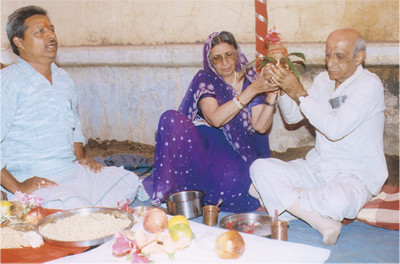
Tehmina and Ratan Damanwala invoke blessings at the launch of a new project
After passing her seventh standard in Pardi (then equivalent to matriculation) followed by BA, she was employed at the Amulakh Amichand Multipurpose School in Bombay’s King Circle. She could not complete her postgraduation for Ratan’s transfer to Calcutta took her to another metropolis. With time on hand she did a diploma course in bakery at Calcutta’s Young Women’s Christian Association (YWCA). On their next posting to Bombay she started cookery classes which continue to this date as her loyal students refuse to let her rest even on an occasional weekend in Bombay. When the BJPCI became coeducational in 1974, then principal, the late Roshan Driver who was Tehmina’s niece requested her to teach work experience to the students of Std IX and X. The oldest amongst the present staff members she now teaches food science to Std XI and child development to Std XII.
With their conservative upbringing Ratan recalls that when he appeared for the Bombay University’s matriculation examination at the J. J. School center he was the only Parsi boy to dutifully cover his head with a topi. Today a topi may not be his constant companion and he may even be the center of traditional Hindu ceremonies when new institutions and buildings are inaugurated under the auspices of the PES but the couple’s "utmost faith in God and the Iranshah” has not wavered. As the centenary of their School approaches they are continuing in their search for a Parsi who familiar with the working of the PES will lead the time-honored institutions to a meritorious future.
◆ ◆ ◆
From the archive