
Cover Story
Himalayan heads and Terai tails
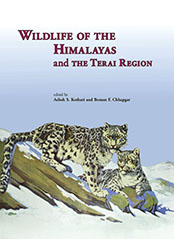 Wildlife of the Himalayas and the Terai Region edited by Ashok S. Kothari and Boman F. Chhapgar. Published in 2012 by The Bombay Natural History Society, Hornbill House, Dr Salim Ali Chowk, Shaheed Bhagat Singh Road, Bombay 400001 and Oxford University Press, Walton Street, Oxford, OX2 6DP, UK. Pp: 216 + 10. Price: Rs 1,250.
"Beneath the snow’s dark forests spread, sharp-laced/ With leaping cataracts and veiled with clouds…Where echo pheasant’s call and panther’s cry,/ Clatter of wild sheep on the snows, and scream/ Of circling eagles…”
"Nature’s cradle” is what Sir Edwin Arnold captioned the Himalayas in his Light of Asia (1879) and because of its "harsh inclement weather” one would expect the wildlife of the Himalayan region to be neglected. "Contrary to expectations, however, it has been adequately studied so that there are several books restricted to the flora and fauna of the Himalayas,” noted B. G. Deshmukh, president of The Bombay Natural History Society (BNHS) for 18 years, in his Foreword to the eyefilling coffee-table book whose publication he did not live to witness.
In the Preface to their fourth book together, Dr Ashok Kothari, BHNS secretary and Dr Boman Chhapgar, reputed marine biologist and researcher, speak about the convolutions of the Earth that in the course of millions of years broke up its two land masses and rearranged its surface to that with which we are familiar today. "The force of collision between the southern shore of Tibet…which was then the south coast of Asia…and the northern shore of India (once a part of South America and Africa) pushed a long stretch of rock upward to form the Himalayas. This is why we find fossil sea-shells in the Himalayas,” they explain.
 Not only do 200 color plates enliven the text of this meticulously designed publication by the Marg Foundation team, the wealth of detail about each specie and subspecie of the region attest to the value of the work. Thus, the male Hangul or Kashmir Red Deer is known as Honglu while its female counterpart is called Minyamar in Kashmiri. Very similar to the Red Deer of Scotland save for the larger horns of the Kashmir stag which have a greater tendency to curve towards the tips, its local status is deemed rare as "The vastly increased herds of cattle, especially buffaloes, that are now annually driven from the plains of India to spend the summer months amidst the rich pasturage of the Himalayas, have had the effect of banishing the deer from many hills where they formerly abounded.”
Shedding their horns in March or early April, the stags retreat to the highest ranges and secluded forests while their horns are growing anew but retrace their steps to rejoin the females once the velvet covering of these new horns is shed. During the mating season towards the middle or end of September the stags begin to bellow, fighting off their rivals.
It is towards the end of the description that the casual reader learns what may be remiss here: "I once saw a small stag on the edge of the forest, and altogether I came across about half a dozen hinds, and heard another stag in the jungle, but I did not even find the tracks of any others. Not a single stag ‘called,’ and in fact the shooting on those hills is a thing of the past.” The amazing wealth of detail of which the above is but a meagre sample in the chapter on the Kashmir Red Deer by Colonel Alexander Angus Airlie Kinloch has been excerpted from his book Large Game Shooting in Thibet, the Himalayas and Northern India (1885) and from an animal lover’s point of view depicts a strange dichotomy between the sustained research on the species and its ultimate direction towards hunting.
"Nature’s cradle” is what Sir Edwin Arnold captioned the Himalayas in his Light of Asia (1879) and because of its "harsh inclement weather” one would expect the wildlife of the Himalayan region to be neglected. "Contrary to expectations, however, it has been adequately studied so that there are several books restricted to the flora and fauna of the Himalayas,” noted B. G. Deshmukh, president of The Bombay Natural History Society (BNHS) for 18 years, in his Foreword to the eyefilling coffee-table book whose publication he did not live to witness.
In the Preface to their fourth book together, Dr Ashok Kothari, BHNS secretary and Dr Boman Chhapgar, reputed marine biologist and researcher, speak about the convolutions of the Earth that in the course of millions of years broke up its two land masses and rearranged its surface to that with which we are familiar today. "The force of collision between the southern shore of Tibet…which was then the south coast of Asia…and the northern shore of India (once a part of South America and Africa) pushed a long stretch of rock upward to form the Himalayas. This is why we find fossil sea-shells in the Himalayas,” they explain.
Not only do 200 color plates enliven the text of this meticulously designed publication by the Marg Foundation team, the wealth of detail about each specie and subspecie of the region attest to the value of the work. Thus, the male Hangul or Kashmir Red Deer is known as Honglu while its female counterpart is called Minyamar in Kashmiri. Very similar to the Red Deer of Scotland save for the larger horns of the Kashmir stag which have a greater tendency to curve towards the tips, its local status is deemed rare as "The vastly increased herds of cattle, especially buffaloes, that are now annually driven from the plains of India to spend the summer months amidst the rich pasturage of the Himalayas, have had the effect of banishing the deer from many hills where they formerly abounded.”Shedding their horns in March or early April, the stags retreat to the highest ranges and secluded forests while their horns are growing anew but retrace their steps to rejoin the females once the velvet covering of these new horns is shed. During the mating season towards the middle or end of September the stags begin to bellow, fighting off their rivals.
It is towards the end of the description that the casual reader learns what may be remiss here: "I once saw a small stag on the edge of the forest, and altogether I came across about half a dozen hinds, and heard another stag in the jungle, but I did not even find the tracks of any others. Not a single stag ‘called,’ and in fact the shooting on those hills is a thing of the past.” The amazing wealth of detail of which the above is but a meagre sample in the chapter on the Kashmir Red Deer by Colonel Alexander Angus Airlie Kinloch has been excerpted from his book Large Game Shooting in Thibet, the Himalayas and Northern India (1885) and from an animal lover’s point of view depicts a strange dichotomy between the sustained research on the species and its ultimate direction towards hunting.
In The Wild Animals of the Indian Empire — Part II of 1934 S. H. Prater describes how the landscape and vegetation change with the increasing altitude. "The bare peaks above the tree line and the strip of luscious grass country lying between the mountains and arid plateaux of Tibet” is described as "a transition zone — a meeting ground between the animal life of the Oriental and the northern or Palaearctic Regions.” The Himalayan barrier "combined with the great difference in climate, north and south of the range, has resulted in a fairly sharp line of demarcation at about 28° between two distinct faunas…The Tibetan Plateau together with Eastern Ladakh…is the only region of the globe where desert and arctic conditions prevail,” notes Prater.
Discussing the "Problem of Wild Life Protection in India,” in his above cited work (Part I) Prater writes, "But for the protection given to the lion in Junaghad State and the Great Indian Rhinoceros in Nepal and Assam these two interesting animals would have been exterminated long ago. The Cheetah or Hunting Leopard, once common in Central India, is now almost extinct in the wild state….Any scheme for the Protection of Wild Life would be incomplete without due provision for the protection of our Birds. Quite apart from sentimental value, birds render incalculable service to Man. While certain species may damage crops, such harm as is done by birds is overwhelmingly offset by the benefits we derive from them. Without their protection, our crops, our orchards, our food supply would be devoured or destroyed by hordes of ravaging insects. Birds are the principal agency that controls the bewildering multiplication of insect life which, if left unchecked, would overwhelm all life on this planet…”
Discussing the "Problem of Wild Life Protection in India,” in his above cited work (Part I) Prater writes, "But for the protection given to the lion in Junaghad State and the Great Indian Rhinoceros in Nepal and Assam these two interesting animals would have been exterminated long ago. The Cheetah or Hunting Leopard, once common in Central India, is now almost extinct in the wild state….Any scheme for the Protection of Wild Life would be incomplete without due provision for the protection of our Birds. Quite apart from sentimental value, birds render incalculable service to Man. While certain species may damage crops, such harm as is done by birds is overwhelmingly offset by the benefits we derive from them. Without their protection, our crops, our orchards, our food supply would be devoured or destroyed by hordes of ravaging insects. Birds are the principal agency that controls the bewildering multiplication of insect life which, if left unchecked, would overwhelm all life on this planet…”
 Considering that this was written 80 years ago, one wonders at the extent of depredation that has occurred thereafter. This reviewer was only recently witness to flock after flock of birds who came for a drink at a watering hole in a large, hitherto deserted, estate. Now being readied for construction, the water was drained overnight much to the confusion and disappointment of the winged denizens who sat around, dry-mouthed, probably wondering at the sudden change in the landscape!
 The amazing list of animals and birds covered by the text include bats and rats, the Little Spiderhunter, a 14-cm sparrow, and the Red Giant Flying Squirrel, one among eight subspecies with distinctive features. We encounter hares, otters, badgers and porcupines, the Leopard Cat which was "originally described from a specimen which swam on board a ship in Calcutta,” the Marbled Cat and the Clouded Leopard, and, of course, the Bengal Tiger whose local status even in 1888-91 was "uncommon” according to W. T. Blanford’s The Fauna of British India, including Ceylon and Burma which was then published.
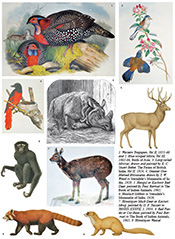
Each documentation is vividly illustrated, most in color, some in black and white sketches by the authors of the books whence the information is extracted. The birds, especially, vividly, flamboyantly rule the roost, thanks to the immaculate reproduction by New Bombay’s Silverpoint Press Private Limited, bringing Dharmendra Mistry’s photography as much as the paintings of the early authors and painters to life.
This resplendent art paper publication which must have cost infinitely more to produce than its sale price, has been financed by more than 54 sponsors, individual and corporate, many of whom are responsible for financing individual plates, some dedicated to special persons. The end beneficiary is the reader.
The only thought that detracts from a beautiful presentation is the fact that there seems to have been negligible original work in this sphere, post Independence, considered worthy of inclusion here. Of the 36 authors listed in the Bibliography, only three are Indians, one of them being the renowned ornithologist Dr Salim Ali. This almost exclusively British contribution to the documentation of India’s natural history is a sad commentary in itself in a fast degrading environment.
◆ ◆ ◆
From the archive