
Cover Story
Jungle jewels
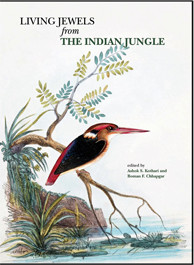
Living Jewels from the Indian Jungle edited by Ashok S. Kothari and Boman F. Chhapgar. Published in 2009 by The Bombay Natural History Society, Hornbill House, Dr Salim Ali Chowk, Shaheed Bhagat Singh Road, Bombay 400023 and copublished by Oxford University Press, YMCA Library Building, Jai Singh Road, New Delhi 110001. Pp: 204. Price: Rs 1,600.
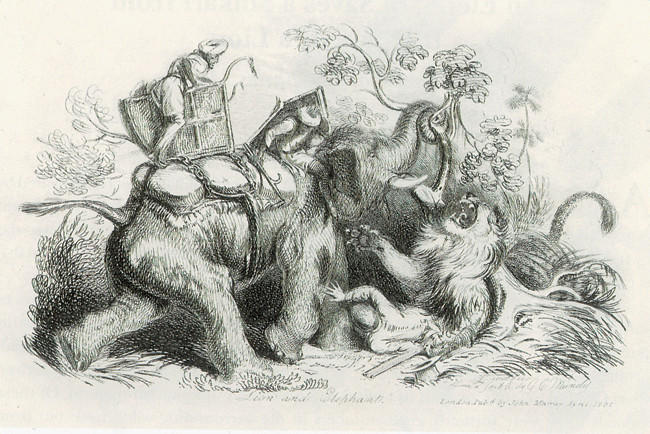
Elephant saving shikari from a lion (Pen and Pencil Sketches, being the Journal of a Tour in India)
With so many beats pulsating in one book, a reader not familiar with the ways of the wild may well feel beaten. Or he may be bitten… with the urge to glean more information on the beat on which a tiger proceeds to hunt its game, the drum beat undertaken by the locals to force the prey to leave its cover, and the area or beat within the control of the subedar.
The accounts of tiger hunts may appear to dwarf the other features on elephants, leopards, panthers, bears and even the prickly porcupine. Their partiality towards tigers is explained by the editors Dr Ashok Kothari and Dr Boman Chhapgar in their preface: "They are not the biggest or mightiest among the beasts of the jungle… but they have a charisma all their own. No one who has seen a tiger walking silently, effortlessly, along a jungle trail, muscles rippling under its beautifully striped coat, can fail to be hypnotized by it. Compare this with the ungainly gait and the wrinkled grey skin of the elephant or the equally drab thick skin of the rhino hanging in loose folds like a suit stitched by an apprentice tailor. Elephant, rhino and other large mammals inspire awe in their own right but the tiger is the darling of naturalists.”
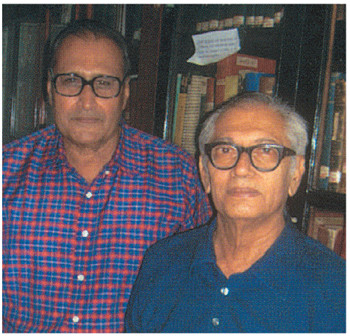
Above: Dr Ashok Kothari (left) and Dr Boman Chhapgar;
"There were an estimated 40,000 tigers in India at the beginning of the last century,” states BNHS (Bombay Natural History Society) president B. G. Deshmukh in his foreword, reminding how their population had come down from 3,642 in 2002 to 1,411 in 2006. "Despite the drastic decrease in numbers, the tiger is not the most threatened animal in India today. Even among mammals, the Asiatic Lion (now confined to Gir) and the Gangetic River Dolphin are far fewer in number.”
The editors need to be commended for their choice of articles and visuals carried in this compendium, Living Jewels from the Indian Jungle, the third in their series on Indian natural history, the earlier two titled Salim Ali’s India and Treasures of Indian Wildlife. The duo have sourced their material from "vintage paintings and excerpts from books, magazines and journals, some of which go back to the late 18th and early 19th century… The BNHS Library has a wonderful collection of old books, thanks in large part to the munificence of donor members,” they acknowledge in their preface.
It is to the credit of the editors that they have chosen narratives that make us sympathize in some pieces with the hunter and at other times with the hunted. The killing of a man-hunter known to have taken 100 innocent lives may be met with jubilation but who could agree with the sentiments of the writer who boasts, "Following up a wounded tiger on an elephant I must say is a royal form of sport. It is a grand thing to see a wounded and irate tiger absolutely at your mercy and without incurring any risk to yourself. You have all the fun and none of the danger one experiences in going after a beast on foot.” Another contributor asserts, "The tiger is sometimes born a man-eater and sometimes made one. This theory will account for some districts never being entirely free from man-eaters.”
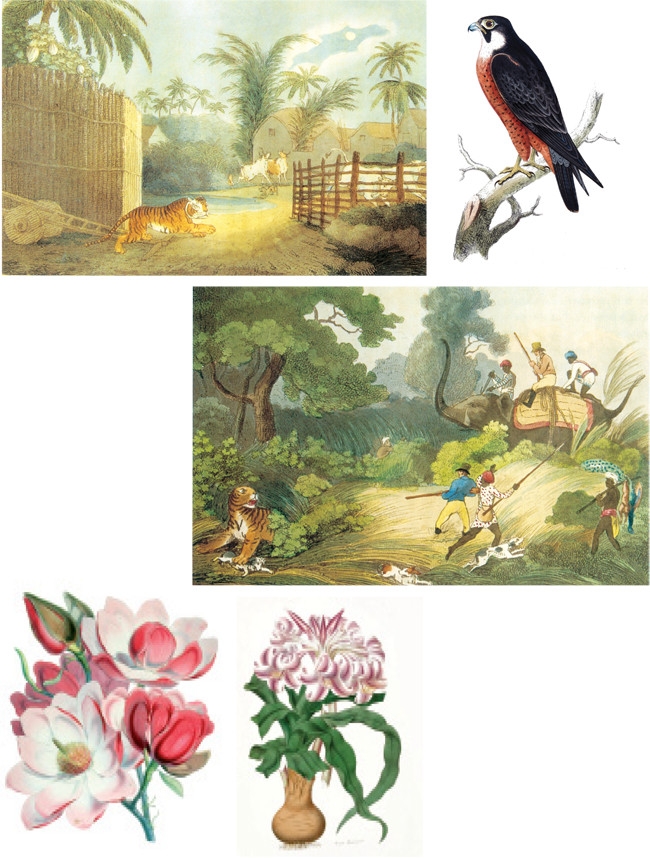
Clockwise from top left: Tiger entering a village (Oriental Field Sports); Peregrine falcon (Illustrations of Indian Ornithology); Tiger at bay (Oriental Field Sports); String lily a (Plantae Asiaticae); and Pink tulip tree (Illustrations of Himalayan Plants)
To Parsis, Vansda or Bansda may be the notorious seat where the infamous navjotes were performed of children of Parsi men and their non-Parsi mistresses. But Bansda is also the territory where eight persons were believed to be killed by a man-eater in 1888, as per the records of the Dewan of Bansda. The same article refers to the Rajah of Bansda as being enlightened, "but not so enlightened as is the English ruler of a neighboring province who with one hand doles out a reward to those who kill a tiger whilst with the other he from time to time pens rules placing needlessly heavy restrictions on those who spend time and money in killing tigers in his province.”
Bombay too, in the 19th century, had its share of tigers and there are reports of a tiger on Malabar Hill coming down and quenching its thirst at Gowalia Tank and running up the hill between the Hermitage and Prospect Lodge in 1822. Salsette, Kurla, Mahim and Mazgaon were the other areas known to be frequented by tigers. There are records of a tiger being killed in 1863 after mauling a Parsi cart-owner. Yet another tiger "was shot at Pir Pau, Trombay, near Sandow Castle by Mr Mullan of the Bombay Port Trust.”
The animal accounts commence with Prof Manekshah S. Commissariat’s narrative of "Emperor Jahangir’s Elephant Hunt in the Panch Mahals” which resulted in a haul of 73 male and 112 female elephants captured with the combined efforts of imperial huntsmen and the huntsmen of Prince Shah Jahan.
One of the most compelling reads is "Newly born elephant calf saved from a hungry tigress” which portrays the do-or-die determination of a tigress and a mother elephant indulging in warfare, not due to enmity but solely to ensure the survival of their newborns. Particularly gory is the account of leopards being used to hunt the wild yet timid antelopes as a sport for the British overlords.
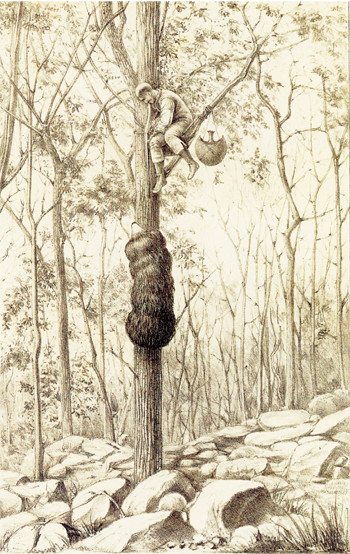
Wounded bear charging up a tree (from a photo by J. D. Inverarity)
Some episodes may be amusing as when we are told of a tiger knocking down Capt Kent who was carrying a gun over his shoulder. Instead of the Captain’s head, the tiger bit on the barrel of the gun and "finding an Englishman so much tougher a mouthful than he expected” preferred to saunter on. Another report gives a detailed account of the anatomy of a dead tigress with cavities in her teeth and porcupine quills embedded in her tongue! The homestead of Mr Shore, a political agent, leaves little to imagination, particularly his style of breakfasting with two black bears, kept as domestic pets, seated on either side of him eating out of their wooden bowls!
Stories on the other dreaded man-eater, the panther, are included here too, particularly the one in Mulher Valley who had killed 30 individuals and mauled another 11. He had gradually become bolder in his attack. Initially he would never touch anyone unless the victim was lying down and there was total darkness. If no one was sleeping outside the hut, he would go inside in search of a prey. The cry of a victim attacked first on the arm or leg was sufficient to make him withdraw but if he happened to get a grip on the victim’s throat, he would drag out the unsuspecting casualty in the presence of others sleeping nearby. The panther was finally killed with bullets over two days, the first day’s bullets striking his stomach and one of his hind legs and that of the second day aimed at his head.
If seeking general information, the reader should turn to the latter half of the book which highlights little known animal traits and behavior like the altitudinal limit of the Indian elephant, how the female dugong carries her young, notes on monitor lizards and land leeches…
As compared to the plethora of animal tales in the book, there are only three pieces relating to botany, the first of which is "Discovery of Amherstia nobilis,” popularly known as the Tree of Heaven or the Pride of Burma, which some consider the most beautiful tree in the world, particularly when the tree is in bloom with its large vermilion colored blossoms. Bombay is supposed to have seven individuals of this species, three of which are at the zoo in Byculla and two in the garden of the Bombay University’s Fort campus. Even though full length articles on plant species are limited there is a profusion of images, mainly paintings and illustrations, of vibrant, colorful flowering plants, each with a brief description of the specimens of flora and feathered friends featured in the book. The focus is on the Himalayan wild flowers.

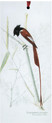
(Left) Dagger tree (Plantae Asiaticae); bookmark bearing Terpsiphone paradisi
To enjoy these delights the reader may need to turn the pages of the book a second time around for, when placed in the midst of other engrossing tales, these may otherwise be overlooked. "The task of enriching this book with rare prints and interesting articles was completed without any financial burden on the Society” thanks to the generosity of large-hearted donors like Dhun Panthaki, a BNHS member and former principal of the Bombay International School. Nearly half a dozen members of the community have been acknowledged as sponsors for contributing to the cost of printing specific pages. Among the other Zoroastrians who have supported this venture are the late Sorabji Godrej whose constant moral support and inspiration has been acknowledged. BNHS vice president Pheroza Godrej’s "generous guidance” has been commended as also the contribution of committee member Rishad Naoroji. In the production of this book the authors also appreciate the cooperation of the team at Marg Publications and its general manager Radhika Sabavala.
Offering levity amongst some of the hair-raising accounts is Rudyard Kipling’s famous story "How the Rhinoceros Got His Skin,” (to be reprinted in Parsiana, March 7, 2011) made immortal by the famous lines: "Them that takes cakes/ Which the Parsi-man bakes/ Makes dreadful mistakes.” Incidentally Pestonjee Bomonjee, the baker in the story, was in real life a student of the Sir J. J. School of Art where Rudyard’s father Lockwood Kipling was the principal, mention the editors.
A renowned marine biologist, Chhapgar has discovered six new species of animals previously unknown to science, mentions the jacket of the book. Author of 12 books and over 100 scientific papers, he enjoys the distinction of being one of only two Indians whose portrait hangs in the Gallery of Carcinologists in the Smithsonian Institution’s National Museum of Natural History in Washington. Before joining the Bhabha Atomic Research Centre to study radioactivity in the marine environment, he was curator of the Taraporevala Aquarium and research officer in charge of the Taraporevala Marine Biological Station. Kothari is a practicing family physician and a senior member of the BNHS executive committee plus long serving chairman of its library committee. Besides conducting large scale tree planting drives and nature trails he has also authored A Celebration of Indian Trees to mark the 50th anniversary of the Friends of Trees.
Living Jewels from the Indian Jungle, celebrating the completion of BNHS’s 125 years of existence, is dedicated to "the Pink-headed Duck which we may never see again.” A thoughtfully provided bookmark bearing the image of the bird Terpsiphone paradisi should ensure that the hardbound, coffee table book is handled with care and treasured by posterity.
◆ ◆ ◆
From the archive