
Cover Story
A window to wilderness
Treasures of Indian Wildlife edited by Ashok S. Kothari and Boman F. Chhapgar. Published in 2005 by the Bombay Natural History Society, Hornbill House, Dr Salim Ali Chowk, S. B. Singh Road, Bombay 400023. Pp: 216. Price: Rs 1,900.
Treasures of Indian Wildlife edited by Ashok S. Kothari and Boman F. Chhapgar. Published in 2005 by the Bombay Natural History Society, Hornbill House, Dr Salim Ali Chowk, S. B. Singh Road, Bombay 400023. Pp: 216. Price: Rs 1,900.
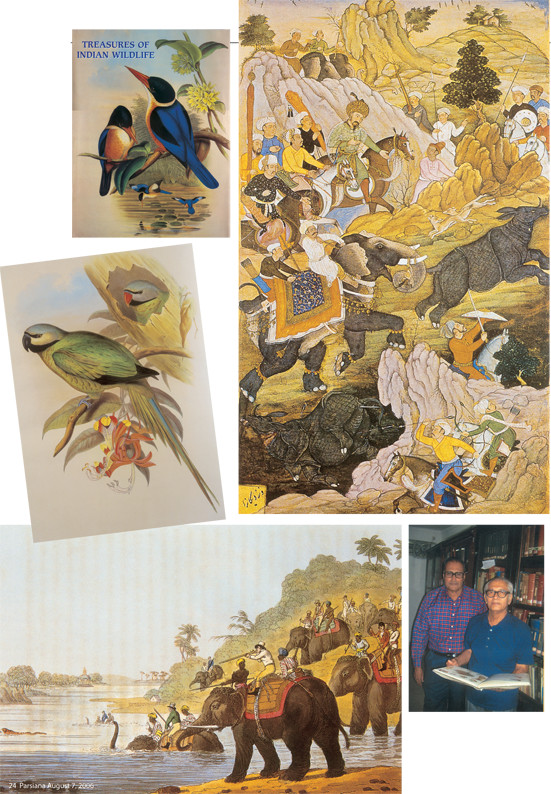
"The deputy was writing his report under a petrol lamp in his room (at Iskakundam Bungalow in the Nallamalli Hills) when he felt something brush against his chair. He slightly turned his head and saw a tiger rubbing itself along the back of the chair! I wonder what a good many of us would have done? Shouted? Screamed? Jumped on the table? Or fallen down in a dead faint? The deputy did none of these things. He was not a big game hunter. I doubt if he had ever killed a thing in his life. He calmly got up from his chair and as calmly walked out of the room — closing the door behind him. As calmly he announced to the conservator in the next room that he had securely locked a tiger in his room…” Such harrowing accounts of encounters with different wildlife creatures from the early 19th century to the mid 20th century keep the reader engrossed in Treasures of Indian Wildlife edited by Ashok S. Kothari and Boman F. Chhapgar.
(Facing page) Visuals from Treasures of Indian Wildlife (clockwise from top left): Black capped kingfisher (painted by John Gould and Henry Richter); Babur hunting rhinoceros near Peshawar (Babur Nama); Tiger across a river (Oriental Field Sports, Vol I); Nicobar parakeet (Birds of Asia, Vol II); Bottom right: Ashok Kothari (left) and Boman Chhapgar: sourcing rare gems
Published by the Bombay Natural History Society (BNHS), this 216-page book is replete with absorbing narratives sourced from rare books, journals and gazetteers. Providing a vivid picture of India as it existed 150-200 years ago, the president of the Society B. G. Deshmukh remarks in his Foreword: "It may have been a life of discomfort — there was no electricity, no railways or motor cars… it was a slow-track leisurely life with plenty of time for indulging in hobbies.” And for the British overlords, the favorite sport was shikar. But before condemning this hobby as a "brutal, bloodthirsty way of slaughter… one has to consider the conditions then existing,” states Deshmukh explaining, "Our villages were tiny clearings surrounded by dense jungle teeming with dangerous wild animals. Tigers were the most notorious among these, and scarcely a day passed without a poor villager or his cattle falling prey to these marauding beasts. The ryots looked up to their Sarkar ma-bap (rulers respected as parents) and beseeched them to rid them of the brute’s depredations. The gora-log (fair-skinned rulers) then had to go after the cause of the hapless villagers’ curse and hunt it down. Of course much shikar was done purely for sport and huge numbers of animals and birds became game for the hunters. However the shikaris had a code of honor and sportsmanship — never to kill a pregnant female or one with cubs. And if their quarry did not die outright, the shikari had to follow it, often at grave risk to his life, and
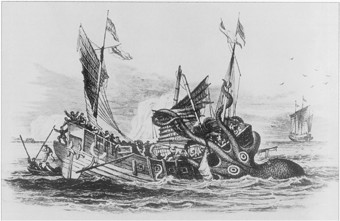
Illustration of the schooner and squid (courtesy Vasant J. Sheth Memorial Foundation)
relieve the wounded beast from its misery. Many a shikari has met a tragic and gory end when attacked by a lurking wounded tiger… Invariably the hunter gradually metamorphosed into an amateur wildlife biologist and true conservationist (like) Jim Corbett after whom our first National Park was named. Shikar as a hobby was also indulged in by the native princes (maharajas) who had exclusive forest patches in their kingdoms for this purpose. It is these very reserves which were protected and therefore retained their virgin wildlife while the common ground was degraded in independent India. They form the bulk of our national parks today.”
The 123-year-old Society has over the years become the repository of skins of birds and animals sent by shikaris as also archival books. "Very few people get a chance to read these invaluable books. So two of our intrepid members Kothari and Chhapgar have been busy for the last three years selecting the cream of lithographs and articles on Indian wildlife… The outcome of their effort is this book — a sequel to their highly popular, similar collection Salim Ali’s India” published in 1996 as a tribute to independent India’s greatest ornithologist, further writes Deshmukh.
A medical practitioner, Kothari is better known as "Dr Green” and is reputed for being an avid nature and tree lover who has long steered the National Society of the Friends of the Trees. Former curator of the Taraporevala Aquarium, Chhapgar is an internationally renowned marine biologist and oceanographist. As scientific officer at the Bhabha Atomic Research Centre his job involved monitoring the effects of radioactivity on marine biology. A Life Fellow of the International Oceanographic Foundation, Miami, Florida, his portrait hangs in the Gallery of Crustacea in the Smithsonian Institution’s National Museum of Natural History in Washington USA — one of only two Indian carcinologists thus honored. He is the author of 12 popular books on marine life, with the 13th due soon for release and the next two already in the pipeline.
As acknowledge the authors in their Preface, "Special mention must be made of F. V. Evans whose donation includes the classic six volumes of John Gould’s Birds of Asia and (with Elizabeth Gould’s paintings) Birds from the Himalaya Mountains and, more recently, Van Ingen’s vast collection of shikar and natural history books. We have culled freely from them for our present volume. Apart from these, many shikaris-turned-naturalists contributed articles based on their experiences to our Society’s Journal which recently completed its 100th volume. The section ‘Gleanings’ contains many of these interesting episodes…” Thanks to Salim Ali we all know who an ornithologist is. Through this book we come to know that an ophiologist is a specialist on snakes and reptiles as the authors cite several authorities when relating the adventures of the colubrine and viperine varieties in the section on "The Poisonous Snakes of the Bombay Presidency.”
To enable the layperson to get an opportunity to glimpse at the contents of "these extremely precious and rare books” Chhapgar says that he and Kothari set about locating articles that would be suitable for the common man, keeping in mind that people don’t have the leisure to go through journals. "There must be barely 17/18 sets of John Gould’s volumes in the world,” he reveals. Even at the BNHS library members are not allowed to touch these tomes which are preserved in special fireproof vaults. Since Gould’s book was printed in large elephant folio size, for the present coffee table book they had to marginally reduce the plate size and they were happy that Marg Publications who produced this book were able to guide them along the right lines. Kothari who is known to have an enviable collection of old books is quite happy that through the sales of their book they have already raised Rs 21 lakhs for the BNHS library. With the demand rising for Treasures of Indian Wildlife, he is sanguine that this hardback "will soon become a collector’s item.”
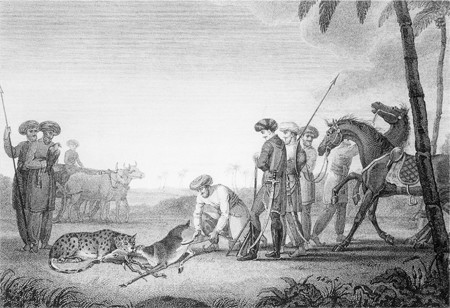
"This time we have thought it fit to dedicate our book to the cheetah or hunting leopard. So different from the more well known leopard, the cheetah was a popular pet in the menageries of our maharajas, being used to hunt deer and small game by running them down at speeds exceeding 96 km an hour. The last three of these were gunned down on the same night by an Indian shikari (in Madhya Pradesh) as recently as 1947,” state the authors.
There was a time when the destruction of certain animals in Gujarat was rewarded by the government as reported in Gazetteer of the Bombay Presidency, 1879: tigers full grown £2 8s (Rs 24); half grown £1 4s (Rs 12); cubs 12s (Rs 6), leopards, panthers and cheetahs, full grown £1 4s (Rs 12), cobra de capello 6d (four annas)…
The agile mongoose which may now be feared was then viewed as a charming and useful pet (except when she is about to pair and a week before and a month after the birth of her young when she can become savage and show her temper!) as all creeping things such as snakes, centipedes, etc are eaten by her as well as scorpions, beetles, wasps, hornets, lizards, rats and mice, and insects of all descriptions. The only thing she does not eat is ants but white ants are eaten with relish.
When the educative book carries a section on "How the Monitor Defends Itself” we are not supposed to have images of a school prefect, but the Monitor lizard which can be three feet in length, almost like a small crocodile. These should always be caught by the tail for they can give a bite that is not easy to forget, we are told. In 1928 a snake charmer had his finger bitten off by a Monitor lizard which refused to open its mouth so finally the strong jaws had to be cut open with scissors. In "Footprints of ‘Snowman’” the identity of the ‘snowman’ is ultimately revealed as the snow leopard!
Hunting of blackbuck with cheetah (Oriental Memoirs, Vol I)
Several individuals and institutions have contributed to the publication of this appealing coffee table volume. The long list of acknowledgements starts with the name of Sohrab P. Godrej for being among the key people to have "inspired and guided us in this endeavor.” In fact the front cover depicting a black-capped kingfisher, a painting by John Gould and Henry C. Richter is in remembrance of Godrej, former vice president of the BNHS, "whose insatiable enthusiasm for nature will be long remembered and admired.” The efforts of the vice presidents of the Society Pheroza Godrej and Dilnavaz Variava in raising funds for this project and Rishad Naoroji, chairman, library subcommittee for his constant encouragement and moral support have been recognized. Among the other Parsis who contributed to this book is Dilnavaz Mehta of Rare Finds who helped in securing out-of-print rare books for specific articles. Marg Publications and particularly its general manager Radhika Sabavala have been thanked for producing this work. The book was co-published by Oxford University Press.
The historical writings by wildlife and bird enthusiasts of the past portray a vivid picture of India’s rich flora and fauna in urgent need of protection today. Paintings, mostly of birds, and lithographs and sketches of animals and trees, scenery and monuments, many of which are recognized as classics of their type, are mainly the work of eminent European wildlife artists of the 19th and early 20th centuries. The color plates in this book, providing intricate details of birds and beasts, evoke both wonder and fear for all nature’s creations. Adding to their appeal are the narratives on the facing page that give meticulous details of the species pictorialized. This book is indeed a prized catch for anyone interested in India’s natural history.
Beware of baugs
"Baug” to a Parsi may immediately evoke images of one of our community’s residential quarters. But in 1813 when a Britisher heard this cry he was supposed to know that a tiger had been spotted in the vicinity and act accordingly. Residential quarters in the Salsette Parsi Colony may now be a coveted dream but in 1813 as James Forbes had related in Oriental Memoirs and reproduced in this book, "The island of Salsette appears like a map around the spectator, presenting a fine champaign of rice fields, cocoa (coconut) groves, villages and cattle; woody hills and fertile vales; the surrounding mountains form a foreground of grey rocks, covered with trees or hollowed into gloomy caverns, the haunts of tigers, serpents, bats and bees in immense swarms…In various parts of Salsette are romantic views, embellished by the ruins of Portuguese churches, convents and villas, once large and splendid. The enjoyment of the picturesque and fertile scenery of Salsette is interrupted by the tigers which infest the mountains and descend to the plains. They not only prey upon the sheep and oxen near the villages, but sometimes carry off the human species…”
◆ ◆ ◆
From the archive