
Nature as teacher
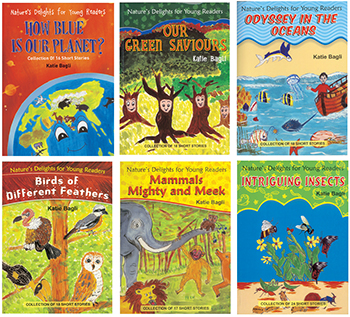
Nature’s Delight for Young Readers (a series of six books) by Katie Bagli. Published between 2012-2014 by Shree Book Centre, No. 8, Kakad Industrial Estate, S. Keer Road, Matunga (W), Bombay 400016; email: sales@shreebookcentre.com Price: Rs 1,350 (for the whole set).
William Wordsworth, the 19th century English poet, is best remembered for being inspired by Nature, and in his poem The Tables Turned, he exhorts the reader to put aside his books, and instead go out to observe nature, insisting that one can learn practically everything by doing so:
"And hark! How blithe the throstle sings!/He, too, is no mean preacher:/Come forth into the light of things,/Let Nature be your teacher.
"She has a world of ready wealth,/Our minds and hearts to bless –/Spontaneous wisdom breathed by health,/Truth breathed by cheerfulness.
"One impulse from a vernal wood/May teach you more of man,/Of moral evil and of good/Than all the sages can.
It is a good reminder for us in our 21st century urban lives, surrounded by technology and machinery, to be made aware of the world around us. And children nowadays, overburdened with school work, extra classes, examinations, are left with few opportunities to enjoy or appreciate the lives of other denizens of our planet, or to learn to understand the environmental problems that beset our own existence.
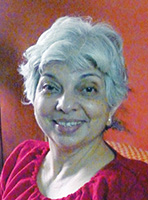
Katie Bagli: sensitizing series
Katie Bagli’s series of books, published from 2012 onwards, are a welcome contribution for Indian children and their parents. Starting with Mammals Mighty and Meek (a collection of 17 short stories in 104 pgs), the other titles are Birds of Different Feathers (18 short stories; 98 pgs) Odyssey in the Oceans (18 short stories, 108 pgs), Intriguing Insects (24 short stories, 114 pgs), Our Green Saviours (18 short stories, 107 pgs), and How Blue is Our Planet? (16 short stories, 102 pgs). Through a series of short stories, rhymes and interesting tidbits, Bagli weaves in factual information about birds, mammals, insects, marine life and vegetation in a way that teaches without being overly didactic, and with a healthy dose of humor and whimsy added. Let alone children, their parents and teachers stand to learn quite a lot from these books. The charming illustrations by the author add to the delight of the books. Information about wildlife from other parts of the world, such as Africa or America, seems to be more freely available and accessible through books and television documentaries, and while these are always welcome, it is wonderful to give children here a chance to learn about the birds, animals and trees that surround us here in our own country.
Stories such as "Rock Concert” (from Intriguing Insects), "Vulture Culture” or "The Firebush Pollinators” (from Birds of Different Feathers), "Tiger versus Man” and the poem "Tales about Tails” (from Mammals Mighty and Meek), or "The Ghost that Haunts Forever” (from Our Green Saviours) are certain to spark off an interest in young readers to go out and explore these phenomena for themselves. A skit such as "The Sacred Grove” (from Our Green Saviours) illustrates the ancient Indian tradition of maintaining sacred groves dedicated to local deities, which conserve native vegetation and medicinal plants along with animal life.
Although the books are primarily about Indian wildlife, they also touch on endangered species in other parts of the world, such as the polar bears of the Arctic, and the final eponymous poem in How Blue is Our Planet? speaks about climate change caused by manmade environmental damage: "We need to think rationally, we need to heal the world,/Make a better place for future generations to behold,/To live sustainably, to spare a thought for ecology,/Indeed, we need to give our planet blue/A better deal for the good it does for me and you.”
The stories are told in a simple, appealing way, using a vocabulary that can challenge and stimulate the young reader. Indeed, a glossary of technical terms might at times be welcome. Parents or teachers could use this as an opportunity to encourage students to look up the definitions of words, and this would become an added learning process. Still, the way and context in which the words are used serve to explain the meanings on their own. The set of books, reasonably priced at Rs 225 each, would make a gift which any child aged about seven upwards would welcome. And one hopes that after reading these books, families would get a chance to go out and try to identify the birds, mammals and trees on their own, since many of them can be found in their own neighborhood.
The Dadar Parsi Colony (DPC), a beautiful residential area, is a green haven in a particularly crowded part of the city. It was founded by Mancherji Edalji Joshi, a civil engineer who ensured that the Colony would include green areas for fresh air and relaxation. For this he set aside space for the famous Five Gardens, along with several other smaller garden plots, in which he planted native as well as exotic trees both to provide shade and to attract several species of birds and bats. The roads in the Colony also have avenues of trees, with each road having a particular specie of tree. The GreenLine initiative directed by Savio Silveira took up the project of mapping and documenting the trees of the DPC, involving people from the neighborhood. Bagli, who lives in the Colony, guided the whole project. She has been closely involved with the Save Rani Bagh project, set up to conserve the Veermata Jijabai Udyan (formerly Victoria Gardens) in Byculla as a valuable botanical garden, and has a fund of knowledge about the trees of the area.
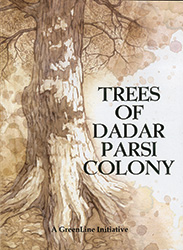
Bagli’s other book, Trees of Dadar Parsi Colony, which lists 60 trees, serves as a useful field guide, as it includes information about the common name, scientific name and place of origin of each tree. It also indicates where the tree is to be found in the Colony. A map is provided at the front of the book. There is a description of each tree, including details of its flowering season, and descriptions of its bark, foliage and blossoms. Further information is provided about the kinds of birds and insects it attracts, and also about its medicinal use if any. Each type of tree is presented over two facing pages, one of which shows an overall impression of a distinguishing feature such as a specifically shaped pod or fruit, while the other contains three photographs to illustrate the bark, blossom and leaf respectively. The photographs have been taken by Bagli, Shubhada Nikharge, Ninad Raut, Jessica Luis, Kaustubh Bhagat, Swanand Gawade and Soniya Mulik. Since the trees are presented in random order, an alphabetical index has been provided to ease the reader’s search for a particular tree.
This book provides a valuable addition to information about the flora of Bombay, and one wishes that similar initiatives could be set up to map the vegetation in different parts of the city. The book is available with GreenLine, stationed at Don Bosco School, the Rustomji Nusserwanji Rustom Framna Agiary in the Colony and the Dadar Athornan Institute.