
Architects of change
Ratan Tata is designated chairman emeritus as he hands over Tata Group chairmanship to Cyrus Pallonji Mistry
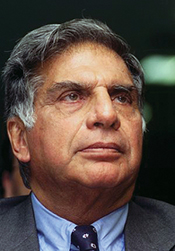 "I would say having time for a private life is my biggest luxury. In the little time I have for myself I have so many interests. I love to read, I love to design. If I ever retire, I want to create a small design group where I can simply develop products for fun, not because they have to become profitable. I enjoy thinking about impossible things and how I can perhaps actually make them possible,” Ratan Naval Tata, chairman of the Tata Group, had told the Spiegel Online International interviewer way back in 2007 when he was nearing his 70th birthday. Flying is "a fantastic thrill,” the senior citizen had added. "I was 17 when I got my pilot’s license and since then I have always flown… Not long ago at a Lockheed air show, I was invited to fly an F-16 (supersonic fighter) and I didn’t have to think about it for more than 10 minutes. Then Boeing came with a similar offer — and I took it too. If there is anything I really regret, it is that we don’t have an aircraft sector in our portfolio.”
Five years on Tata has retired. On December 28, 2012, 44-year-old Cyrus Pallonji Mistry sat in the hot seat behind the big desk in the corner room on the fourth floor of the Tata Group headquarters at Bombay House. There was no fanfare, no flashing bulbs and posed photos. The street below was filled with jostling journalists and press photographers. Mistry drove up in a Tata Manza, declining as is his wont, to make a statement and was swiftly ushered in. Ratan Tata was away in Poona, celebrating his landmark 75th birthday with the workers and staff of the establishment known to be close to his heart — Tata Motors (see "Value Added Tata,” Parsiana, February 7, 2008), a company that has given him both agony (Singur) and ecstasy (Nano, Indica…). The succession has been smooth in a country which has seen large industrial houses being beset by squabbling families and public sparring. Lend me a year, Tata told Mistry in November 2011 when the selection panel announced his name as chairman designate (see "The chosen one,” Parsiana, January 7, 2012.) Since then, Mistry has accompanied Tata, learning leadership lessons, always a step behind, keeping his usual low profile. A few days after assuming office Mistry launched full tilt into his new role, visiting New Delhi, meeting Prime Minister Manmohan Singh as well as Montek Singh Ahluwalia, deputy chairman of the Planning Commission and Salman Khurshid, minister for external affairs.On January 3, 2013, Mistry had written an e-mail to all Tata employees: "Our commitment to India is intact. As a Group, we have over the past three years invested over Rs 50,000 crore across our various businesses in the country, in the process creating primary employment for over 85,000 persons while generating many more secondary and tertiary jobs and we have already put in place plans for additional investment in excess of Rs 45,000 crore over the following two years. The recent emphasis on policy clarity and a renewed thrust to economic reforms by the Government of India is encouraging…I look forward to our Group playing its role in continuing to invest in the Indian growth story.”
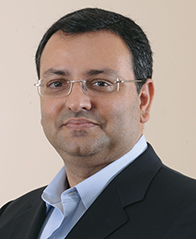 Mistry stated that apart from India, "we will be required to work to both deepen and widen our global engagement with an emphasis on emerging markets in Asia, Africa and parts of Latin America, adding to our existing presence in Europe and America… As history has shown, corporations that are happy with resting on their laurels are weeded out by nimble competition…The Tata Group’s revenue today stands at over $100 billion (around Rs 475,000 crore in 2011-12). That seems an incredible figure when you consider where we were a decade back. For my part, I pledge to work alongside you, to reinforce the unique platform that has been handed over to us by Ratan Tata.”
During his 21-year tenure as chairman, it was Ratan who was largely the architect and driver of Tatas’ global growth, with the buying of blue-blooded British brands like Tetley, Corus and Jaguar Land Rover (JLR)! In a sense the change of guard brings a reversal of roles. Tata moves from heading a giant conglomerate with over 100 operating companies to becoming the chairman of the Tata Trusts, which hold two-thirds of the equity of Tata Sons, the promoter holding company. The Sir Dorabji Tata Trust, Sir Ratan Tata Trust, Navajbai Ratan Tata Trust and others disburse millions of rupees each year to institutions, NGOs (non-governmental organizations) and individuals in the fields of rural and urban livlihoods, health, education, human rights, art and culture, etc.
Mistry takes on the burden of great expectations! The Tata Group has 32 companies listed on Indian and foreign bourses, with a combined market capitalization, as of January 3, 2013 as per official sources, of about $91.87 billion! It has a shareholder base of 3.8 million and 450,000 employees worldwide, with 58 percent of revenue coming from outside India. Its range of goods and services is vast -- steel, power, transportation, chemicals, information technology, telecommunications, DTH (direct to home) services, watches and jewelry, beverages, hotels, housing, salt, retail marketing of consumer and agri products, etc. It is exponentially bigger than the Shapoorji Pallonji Group (SP Group) of which Cyrus was joint managing director earlier with his brother Shapoor Pallonji Mistry. On being named chairman designate, Cyrus relinquished all executive positions in the SP Group to avoid conflict of interest.
Ratan has been designated Tatas’ chairman emeritus. Mistry becomes the sixth chairman of the Group and the first non family member in their 144-year history. Of the present directors on the Tata Sons board, he is the youngest -- Farrokh Kavarana, R. Gopalakrishnan, Ishaat Hussain, R. K. Krishna Kumar and Arunkumar Gandhi all being his seniors. The Mistry family, however, has had a three-generation association with the Tatas through their 18.5 percent holding in Tata Sons, making them the largest single shareholder after the Tata Trusts. Cyrus became a director of Tata Sons in 2006 after his billionaire father Pallonji exited the board. His sister Aloo is married to Noel Tata, Ratan’s half brother. "I feel Cyrus will be a worthy successor to Ratan and will uphold the strong tradition of growth, globalization and values of the Tata Group,” Godrej Group chairman Adi Godrej is quoted in the Hindustan Times, December 29, 2012.
Ratan’s 50 years with the Group (he joined Tata Steel in 1962 on the shop floor) have been diligently devoted to the 3 ‘R’s — restructuring, risk-taking and recovery! For a man portrayed by many as shy, who prefers to be away from the limelight, he has nevertheless very much been Tatas’ 21st century face! He has granted many an interview — in print and on TV, speaking candidly in his slow drawl, measuring his words, about business, governance, corruption ("they asked me for a bribe to open an airline”) or the bride that never was ("seriously, I came near on two occasions to getting married”). He has been hounded by the media, particularly during the time of the Radia tapes and the 2G controversies. His remarks ("banana republic,” "crony capitalism”…) may have been quoted/misquoted or taken out of context by both foreign and Indian journalists, but governments and India Incorporated have heeded what he says!
In 2008, the Government of India awarded him the Padma Vibhushan, the nation’s second highest civilian honor. He was made the chairman of the Investment Commission of India set up by the ministry of finance, with Deepak Parekh, chairman of the Housing Development Finance Corporation, and Dr Ashok Ganguly, former chairman of Hindustan Unilever, as members. "Always a gentleman, Ratan is known for his chivalry and exemplary composure even under pressure and trying times. A true test of a man is when his universe is in peril. The day, November 26, 2008, was one such shattering event. Ratan stood stoic in front of his burning edifice, determined more than ever to do right by his people, to salve wounds and to assuage his personal pain by a steely resolve to rebuild his beloved palace. Not only did he repair brick and mortar but also the lives of so many who served the Taj -- kudos to his monumental faith in the loyalty of his staff and the humane resurrection from destruction,” writes Parekh in Business India’s cover feature on Tata, January 6, 2013. "Whether he is speaking to an admiring teenager, or he is arguing for reforms at the PM’s Council of Industry or talking to a colleague of his on an industry issue, his sincerity, depth of knowledge, intense patriotism and his legendary courtesy shine through effortlessly… on rare occasions he may disagree with you but is never disagreeable. My wife Sudha, a vociferous and loyal admirer of JRD (J. R. D. Tata, who was chairman before Ratan), and I form a strong fan club of Ratan… Let there be more Ratans so that India can indeed shine like a diamond,” states N. R. Narayana Murthy, chairman emeritus, Infosys Technologies in his full page tribute in Business India.
"The leadership change means more than 50,000 workers in the UK now have a new boss,” wrote The Telegraph, December 28, 2012. The Tatas are the UK’s largest private sector employer and Ratan has been on British Prime Minister David Cameron’s Business Advisory Group. "So far Mistry has made little public comment about his plans for the UK companies and investment,” notes the paper, adding that "Mistry, a construction tycoon, is understood to be an Anglophile… he classes his nationality as Irish because his mother, Patsy Perin Dubash, is Irish (born in Ireland).” The Tatas have not escaped criticism, despite their GBP 16 billion investment into UK manufacturing! "We are told (by critics) that it is silly to have made an investment in Corus. But the economic environment that followed (the global financial meltdown from 2008) — even if we were Indians we were not astrologers!” Ratan is reported to have told a British paper.
The Corus (now Tata Steel Europe) turnaround is among the many challenges facing the new incumbent. The diminishing market share of Tata Motors (despite JLR’s success), the uncertainties in the power and telecommunications sectors, increasing competition in hospitality, retail and a host of other constraints will make it, for Mistry, mission critical at least over the next year or two. "Just be driven by the fact that every act you do and every move you make has to stand the test of public scrutiny,” is the outgoing chairman’s sagacious counsel.
For Ratan, perhaps there will be more space and time to stand and stare. Or walk his dogs. Or take his favorites, a Ferrari California or Maserati Quattroporte, out for a spin every Sunday.