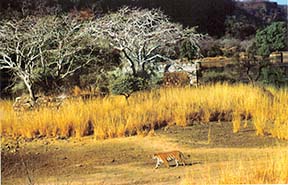
Rathore in Ranthambhore
You hear a koel call, then a partridge on a wintery November 18, 2012 during the book launch of Tiger Warrior a biography of the late Fateh Singh Rathore the architect of the Ranthambhore National Park (RNP) by Soonoo Taraporewala, at the Fateh Public School in Ranthambhore, Rajasthan. Unlikely sounds of birds in a populated school. Then realization dawns that these are cellphone ring tones, merging with the background ghazal "Aao van ko bachayéngé hum, Aao Ranthambhore ko sajayéngé hum (Gather, we will save the forest; Gather, we will decorate Ranthambhore),” written at Rathore’s request by music teacher Amit Marc of the school.
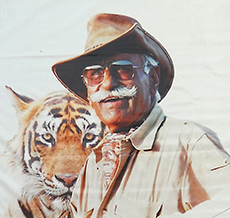
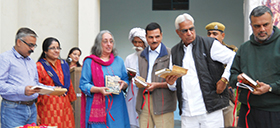 Rathore was instrumental in establishing the RNP in 1973 under the aegis of the Government of India’s Tiger Project. The family — son Goverdhan, daughter Padmini and daughter-in-law Usha — organized the launch and conceived the evening with all that their father favored. Two candles burned at the base of his portrait, no lighting of an arti (lamp); bhajans (hymns) were replaced with songs composed and/or sung by students of the school named after him. All speakers (none of the family spoke) had known Rathore in their personal capacity and
  some had worked with him, as well — Alauddin Azad, member of the legislative assembly; Giriraj Singh Kushwaha, collector; Jaskaur Meena, former member of parliament; and Y. K. Sahu, district forest officer. Chief guest Azad said that "Rathore’s memory and that of his ancestors would be kept alive (with this book).” Rathore "did not take advantage of his lineage, and did things on his own.”
The family members also requested drivers with about 30 years’ experience, who double up as trackers, to speak. Nafeez Mohamad, Shafi Mohamad and Manohar Singh Shekhawat spoke about Rathore, the man and boss. Nafeez mentioned Rathore’s unique way of training by taking them into the jungle and experiencing tough situations. Shafi was grateful to Rathore for sensitizing him to the forest. He has now driven his three sons into tracking as well. Shekhawat illustrated Rathore’s inimitable style when, as field director, "Rathore ordered him to capture cauldron, lid and game which was cooking in a hotel and bring it to his doorstep in an hour.” Rathore learnt from his source that a deer had been killed — probably shot. He wanted word to spread that neither poaching nor shooting would be tolerated at RNP. Chhitar Gujjar, a villager, blessed Rathore for "talking him out of the park and re-locating himself to prosperity.”
The family had chosen a student academician, Dharm Singh Meena, and a footballer, Vinod Meena to talk of their experience of the founder of their school. Dharm said, "He is the man who changed my life, gave me a new way of looking at life.” Aditi Sharma, also a student, mentioned "his smile itself was a moral support to us. He had no partiality, nothing.”
Rathore had approached Taraporewala in 2000 to document his life. Four years later, the author started her work. On December 18, 2012 there was another launch of the book in Bombay at the British Council where Taraporewala had been a librarian for 24 years. Dr Divyabhanusinh Chavda, president of the Indian chapter of the World Wildlife Fund launched the book as chief guest.
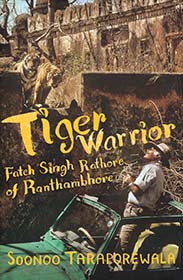
Tiger Warrior by Soonoo Taraporewala. Published in 2012 by Penguin Books India Pvt. Ltd, 11 Community Centre, Panchsheel Park, New Delhi 110 017, India. Pp: 230. Price: Rs 499.
In her biography of Fateh Singh Rathore, Soonoo Taraporewala narrates battles fought against bureaucracy, poaching and petty politics, which culminated in the creation of the Ranthambhore National Park (RNP), a world class game sanctuary to preserve the tiger.
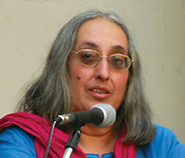 The former British Council librarian, in her first book dwells on the "tiger man’s” early years. He refused to be entrapped in the cultural and conservative social milieu of his village Chordiyan in Rajasthan, India. Not interested in a formal education, Rathore thought drama and theater would be a suitable career option. This hope was quickly dashed when he took part in a school depiction of the epic Ramayana which was deemed disrespectful of the Hindu religion, raising much ire in the family.
"Fateh’s grandfather had once got so annoyed with him for not learning his lessons that he picked him up and flung him across the courtyard,” when he was about two-and-a-half years old. The fall-out of this seems to have been that his mother picked up the courage to persuade her brother-in-law to take him away to Jodhpur so that he would be far from the man who flung children.
The calling of a career
Continuing his search for a career to his liking, Rathore ultimately decided to follow chacha (paternal uncle) Khet Singh’s suggestion of trying for the post of game ranger in Sariska. His mentor Bhanwar Singh taught Rathore about tiger behavior and habitat.
 From Sariska he went to Sawai Madhopur (SM) where his first assignment was a tiger shoot organized for Queen Elizabeth II. A goat was used as bait. For the first time, roads had to be laid in the game sanctuary. This laying out of roads and building them has been meticulously documented and can serve as a guideline for future sanctuaries.
Rathore owes his grounding to Saroj Raj Choudhury, director of the Forest Research Institute, Dehra Dun which he attended. He not only learnt about forest care and animals but also recognized his boss’s panache in the field. Taraporewala recounts how Choudhury captured a large cobra snuggled in his tent as no one else had the daring to do so. As he was catching it, he slipped and fell but had the presence of mind to hold down the snake’s head with his hooked stick.
Kailash Sankhala, initiator of Project Tiger (1973), was another source of inspiration, the biography reveals — not only for the depth of his knowledge about tigers and their behavior but also as an example of uprightness, frugality and their common love of Panthera tigris. Taraporewala mentions how Diana Wordsworth (a relative of William Wordsworth) inspired Rathore and "inculcated in him a sense of the importance of always being true to oneself, and was the one who gave him his first experience of the world outside his own country.” She also "bought him a Nikkormat camera with a variety of lenses so that he could learn how to take photographs.”
The first time Rathore dared to befriend a girl, he had to stop talking to her as she was from another caste; on another occasion his lady friend’s Dutch mother forbade him from any communication at all. Another escapade ended in marriage with Khem Kanwar. Later, he had a lady partner for more than a decade. Born in a Rajasthani landlord family, Rathore’s unconventionality has been documented sedately. The book stays in the narrative mode throughout and one misses the fleshing out of the personality of the bon vivant as one knew him.
Taraporewala documents her impatience with anyone not in sync with Rathore’s thinking. On a number of occasions she refers to Rathore being "vindicated” and how his point of view was "the right one.” She begins "needless to say, his uncompromising actions produced many enemies for Fateh” and ends the same paragraph with: "However, Fateh would pay a high price for this, and continued to pay it for the rest of his life.”
Rathore had the notorious poacher Surjan Bawariya caught, a man who could reportedly shoot a tiger guided only by the animal’s sound in the night. She further narrates how Bawariya had ruled the Sariska and Ranthabhore areas from which he sold hides to another notorious poacher, Sansar Chand. The latter eluded capture by flinging buckets of feces on the faces of occupants of approaching vehicles. The author also narrates how Rathore unearthed the use of animal baits to enable tourists to take photographs, for which the forest staff received large tips.
Following Rathore’s much publicized speech highlighting the disappearance of 18 animals, Tiger Watch was banned entry into RNP: "We are missing 10 of the 16 tigers which were photo trapped in 1999. Also eight tigers which we had studied can no longer be seen. So a total of 18 tigers are now missing from Ranthanbhore,” the author quotes the tiger expert’s report that created a brouhaha.
We are also educated about the welfare activities that Rathore initiated to rehabilitate poachers and their families under the auspices of Tiger Watch and personally rehabilitating several poachers and tribesmen whose source of livelihood depended on the destruction of tigers and their habitat. The work is still being carried on by Goverdhan by way of the setting up of the Fateh Public School and Fateh Singh Memorial Hospital, after his death on March 1, 2012. Taraporewala enlightens readers on how Rathore, along with Billy Arjan Singh and Valmik Thapar, re-aligned census methods to reveal a truer picture of ground realities.