
Books
Rishad’s raptor research
Birds of Prey of the Indian Subcontinent by Rishad Naoroji. Published in 2007 by Om Books International, 4379/4B, Prakash House, Ansari Road, Darya Ganj, New Delhi 110002. Pp: 692. Price: £ 40.
Birds of Prey of the Indian Subcontinent by Rishad Naoroji. Published in 2007 by Om Books International, 4379/4B, Prakash House, Ansari Road, Darya Ganj, New Delhi 110002. Pp: 692. Price: £ 40.
Destiny came to him winged. Even as a little boy Rishad Naoroji was different from other boys in outgrowing his toys sooner than they did, till one day at the impressionable age of 12, in the course of his travels in the Kumaun Himalayan foothills, he stood transfixed watching a Golden Eagle busy at its cliff nest near Ranikhet. Enraptured, he would have continued watching had not his concerned father, who did not share his son’s enthusiasm for whole day watching, gently led him away. Still, as an understanding father, Kekoo continued gifting him with all the books he wanted, particularly on birds of prey. He saw no harm in letting the little fellow enjoy his rather unusual hobby. Rishad went through the usual routine of school and college and being a close relative of the Godrej family (his mother Dosa being the daughter of Pirojsha Godrej), it was taken for granted that after graduation Rishad would join as apprentice in the vast family enterprise. But Rishad was never one to be taken for granted, and he steadfastly refused to join the family business.
He had made up his mind to become a "raptorphile.” When this reviewer started working in 1991 as Godrej’s official biographer, he had many occasions to interact with Rishad.
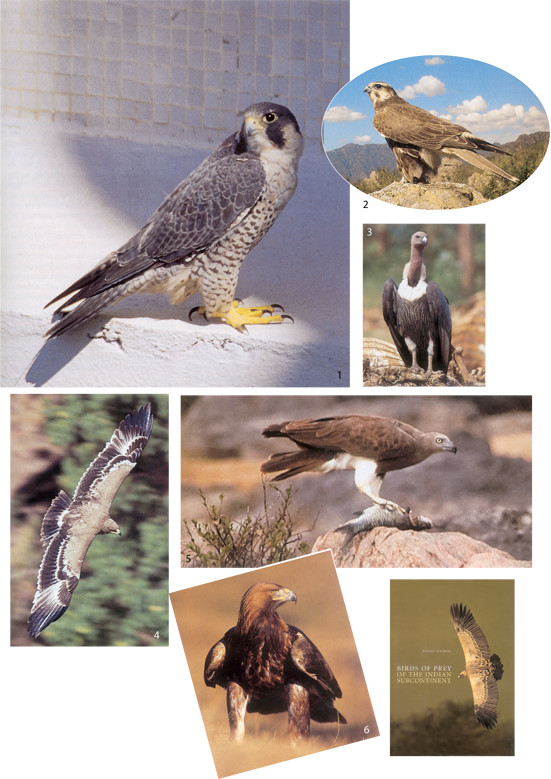
1. Peregrine Falcon
2. Saker Falcon
3. Indian White-backed Vulture
4. Steppe Eagle
5. Lesser Fish-eagle
6. Golden Eagle
Photo: Mike McKavett
We soon became friends, associated as both of us were with writing, he who had already begun his work on raptors and I on the company he had steadfastly refused to join. Tallish, rather heavily built, ruggedly handsome, he had the habit, a quirk of throwing his pencil up in the air and then grasping it when it came down. At heart he was a scholar and research was his first love. There were books lying all around, not only on the shelves, but on his table and tumbling out of chairs. And they were all, each and every one, on the subject of birds, not only of prey, but other varieties as well. It was a revelation to me, a bookworm myself, that such a wide variety of books had been written on birds and, indeed, that there were so many birds to be written about. Birds were his passion, his obsession, I realized, and nothing and no one would be able to divert him from the work he had taken upon himself.
The habits of raptors had to be observed and studied in different parts of the country, at all hours, in all weathers, and under extremely difficult conditions. Rishad’s book has been a pioneering effort and as such should do much to stimulate, as Prof Ian Newton observes in his Foreword. He has provided for the Indian region a sound base of information, through personal observation.
As one reads this handsomely produced book, with its enchanting cover of a raptor in full wing, heavy to carry but worth its weight in words, Birds of Prey of the Indian Subcontinent, one’s mind turns inevitably to the men of prey who have as usual done irrevocable harm to important habitats, especially the scrub-woodlands, grasslands and wetlands that once covered wide areas. These men have also been guilty of adding to the mortality rate by indiscriminate use of the most toxic pesticides banned in several other countries. Says Prof Newton: "The massive decline in the number of raptors and other birds around the world-famous reserve at Bharatpur is a source of great sadness to the many thousands of visitors.” Many conservation battles need to be fought and won.
Today, as no vultures survive nor breed in the extensive grounds at Doongerwadi, the community is faced with the problem of disposing of the dead hygienically while adhering to ancient practice. Breeding vultures by artificial means was not found possible and solar concentrators deployed at a few Towers of Silence have not proved satisfactory. But let Rishad who is an authority on the subject have the last word: "The Parsi vulture project aims to ensure that corpses of people who were treated with diclofenac are not placed in the Towers of Silence. For this, modalities have to be worked out, e.g. relatives of the deceased should provide information certified by doctors regarding the medication given during the last few days, before demise. For those who wish to adhere to customs, bodies treated with diclofenac could be placed in Towers where solar concentrators have been installed. However, Parsis are already opting for burial or cremation.”
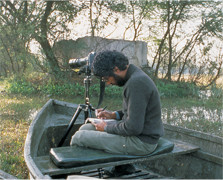
Author Rishad Naoroji
This book has been written primarily for field ornithologists and serious birdwatchers in India. But it is also of interest to the general reader who is a seeker of knowledge about the world we live in — as for example its highly readable Introduction and the well-researched "Raptors in Indian History and Mythology.”
Birds of Prey deals with no less than 69 species of migrant and resident raptors. Their very names arouse curiosity — from Red Kite, Black Kite, Black-eared Kite, Brahminy Kite to Red-headed Falcon, Amur Falcon, Laggar Falcon, Sooty Falcon, Peregrine Falcon; and from Short-toed Snake Eagle, Crested Serpent Eagle, Great Nicobar Serpent Eagle and Andaman Serpent Eagle to White-eyed Buzzard, Grey-faced Buzzard, Common Buzzard, Long-legged Buzzard, Upland Buzzard and Rough-legged Buzzard.
The descriptive methodology is thorough — etymology, field characters, status, distribution and habitat, behavior, food, breeding.
The book gives one an understanding of the world raptors live in, a world as exciting as our own. It is replete with stunning plates by John Schmitt and several photographs by Rishad himself. But its strongest point, one that will stand the test of time, is its research into much unexplored territory. Its bibliography alone extends over 41 pages.
It is only when one ploughs through the book’s 630 closely printed pages (the book was originally to have been in two volumes) that one realizes how much there is still left to learn about this wonderful world of ours. The book is indeed a masterpiece of research, a part-lifetime achievement. ‘Part’ because there is still a lot to be learnt and written about. Remember, destiny came to the author on wings, and it may take off again anytime.
◆ ◆ ◆
From the archive