
Welfare
The dyslexic’s dilemma
The Maharashtra Dyslexia Association founded by Kate Currawalla is assisting children to tackle learning impairment
"About five percent of a population suffers from dyslexia,” says Kate Currawalla, 56, (née Balsara) one of the founding parents of the Maharashtra Dyslexia Association (MDA) and its current president. Dyslexia is a learning disability marked by difficulty in reading, writing and counting. "In our culture where achievement is equated with mental and scholastic attainment, children with learning disabilities (LD) are termed retarded, challenged,” she adds.
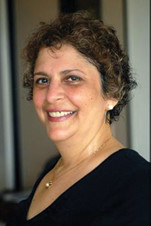
Kate Currawalla
The MDA assists in overcoming the basic disadvantage of those afflicted and attempts to narrow or ‘close the gap’ of this genetic disorder between a dyslexic’s current level of performance and the average norm. Some school principals however, when approached by members, seem to respond: "We don’t have kids like that.” Mothers of some dyslexic children were realistic enough to accept their children’s drawback and recognized that schools were ill-equipped to handle their children at that time. Others are in denial or defensive. Of course there are some who are also pro-active and understanding, realizing that "you can overcome the disability the earlier you identify it, especially with the right kind of help. Parents and teachers get impatient with these children as they think differently, they perceive things differently.”
The Association has three centers in Bombay at Deonar, Parel and Dombivli. These cater to all children with this neurological problem. They also offer training in LD. A far cry from 1996, MDA now has a staff of post graduates in clinical psychology, counseling and special education. The Board and administration staff are volunteers. Several of these are Parsis, helping with their specific expertise — Keshwar Dalal is the joint honorary secretary, Tanaaz Shroff assists with financial investments, Tehmi Morris uses her network for raising funds. Soona Machhi heads administration at the Parel office after retiring with more than 35 years at Indian Airlines as deputy commercial manager. Machhi is also an accomplished pianist.
In 2003 social entrepreneur Currawalla was elected a Fellow of Ashoka Innovators for the Public — a foundation in Washington, USA that promotes innovative entrepreneurship in the voluntary sector. She was also felicitated as the Woman Achiever of the Year in 2008 by the Sri Shanmukhananda Fine Arts and Sangeetha Sabha.
Under the guidance of Vinita Pandit — Principal of Arya Vidya Mandir for a little under 30 years — the Association operated from Pandit’s office initially. Currawalla highlights how the Bombay International School supported both her sons and was open to learning themselves though she acknowledges that the older one found his feet at the H. R. College.
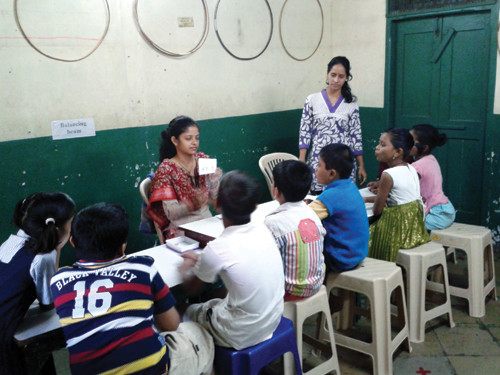
Counsellors aiding dyslexic children to create new neural pathways to be on par with peers
Paving the way
Due to no prior experience in tackling LD in India, the parents looked to the west. "Our inaugural workshop was by the Education Director of the British Dyslexia Association — Dr Lindsay Peer. We got a lot of support from her. She came by taking (personal) leave over a weekend to set us up. Parent Jyoti Row Kavi arranged for a ticket on Air India, and another parent gave the expert free accommodation and also a hall to conduct the workshop at Rangsharda (hotel, in Bandra).” The mothers were so worried that there may not be an adequate audience that they had forewarned their husbands to take leave on that day if necessary. However, after inserting an advertisement in a daily, they had 180 registrations from parents and teachers. Ultimately, they had to request some parents to withdraw in favor of teachers as the scope of influence of teachers would be wider.
The Parel center is the only office that offers Sensory Integration Therapy as it has the equipment and the space. Put simply, dyslexia is mainly different parts of the brain not functioning together. This integration therapy assists the brain to co-ordinate, to create and develop neural pathways. It is also at the Parel office that a battery of tests is given to assess how dyslexic a person is. Currawala elucidates "we avoid using the term test as that can be intimidating.” The assessment is made in oral, written, expression, reading, decoding, fluency, comprehension, vocabulary, etc by administrating standardized tests bought from abroad.
The Way Forward
The Secondary School Certificate (SSC) Board and the Directorate of Education had already set a norm codifying dyslexia in 1996. However, little was known about this and moreover few schools adhered to the order. In 2006 a parent, Vincy D’Silva, sued and won in the Bombay High Court, a case against a Bombay school for not allowing the prescribed concessions granted by the SSC Board. That was a landmark judgment for MDA. Currawalla gives credit for this to Dalal who, just as the Court was closing for the day, requested the judge to give an order to the principals to follow what had been stipulated ten years ago. The judge’s last statement, Currawalla informs us, was "principals who do not follow these guidelines can be held in contempt of the Court.” This single statement propelled the cause forward. Pioneer Maharashtra therefore has inclusion of dyslexics in normal schools and their ‘hidden disease’ is acknowledged.
Taking a cue from this, several other states have sought MDA’s expertise to set up their own associations. One such is in Hyderabad. MDA pushes states to form their own associations, parent support groups, propagating their belief in self-reliance. Parents and associations come back with useful feedback to petition governments at the state and central level. "We want a better inclusion,” Currawalla says. "There is the Persons with Disabilities (PwD) Act 1995. The disabilities sector finds PwD inadequate, so all societies of the disabled have asked for a new act. MDA is striving to include dyslexia as a disability so that it becomes the law (and impossible to flout).” Some balk at the word ‘disability’ and prefer to use ‘difference’ as there seems to be no stigma attached to the word difference. Under Clause 26B of PwD Act, teachers would have to learn remedial education in order to become more sensitive to children who learn differently.
MDA’s policy is "not to turn away a child, especially for monetary reasons.” So, where do they get their resources from? "Donations are 20 percent of the income; the rest is from being self sufficient,” the president states. MDA earns from workshops offered to schools, professionals and teachers. They also charge full fare for tests to those who can afford it while the really poor are free. Others are helped, if needed, by raising funds. MDA has also signed up with non-government organizations who work with municipal schools to assist students with LD. This symbiotic relationship is advantageous to the schools and to the staff of MDA as they can reach out to a wide range of children. Currawalla actively supports the ‘buddy system’ for dyslexics, where children can share notes as they may have a problem taking down things appropriately and correctly either as notes or from the school board.
This activist says it was providential that she learnt that some family members abroad were identified with LD. So she and her husband Mehernosh set off on the path to identify their sons’ differences, only to realize that both suffered from symptoms identical to their cousins’. Today, Murad (aged 30) is a graduate in digital media and computer graphics from Otis College of Art and Design, Los Angeles. Active in Rotaract and in Zoroastrian Youth for Next Generation, Murad has a deep sense of commitment and social responsibility. He has also worked in Hollywood. Rashid (27) has joined father in his business of clearing, forwarding and transport at FAK Cargo. Music is Rashid’s recreation. The mother informs us that as parents they always encouraged the sons to excel in extracurricular activities and did not force either of them to achieve only in academics.
The social worker calls herself a liberal Zoroastrian and believes that the children of either Parsi parent should be termed Zoroastrian. Currawalla is "sad that dakhmenishini has become such an issue and so politicized. It is unfair that those who choose not to opt for the dakhma system are deprived of last rites. It is criminal.” She adds that she finds a disproportionate number of Parsi children approaching MDA for help. She has no conclusive evidence yet whether this is genetic or the result of a high level of awareness. She sighs and informs of an on-going study in Gurgaon which should shortly throw up a definite answer. "Awareness is just the beginning…,” remedial recourse is the next step. Currawalla and her band are doing their best to walk this path.
Defining dyslexia
Dyslexia is popularly known as ‘word blindness’ though experts have categorized it as dysgraphia (writing difficulty with limited eye-hand co-ordination), dyscalculia (math difficulty with limited ability to retrieve basic mathematical facts) and dyslexia (difficulty in encoding and decoding words, confusion of left and right hands). The generic terminology remains dyslexia (derived from Greek meaning ‘difficulty with words and language’). Currawalla adds that very few children are diagnosed with dyscalculia.
◆ ◆ ◆
From the archive