
Education
“The power of the mind” - III
The K. R. Cama Oriental Institute’s seminar focuses on seminaries for the priesthood, a library for the city and the right to inclusive education for the marginalized
The first installment of the Parsiana report dealt with the establishment of schools for girls, both Parsi and cosmopolitan, in the teeth of orthodox opposition. The second part featured the formation of the University of Bombay and the establishment of medical, technical and art education in the city. The last part will deal with the creation of post-graduate institutions that have altered the national intellectual landscape.
Two presentations in the third session dealt with "Religious education, libraries and archives.” Speaking on Zoroastrian madressas in Bombay Ervad (Dr) Rami-yar Karanjia, principal of the Athornan Boarding Madressa in Dadar and the Sir J. J. Zarthoshti and Mullan Feroze Madressas provided a historical background to the four that exist in the city.
The Mulla Feroze Madressa was established in 1854 in memory of the erudite Dastur Rustamji Kekobad Mulla Feroze to teach Avesta, Pahlavi, Zend and Persian. In the beginning teaching was imparted in the traditional way at the Dadysett Atash Behram. From 1861 for two years Khurshedji Rustamji Cama held classes in the comparative philological method of European scholars in his home at Fort. Ervad Kavasji Edulji Kanga, a fellow of Bombay University and its examiner in Avesta, joined the Madressa as principal in 1863, serving it until his death in 1904. A line of Parsi scholars served the Madressa but from 1940 onward the number of students declined and in 1963 its assets were transferred to the Bombay Parsi Punchayet by a court order and it was merged with the Sir J. J. Zarthosti Madressa which had been established in 1863 to commemorate Sir Jamsetjee and to teach Indo-Iranian languages to priests and laity with Sorabji Shapurji Bengalee as its first superintendent.
From time to time western scholars were inducted to get the work of the J. J. Madressa in line with western standards, noted Karanjia. Dr E. W. West, Prof L. H. Mills, Prof A. W. Jackson and Dr James Darmesteter served as external examiners. In 1931 Ervad Behramgore Anklesaria became the first principal to look after both madressas. Diminishing interest in religious academic study led to a part of the fund of this institution being diverted to the Sir J. J. College of Commerce in 1951.
As against the emphasis of these two madressas on the scholastic understanding of the scriptural languages, the Athornan Boarding Madressa and the M. F. Cama Athornan Institute in Andheri are seminaries for the training of the sons of priests to take on the profession. Hence learning the prayers and performing the ceremonies are their priorities. The boys are inducted at an early age into living the life of priests, some even before they are navjoted, and educated in secular academics alongside at neighboring schools.
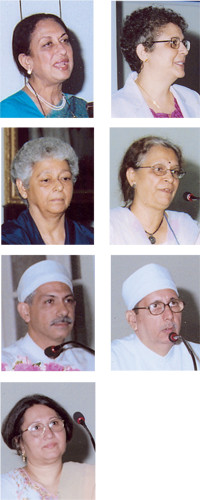
Clockwise from top left: Meher Banaji, Kate Currawalla, Dr Madhuri Kulkarni, Ervad (Dr) Rooyintan Peer, Shehernaz Nalwalla, Ervad (Dr) Ramiyar Karanjia and Dr Roda Billimoria
Both institutions have produced stalwarts who have later functioned as high priests as well as many who have primarily opted for higher education and secular careers abroad where they have served their communities as volunteer priests. Both institutions experimented with the elimination of secular education, each time a disaster with a precipitous drop in the number of students and have had to reinstate normal schooling alongside for the boys in their care. The Dadar madressa now even permits its brighter alumni to avail of its boarding facilities, maintaining their religious functions as they pursue their college education.
It is a catch 22 situation. As Karanjia put it, "with secular education priests go into other full-time jobs. But without secular education they are unable to integrate with the community.” And, as with all community institutions their numbers have been affected by the demographic decline.
Shehernaz Nal-walla who has specialized in Greek philosophy at the Master’s level spoke about libraries in Bombay growing with the population’s growth in literacy and presented a study of the J. N. Petit Institute. In 1856 a dozen students from the El-phinstone College started the Fort Improvement Library which later evolved into the Fort Read- ing Room and Library. Then, in 1891, Nesserwanjee Manockji Petit donated 2.5 lakh rupees in memory of his son Jamsetjee who had been closely connected with the welfare and progress of the Fort Reading Room. Together with other munificent donations from the Petit family the Fort Reading Room burgeoned into the J. N. Petit Institute, one of the leading centers of intellectual activity in the city.
The seminar’s fourth session concentrated on the Parsi contribution to special education chaired by pediatrician Dr Madhuri Kulkarni who started the Early Intervention Clinic for developmentally subnormal children in 1985, the Pediatric Neurology Clinic in 1992 and the Learning Disability Clinic in 1996. Dr Roda Billimoria, who has researched the integration of special and general education and established the Sir Shapurji Billimoria Foundation (SSBF) in 1998 where all children have access to the best that education can offer, shared her vision of integrated education with the audience.
Imbibing the Swedish concept of Normalization which aims at enabling people with various impairments and disabilities to participate in an ongoing society — "To be like others among others” — Billimoria seeks to redesign the way teachers are taught to teach. Indeed, the concept goes on to redesign the way society defines success with tuitions, competitions, high performance. "It is unhealthy,” says Billimoria. "There is no room for the average child… Why are there student suicides? Cognition alone is not the defining element.” People are born with multiple skills and talents. According to Billimoria the standard teaching technique assumes that all students are capable of independent learning. "It does not recognize that teaching styles do not match learning styles. We need to integrate different methods, develop appropriate pedagogy which is in step with the pace of learning. Teachers need to learn new strategies, also need exposure to braille” which she added has been incorporated in the new BEd course.
Noting that the Kothari commission report in the 1960s had estimated 25 million special children in India and emphasized the need to bridge the gap at the national level, the SSBF aims to address the needs of children of differing capacities as well as to redesign teacher education and training to enhance the optimal development of the children by teaching differently. It also aims at the inclusive education of children coming from culturally and economically disadvantaged backgrounds. The Foundation’s short-term courses for teachers from a variety of schools — general, special, remedial and municipal — incorporated inputs from various professionals including doctors, counselors, dramatists, etc. The courses held from 1999 to 2002 also introduced the teachers to real life experiences, the rehabilitative potentials of children with special needs and a variety of teaching methods and experiments in integrated education. They were encouraged to adopt an eclectic approach and to involve themselves in creative activities.
Moving on, the Foundation has planned India’s first Institute of Integrated Education at Kharghar which will include a demonstration school to serve as a model for the propagation of the central government’s Sarva Shiksha Abhiyan policy, a center for teachers’ training, a two-year Diploma in Integrated Education and regular in-service courses for working teachers. Ongoing research and the creation of a database are also on the cards. The Foundation has been one of five institutions in South Asia that have received UNICEF approval, noted Billimoria who believes, no doubt as her grandfather Shapurji and granduncle Dr Rustom Billimoria who founded the Bel Air Hospital surely did, "Do not go where the path may lead; go instead where there is no path and leave a trail.”
Kate Currawalla, founder president of the Maharashtra Dyslexia Association, recounted the struggles and dedication of four outstanding Parsis over the last 25 years who aimed at making life worth living for children with learning difficulties. Currawalla defined the problem: "By its very nature, education for those with special needs demands close cooperation between professionals with diverse skills and training — teachers, special educators, speech and occupational therapists, counselors and doctors — to ensure that all the complex rehabilitation and educational needs of the child are seamlessly met. It is this teamwork that offers unique challenges to any institution attempting to integrate a child with special needs into a mainstream program and few educationists are willing, even today, to take up the gauntlet. To those who do, inclusion as a philosophy has come naturally, believing as they do that the learning environment must adapt itself to the needs of every child rather than the other way around.”
Referring to Roshan Khariwala, former principal of the Bai Avabai Petit Girls’ School who went on to join the Learners’ Academy and her daughter Kashmira Jamali, a Masters in clinical psychology, Currawalla said the mother-daughter team created an innovative, activity oriented school. As Currawalla described it, "For the average schoolgoer this child-centered learning environment offered a refreshing alternative to the regimented rote-learning prevalent in most Indian schools, but for the child facing physical, psychological and intellectual challenges it was a boon.” Khariwala had marshaled a team of counselors, special educators, speech and educational therapists as well as a visiting psychiatrist and admitted students with a range of special needs including cerebral palsy, autism, dyslexia and Down’s Syndrome. Later they broke away to found their own pre-primary school, Small Wonders, in Khar which grew into an ICSE school named Beacon High and a much sought after institution in the western suburbs. With Shehnaz Jamali now a vice principal, the third generation of the family is rendering support.
An article on Learning Disabilities that psychiatrist Dr Kersi Chavda wrote for the Reader’s Digest in 1988 resulted in teachers and parents writing in from all over the country. It led him to start a self-help group for parents at Sapling — School for Appropriate Learning. Soon Chavda was consulting with several special schools as well as institutions practicing inclusion, making a significant change to management policies. Apart from Learners’ Academy and Beacon High, Chavda contributes his expertise to Don Bosco School, the Manu Prem Special School and the S. P. J. Sadhana School for exceptional children as consultant or as member of the governing board, related Currawalla.
A child with multiple disabilities at the G. D. Somani School where she was appointed nursery teacher set the course of Rukhshana Sholapurwala’s remarkable career in special and integrated education. Starting initially with the Malti Centre for Integrated Education, Rukhshana, daughter of Feroze Sholapurwala who set up the FKS Foundation, joined the Dadar Parsee Youth Assembly (DPYA) School as a special educator and counselor, setting up her private consultancy on the side. "She convinced the management of the DPYA to provide curricular and other supports to the students she identified as having learning issues, a pioneering effort that pre-dated the special provisions later codified by the State Department of Education,” stated Currawalla. As honorary secretary of the NGO CHILDReach Sholapurwala’s concern for the isolation of children who had dropped out of the mainstream of education led her to work towards creating a parallel confederation of special schools to organize competitions and interschool sports to enable them to interact with their peers and compete in an appropriate setting. "Today, these summer camps, nature walks and overnight picnics are the highlight of the special schools’ calendar, giving students with limited cognitive abilities or psychological issues an opportunity to develop daily living and social skills that foster personal independence,” noted Currawalla.
In 1996 the Learning Disabilities Clinic was set up at the Lokmanya Tilak Memorial General Hospital at Sion in response to the need to have a certifying government clinic to implement the special provisions for students with learning disabilities that were introduced the previous year. Sholapurwala was appointed its first special educator with responsibility for creating a viable procedure for assessment. The Clinic, the only one of its kind in Maharashtra, grew rapidly but faced a resource crunch when the grant from the Rajiv Gandhi Foundation ran out. Stepping into the breach in 2002, the Tata Interactive Services Limited adopted the clinic as its corporate social responsibility project, providing not only financial resources to keep the service going but also customized software and management expertise.
With the passing of her father Sholapurwala is also shouldering the responsibility of running the FKS Foundation which sponsors 25 school-going children including those going to special schools through a grant from the Sir Ratan Tata Trust. With the help of the Roshan and Erach Sadri Foundation she helps college and professional students.
Even as educationists like Khariwala addressed the needs of special children in mainstream schools, it led to a new dilemma in the early 1990s. Unlike those with physical impairment, students with learning disabilities were not given any consideration by the educational department of the state or the state and national examination boards. Without such accommodation they could not hope to clear the highly competitive school-leaving examinations and access higher education or vocational training programs "despite their obvious intelligence and varied talents.” A group of parents and educationists got together to petition the State Board offices in Bombay and Poona, meeting innumerable officials in pursuit of their quest. In 1995 the state department of education granted special accommodation for dyslexic students at the SSC examinations.
To ensure that the initiative did not fizzle out once their own children had finished school and to foster a more inclusive education system the group was formalized as the Maharashtra Dyslexia Association (MDA) in 1996 with Keshwar Dalal and Jyoti Row Kavi as its joint secretaries and Currawalla as president. She recognizes the late legislator Pramod Navalkar and art historian Pheroza Godrej as their most supportive patrons. The focus of the group shifted to creating a better understanding of the problem among the public and an infrastructure to support affected students and their families through the crucial early years. MDA adopted the tag line: "If I can’t learn the way you teach, will you teach me the way I can learn?”
With support from the media the Association’s membership grew to almost 300 within months. Its programs were over booked and a stream of enquiries demonstrated that the demand of information and services was undersupplied. In 1997 a resource center was established at Deonar in premises provided by the government. Today the MDA runs three full-fledged centers in Deonar, Parel and Dombivli. Its awareness programs address schools as a whole, training the entire staff to identify students with learning problems, guide and support them through the school system. The focus on institution building led to the MDA being elected the International Dyslexia Association’s Global Partner in India in 2007. The Association’s activities are almost exclusively funded by Parsi trusts — the Pirojsha Godrej Foundation, Sir Dorabji Tata Trust, the N. M. Petit Charities, the Master Charity Trust and the Shapurji Broacha Trust being the major though not the only contributors, noted Currawalla adding, "Such support from a single community for an initiative that has spearheaded an evolving social movement and changed the way we view school failure is surely worthy of note.”
On the international front too there is a Parsi presence. Clinical psychologist Dr Zenobia Nadirshaw, governor of the London Metropolitan University, is a trustee of the Mental Health Foundation and the Foundation for People with Learning Disabilities, UK. She has had a significant impact on the understanding, training and service delivery issues at the local and national levels, noted Currawalla.
The third presentation on the theme of special education came from Meher Banaji, principal of the Happy Home and School for the Blind since 1969. Working with 200 visually and multiple impaired children ranging in age from three to 20 years, Banaji said that from the perspective of the blind "the world is an unfamiliar, unfriendly place” but with the requisite skills those so impaired can acquire self-confidence and self-esteem.
Founded by Coomi Bharucha in1925 with five blind waifs who were denied entry into the Victoria Memorial because they had no family, the school focuses on ability rather than disability. The Annie Besant Road land where the institution is now located was acquired in 1965. Even in 1971 there were 65 children on its rolls. They come from all over India, it being the only recognized school for the blind where the boys are taught up to Standard X. Most of them are boarders but some day scholars also attend. The infrastructure provides adequate support for training them and maximizing the use of their alternate senses. In her long association with the institution Banaji said she has taught only three Parsi children.
To be concluded
◆ ◆ ◆
From the archive