
Politics and Policy
Surat’s stewardship
Twenty anjumans of Gujarat discussed local issues at the West Zone B meeting convened by Federation vice president Darayas Master
The largest funds and properties in the community are probably in Gujarat. From the 40,000 community strength in Bombay, 20,000 must be hailing from Gujarat. "Despite this how much voice do we have” in the Federation of the Parsi Zoroastrian Anjumans of India? "Who listens to us? How many of our problems have been resolved?” enquired Dastur Khurshed Dastoor, High Priest of Udvada who was the chief guest at the West Zone B meeting of the Federation at the hall of Seth Rustamji Mancherji Kooka Parsi Panchayet Building in Surat on April 21, 2012.
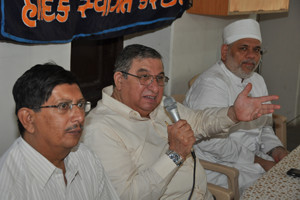
(From left) Pervez Mehta, Darayas Master and Dastur Khurshed Dastoor
"Today should be a "yaadgaar divas (memorable day),” remarked vice president of West Zone B and president of the Surat Parsi Panchayat (SPP) Darayas Master inviting the office bearers and trustees of 20 anjumans to share their experiences and difficulties so that solutions could emerge from the deliberations that were conducted in Gujarati. Social problems related to education and health could also feature at this forum, he suggested.
To address the grievances raised at the meeting, it was recommended that a Gujarat committee be formed under the leadership of Master or Dastoor. As Dastoor addressed Master, "Halaavaanu kaam tamaru chhè (to shake the anjumans out of their reverie is your job).” Master though responded, "If Dasturji takes the leadership we will be willing to join.” Shortage of mobeds and low salaries being a recurring problem, joint honorary secretary of the Federation Pervez Mehta of Bardoli will undertake a research of the fire temples in Gujarat to determine a future course of action. To prevent misuse of the proxyship clause in the Federation constitution that permits member anjumans to be represented by their nominees, it was decided that the main body be requested to bring up this item at the next executive council meeting to permit representatives to consult their respective anjumans.
Appreciating that instead of merely basking in his new post Master had taken the initiative to convene this meeting within three months of being elected vice president, Mehta commended his proactive role so that anjumans facing problems with the charity commissioner or land disputes can attempt to redress their grievances at this common forum.
Impressed with the turnout of office bearers at this meeting, Dastoor enquired why they don’t come for the executive council meetings of the Federation? "Why send a proxy? Are we not capable of overseeing our own affairs?” Sending proxies, especially those with no connection with the anjuman, gives rise to politics. As compared to the earlier harmonious workings, problems in the Federation have emerged in the last five to seven years, mainly due to the lure of office or position, he added. He proposed that strong signals be sent to the parent body for a change in the system so that only those trustees voted or nominated by their anjuman be permitted voting rights at the Federation and not any nominated member.
As explained Mehta, the proxy issue had come to the fore when, on the eve of this meeting, one of the Gujarat anjumans insisted that proxies should not be permitted to attend. Mehta hoped this suggestion would find favor at the next Federation executive council meet too.
Whilst a proxy cannot be debarred from voting, he can be prevented from contesting an election, opined Baman Cama of Vadodara who felt that no individual should be permitted to contest Federation elections if he/she is not representing his/her anjuman. Sam Chothia of Valsad opined that the subject of proxy rights should be brought before the executive council meeting so that representatives can give their anjuman’s considered opinion instead of personal views.
Why should an anjuman’s right to vote be taken away just because the trustees are unable to attend a meeting? enquired Farroakh Govadia representing Nargol. According to him Nargol has 45 persons, all aged, and sometimes they are not able to perform the paidust for a community member. How then would they be able to attend a Federation meeting? He regretted that no big anjuman has come to the help of Nargol which cannot afford the services of a priest or Tarapore which has an agiary. Likewise Davier cannot find a priest and in Sanjan too the common refrain is no one comes to pray at the agiary.
Dastoor’s practical suggestion was that due to shortage of priests, kathi and devotees, the trustees should shift the sacred fire to a well patronized agiary where it can be housed in a separate room without merging the fires. This proposal was rejected forthwith by Davier’s Marazban Wadia who believed that the spiritual strength of the fire should not be tampered with.
Shifting of the fire was even anathema to Pervez Khergamwalla of Khergam who mentioned how after his brother’s demise he had been devotedly looking after the fire temple at personal cost. "I will not stop looking after it until I die,” he declared making Dastoor enquire what would happen thereafter. Revealing how he was once considered the black sheep of the family but is now so committed to the upkeep of the agiary, Khergamwalla was sanguine that his son and grandchildren would look after it in due time. His regret that his son who is now in his 20s was not made a priest made Dastoor clarify that he could still become one.
Assuming that there is a person who comes to do the ritual boi, what is the sense in feeding the fire with three meals and two breakfasts after which it is locked up and left isolated, sans company, argued Dastoor who felt the primary duty now should be to prudently preserve what is possible instead of being awashed with sentimentality. He cited the case of the Doongaji Agiary fire in Bharuch where one devotee had objected to its shift to Bombay and the unfortunate result was that there now remains neither a fire nor a fire temple. Manek Tadiwala of Udvada specified that when he had gone to deliver kathi at Davier the temple was locked, there was no one to take charge of the kathi and nor did there appear to be a blazing fire. Often it is the trustees of the fire temples who do not want to sit conjointly to discuss a plausible solution in the interest of the sacred fire. "We have to change this mentality,” Dastoor persisted.
According to his estimate there is the likelihood of barely 30-40 athornan children becoming mobeds in the coming years. If they are given a salary of Rs 15,000 per month how can they sustain their household, he wondered? Gandevi Agiary’s Ervad Kurush Sidhwa rose to announce that he has been a priest for the last 19 years and his current income is Rs 11,000. Whilst working in conjunction with the priest from Billimora such that they can mutually relieve each other in times of need, he reiterated the difficulty in finding substitute priests. Regrettably the community thinks the priests are puppets. It is up to the priests to take on the responsibility to find substitutes as a sense of duty, advised Dastoor who believed it unfair to continue with a fire temple for the sake of only one individual.
"We look after our priest well,” announced Marazban Baria of Billimora advising that there should not be a boss-employee relationship between the trustees and the priests keeping in mind that if the trustees nurture the priest, he in turn will nurture the sacred fire. He offered financial assistance to any anjuman in need of funds for their fire temple or ruvan ni bungli.
Surat Panchayat trustee Zubin Bhatporia cited the instance of the Dumas agiary fire that was shifted to Nanpura with the support of Master when there remained only two families in the area and the octogenarian priest suffered from Parkinson’s disease.
To lighten the mood, SPP trustee and well-known thespian Yazdi Karanjia urged, "Worry not about the sugar in your blood but the spice on your tongue and the salt in your heart. It is not important to go to heaven after you leave earth but to create heaven whilst you are alive with your good thoughts, words and deeds.”
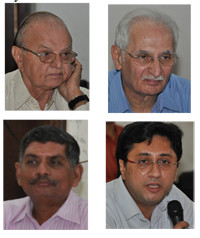
Clockwise from top left: Surat trustees Yazdi Karanjia, Jamshed Dotivala, Zubin Bhatporia and Hormazdyar Patel;
Counseling the community
The community is small but the trustees here are doing the biggest job. In the fields of medicine, housing, no other community is doing such systematic work, admired legal expert Harshad Pandya who had been specially invited to the meet so that the smaller anjumans could benefit from his counsel.
Sarosh Bhurana of Ankleshwar enquired regarding the correct procedure for selling a property where the tenant currently pays only Rs 75 as rent. As advised by Pandya, the sale offer must first be made to the tenant and if he declines the highest bidder at the auction could buy the property on ‘as is where is’ basis.
Mehta’s query related to three change reports that have been submitted following elections in Bardoli to the charity commissioner in Surat and yet no records being amended at the charity commissioner’s end. Pandya said this could be because the charity commissioner’s post was vacant and advised Mehta to send the Surat office a monthly reminder with a copy to the Ahmedabad charity commissioner’s office.
Vyara’s Persi Buhariwala sought to know whether funds can be raised towards the construction of a ruvan ni bungli if not specified in the objects of the trust. He was advised that if contributions are made anonymously in the donation box the monies could be used.
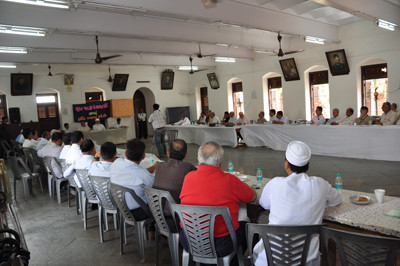
West Zone B meeting in progress
Religion with politics
"Let the youngsters come forward and represent the community. They have knowledge and experience. Allow them to rise,” recommended Dastoor. He was critical of the current practice of mixing religion and politics at Federation meetings reminding the assembly that they should manage their anjumans and leave religion in the hands of the priests. The same Federation that is meant to bring the dwindling community together is causing fragmentation and breaking the fabric of the community by dividing the body into orthodox and reformist... dharam doobav and dharam saachavnaar (religious traitors and upholders of the faith).
Govadia alluded to the Federation’s role under the leadership of Areez Khambatta and Khojeste Mistree in warding off the takeover of the Bombay Parsi Punchayet and other anjumans by the London based World Zoroastrian Organisation (WZO). Since he was apparently confusing the WZO with the proposed world body that was on the anvil in 2004 Dastoor had to remind him how the WZO has worked for the poor in the rural pockets of India, how they had contributed four lakh rupees towards the fencing of the Nargol dakhma land, an amount given without any intention of buying votes...
To break the Federation would require only one fool, stated Rusi Besania of Surat who poetically referred to the importance of unity for progress and welfare. He reminded the gathering that the hall where the meeting was being convened had witnessed its inaugural jashan 100 years ago. He reiterated the importance of Gujarati culture and language for the community’s growth.
For such meetings to be meaningful, anjumans should be asked to state their problems beforehand, advised Sorab Katpitia of Surat who looks after the defunct anjumans’ properties. He also urged the small dwindling anjumans to hand over their documents in the safe custody of the Federation because in the absence of necessary titles they find it difficult to retrieve community land that is encroached and usurped.
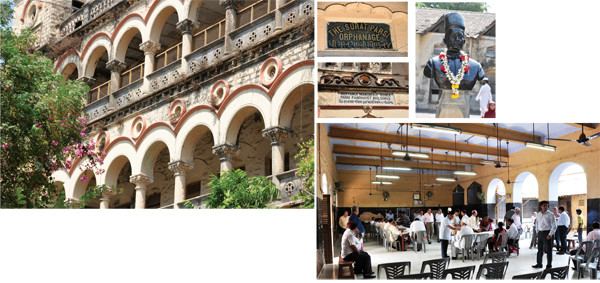
Venue of the Federation West Zone B meeting with bust of Rustamji Kooka; (below) lunch served on the otla
"If I entrust the Khergam property to the Federation, I can well imagine how it will be frittered away,” stated Khergamwalla making Katpitia’s assistant Jimmy Bacha interject that if he has maintained his anjuman property why is their agiary in a bad condition, encroachment on the dakhma land and neglect of the old school building behind the agiary?
As explained Katpitia, the Federation has made an application under section 50 of the Bombay Public Trust Act to get the Federation’s name on the land records as was successfully done in the case of Junagadh and Surendranagar which have aramgahs, and Khambat which has an agiary. In Rajkot too where there are only eight Parsis remaining, the Federation has made an application to get itself declared as owner. Once the Federation is able to sell the encroached defunct anjuman property — the proceeds would go to the former residents and heirs of that area and thereafter the money would be used for the welfare of other Zoroastrians.
Referring to the major property dispute last year when a stay was brought on Nucleus Developers Private Limited from developing the property around the Iranshah in Udvada, Dastoor announced that the final hearing at the Gujarat Revenue Tribunal was due on April 26. Appreciating the cooperation from the Bombay Parsi Punchayet and the Federation who got themselves included as intervenors as also Gujarat chief minister Narendra Modi, Dastoor forewarned, "Sooner or later we will have to buy this property else the scenario in Udvada will be similar to the atash behrams in Navsari, Surat and Bombay which are in the midst of non-Parsi pockets.” The Zoroastrian population in Udvada would in the proximity of around 100, of whom 75 are local residents. Assuming they get a community syndicate trust to buy over the property they don’t want any development there lest the wells get polluted in the absence of a sewage and drainage system.
Whilst SPP has good funds, as per their objects, they are bound to use the income from their 12 funds only on their respective institutions, stated Master. He cited the case of their Entee Dharamshala, the development of which is dependent on their application to buy land from another community trust but that application is pending with the charity commissioner for the last two years. "Unfortunately we don’t have a vote bank,” pointed out Master alluding to a part of the Surat dakhma land which was unilaterally acquired by the government ostensibly to build a leprosy hospital. Their vacant land being constantly eyed by local politicians, they have now planted bawal trees on their Doongerwadi property such that free kathi can be availed of by any anjuman in India in the future.
Mahuva has a corpus of only Rs 3,00,000 and representatives attend the Federation meetings by personally paying for their second class fare. Unless the venue and dates of the Federation meetings are decided four months in advance, it becomes difficult to make railway reservations, lamented Dr Hoshang Mogal. He referred to their plan to renovate their community hall at a cost of Rs 20 lakh and give it out on rent to earn income for the anjuman. Currently their fire temple and dakhma land is sustained from the income they earn from selling grass.
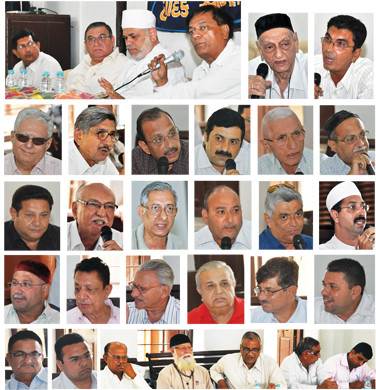
(From left, 1st row) Pervez Mehta, Darayas Master, Dastur Khurshed Dastoor, Harshad Pandya, Sorab Katpitia, Jimmy Bacha; (2nd row) Rusi Besania, Baman Cama, Marazban Baria, Sam Chothia, Farroakh Govadia, Persi Buhariwala; (3rd row) Hosi Bajina, Dr Hoshang Mogal, Pervez Khergamwalla, Sarosh Bhurana, Shavaksha Todiwala, Ervad Kurush Sidhwa; (4th row) Manek Tadiwala, Jehangir Parabia, Dr Minoo Parabia, Dhanjishaw Avari, Vistasp Katrak, Pervez Mandviwala; (5th row) Nevil Buhariwala, Sarosh Buhariwala, Pesi Kasad, Marazban Wadia, Sarosh Poonawalla, Adi Patel and Mehernosh Patel
"Constitution pramaané kaam nathi thatu (the Federation is not working as per the constitution),” regretted Mehta referring to the ensuing executive council meet in Jabalpur which, after the Bombay meet in February, should have been held after six months in August. Citing monsoon problems Jabalpur reportedly insisted they could only host the meet in November. When it was suggested that instead of the 2012 meet they could host the next one six months later in 2013 they again reportedly refused saying either November or never.
Jabalpur is viewed as a World Alliance of Parsi Irani Zarthoshtis (WAPIZ) stronghold and as some WAPIZ trustees are also Federation office bearers "the dual role” of some trustees is causing such cross-communication, believed Mehta.
To coordinate the workings of different community trusts it was recommended that there be a joint screening of applicants to avoid duplication. Among the suggestions on this topic was that cheques should be sent to the offices of the smaller anjumans instead of the applicant’s residence to keep the office bearers in the know. Whether the names of the applicants should be displayed on the Federation website was also deliberated.
When Wadia enquired why the Surat High Priest Cyrus Dastoor was not present at this meeting, Master explained that he had chosen to distance himself from the Federation workings. When Wadia subsequently enquired if the minutes of this meeting would be available Master responded that the proceedings have been taped.
The downfall of the community is not due to interfaith marriages but a rise in migration and financial hurdles with no single window to help the deserving especially in the mofussil areas. Dastoor believed that couples restrict the number of offspring in the absence of any convenient facility where they can leave their children whilst they are working. Creation of day care crèches could help such couples whilst simultaneously supplementing the income of those who are retired. If a mediclaim cover is assured to the deserving just as the Parsi Resource Group provides mediclaim for the mobeds, those who are economically disadvantaged could divert their funds for educational use.
Those attending the Federation meeting were: Sarosh Bhurana from Ankleshwar; Pervez Mehta from Bardoli; Marazban Baria and Dhanjishaw Avari from Billimora; Vistasp Katrak from Chikhli; Marazban Wadia from Davier; Ervad Kurush Sidhwa from Gandevi; Pervez Khergamwalla from Khergam; Rohintan Mogal and Hoshi Bajina from Mahuva; Pervez Mandviwala, Cyrus Satarawala and Godrej Hansotia from Mandvi; Farroakh Govadia from Nargol; Dr Hoshang Mogal and Dara Gandhi from Navsari; Sarosh Poonawalla from Saronda; Darayas Master, Hormazdyar Patel, Jamshed Dotivala, Yazdi Karanjia, Zubin Bhatporia, Rusi Besania and Dr Minoo Parabia from Surat; Adi Patel and Mehernosh Patel from Tavdi; Manek Tadiwala from Udvada; Baman Cama, Aspi Vajifdar and Jehangir Parabia from Vadodara; Sam Chothia from Valsad; Pesi Kasad from Vansda; Shavaksha Todiwala and Homiyar Damania from Vapi-Daman; Persi Buhariwala, Nevil Buhariwala and Sarosh Buhariwala from Vyara. Sorab Katpitia and Jimmy Bacha represented the defunct anjumans subcommittee. The chief guest was Dastur Khurshed Dastoor and the guest speaker was Harshad Pandya. The Press was represented by Parsiana.
◆ ◆ ◆
From the archive