
Observation
The hills are alive
The Zoroastrians of Panchgani and Mahabaleshwar founded many flourishing businesses and schools here
This is the second article on establishments in the two hill stations. The first part dealt with Parsi hotels.
We were the original, we didn’t have to be pseudo,” states Zavare Irani, 71, of Imperial Stores, Mahabaleshwar. "Parsis had the expertise,” yet after Independence they panicked under a mistaken notion that a holiday was a British concept. "With the British gone, how will we manage?” wondered his dad’s generation. "It was up to us to bring in heritage tourism (to Mahabaleshwar) which we didn’t. We went for glamor. We were not proud of our heritage. We’ve paid a heavy price for it. Imperial (Stores) is what a country shop should be. Grandpa (Irani) got preserves from South Africa, Kraft cheese balls — it was no less than a super market in those days. There was so much fun and no less business,” adds Zavare.
The owner of Imperial Stores at one end of the Mahabaleshwar bazaar links the history of this hill station to his establishment. Mahabaleshwar was a military camp with a garrison located at the current holiday camp. Imperial Stores was started in 1928 by his paternal grandfather to serve this imperial garrison.
Zavare’s Iran born wife Shekufay’s grandfather, Tehmurasp Satarawala, came to Mahabaleshwar from Satara to collect herbs and is said to have started the first stage coach service between Satara and Mahabaleshwar — a distance of about 60 km. He then opened a store in the bazaar called Panchgani Stores and Pharmacy down the lane from where Imperial stands today. Shekufay, 60, and he "are equals in business, Sheku is my right hand, a big guiding force in my life. We never felt envious of city folk. The hill Gods saw both my children through. Excellence was our sense of achievement,” mentions Zavare.
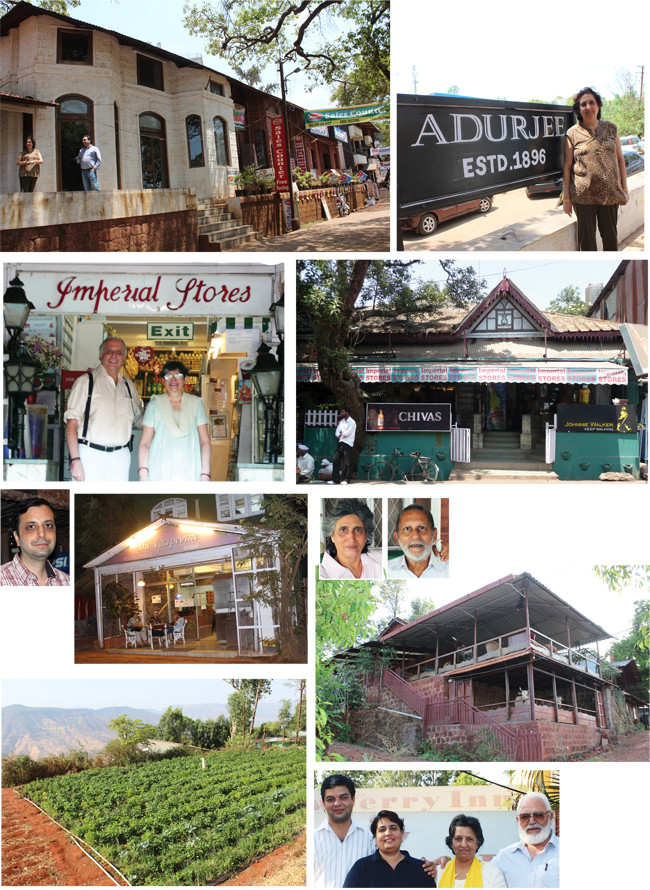
1st row: Adurjee and Zeubin Palia before signage;
2nd row: Zavare and Shekufay Irani and frontage of Imperial Stores (Photos: Mehroo Kotval) ;
3rd row:(left) Raiomand Irani, owner of The Grapevine (alongside); Left: Mona and Peter Patrao (below) The Redstone Eco Center run by the Patraos;
Last row: (From left): Rustom’s strawberry farm; owners Zavareh, Zenobia, Rupina and Minoo Sethna
"Our heritage is our heritage”
Shekufay meticulously does all the inventory management of the shop. "We must always have stocks of medicines as we are the only medical store in the vicinity.” They source supplies from nearby Satara, Karad and Poona. She narrates how the villagers from the valley have to "spend anything from Rs 80 to 100 to come.” For snake bite antidote, there is no other chance. Imperial also sells books, music, compact discs, provisions, frozen foods and runs a cafeteria, wine shop, petrol pump and an agency for gas cylinders as well.
Despite selling toys in the shop, Tuhid their younger son was instructed to pick one shield from the several regimental awards as reward for academic achievement that his mamava (maternal grandfather), Lt Gen Jehangir T. Sataravala, Member of the Order of the British Empire and Military Cross had earned in his career. "No toys and rubbish like that were given to him,” his mother states.
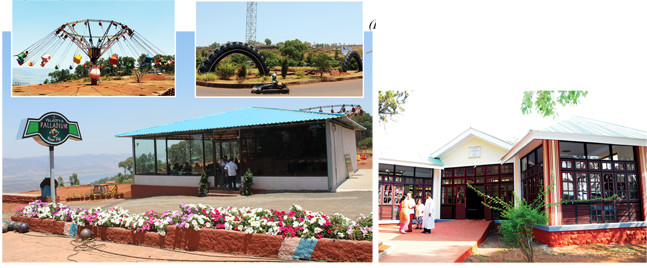
(L to R) 1st row: Merry-go-round and go-karting track at Velocity Entertainment; 2nd row: Non-vegetarian restaurant at Velocity and Bel Air Hospital in Panchgani
Zavare is aware how "this hill station brings you close to your family and God. I realize how green our religion is... Sometimes I feel it’s such a responsibility because we are looked up to with so much respect and work is done because I am a bawaji. Both the local and visitor population is reaching unmanageable proportions. A hill station was built for a select population” but now with bus loads of people coming there are too many.
Zavare and Shekufay’s older son Raiomand, 36, returned to Mahabaleshwar on completing his internship in hotel management in the Maldives. "I wanted to settle here. I wanted to come back.” Raiomand established The Grapevine in 1997, a restaurant with a single page menu which now runs to 10. Among his innovative dishes which are runaway successes are the Harvey foot-long (roll) and several desserts to suit the budget and palate of guests. The Harvey foot-long was dedicated to director Harvey Keith who was shooting for a film on Graham Staines, the missionary killed by religious fanatics in Orissa. Keith disliked what was dished out to him during his 45-day stay, so Grapevine created the foot-long for him with one full chicken as filling.
The restaurant has not looked back since it got mention in the Lonely Planet. Irani’s speciality is western and Parsi cuisine — Greek salad with feta cheese, lobster, pasta, dhansak and patra ni machhi. The cheapest item is French fries at Rs 45 whilst the most expensive is the lobster — Rs 1,250-1,950, as per weight. Interestingly, he makes all his cakes without eggs for health reasons and customers’ dietary preference. He has no problem sourcing anything as he gets ingredients from Bombay or Poona and in season has sold 50 kilos of cakes in one evening. Grapevine serves chocolate strawberries with cream, perfectly coated, as can be found in their telephone contact 02168 261100.
Strawberries are in season and you find them in every size, shape and dish at every eatery. They are served not only with cream but as in-house jam at Hotel Dina, Redstone Eco Center and Maidstone, in the form of shakes at Temptations, the restaurant at Velocity Entertainment, as a crush at Redstone, as juice in the market.
The Iranis "are leading a very, very happy life and I am blessed that I could continue in both my grandfathers’ tradition. Raio will take over and it will be on a bigger footing.” Zavare’s octogenarian mother Thrity feels she belongs to this region as she was reportedly responsible for the first school into Mahabaleshwar, the first x-ray machine for the local hospital and was president of Mahabaleshwar municipality for 20 years, her nephew Shiraz Satarawalla of Ripon Hotel informed us. Shekufay told us how the Devasthan Trust of Old Mahabaleshwar would not let her mother-in-law resign even after 50 years — a singular compliment to the only non-Hindu on the trust.
History repeated
At the other end of the Mahabaleshwar bazaar stands Adurjee’s, a departmental store established in 1896. Adurjee’s was owned by Adur Anklesaria, catering to the needs of the British. Grand niece Zeubin Palia, 58, states "we sold everything from a pin to an elephant.” She has memories of cupboards full of imported tea sets, cutlery, chocolates and toffees cramming the wooden and glass showcases.
Being childless, Adur left several properties including Adurjee’s, Adurjee and Victoria Hotels, a petrol pump and several bungalows in Mahabaleshwar as well as Poona to his brothers’ sons. Zeubin still uses the crockery of the Victoria Hotel with nostalgia — complete with tureens and flat dishes. Her grandmother used to be seated on a straight wooden chair, ramrod straight at 86, with the bearing of a grand lady. Tall at five feet, eight inches, Bachubai rode to the Parsi Gymkhana in a carriage drawn by four white horses.
All the nephews save Dhunjishaw Anklesaria sold out their share in Mahabaleshwar. Later, Dhunjishaw also sold the two hotels preferring to run a house agency managing 62 bungalows in the hill station (several of which were theirs to begin with). Palia recalls how her father Dhunjishaw’s cardiologist permitted him to go to Mahabaleshwar after three heart attacks as he pined to go to this hill station, at a height of 4,500 feet, which cardiac patients are not encouraged to visit. Dhunjishaw’s sons Adil and Firdosh chose not to have any presence in Mahabaleshwar, says Palia. It was thus left to Zeubin to run the family business. She promised her father she would run the establishment till it completed 100 years. She notched up 116 years. The property is now converted to a food mall with some branded eateries. Brought up in Poona, Zeubin continues her ties with the hill station, for she and her husband are owners of Sherwood Resort.
The bosses of Bhose
On the ribbon road between the hill stations of Mahabaleshwar and Panchgani, at a village called Bhose, two differing establishments face each other. Velocity Entertainment, as the name suggests, revolves round bigger-better-faster with its entertainment park. On the opposite side of the road is Redstone Eco Center which leads to an eco-friendly farm practicing sow-grow-reap. The gleeful screams of those in the entertainment park rent the quiet air at the farm as funsters have their thrills while go-karting, being flung on tall contraptions of bungee ejection or bungee trampoline, bumping cars, air hockey, volley ball and basket ball. Go-karting seems to be the most popular and the biggest revenue earner. For the smaller children there is a hanging merry go-round with hobby horses, aeroplanes, etc. Dorab Dubash is the managing director of this entertainment company with his wife Bakhtavar and three children as co-directors. Dubash is excited about his helicopter joy ride at Rs 3,500 per person which he will shortly launch.
Dubash proudly demonstrates the drop tower free fall which he has sourced from Italy. One of his 60 staff members gives a live demonstration, being hoisted into the air and ejected onto the platform beneath at high speed. The staff is 50 percent locals. Bakhtavar and their daughter Safna, who lives with them, assist in the park. The other two children, Taronish and Kamran, will return after their studies.
He has another dream of doubling his revenue in five years with a water park including a wave pool and a discothèque, a bar for men, a boutique for women and possibly also a residential club. He claims to be the first entrepreneur to keep Mahabaleshwar open during the rains. Having run Bakhtu Travels from 1993 to 1996, he paved the way for transport to this hill station during the rainy season and made it lucrative as the place did not have to shut down.
Bakhtavar narrates all the changes they have seen over the years. She counts the vegetables on one hand that used to be available — "vengna (brinjal), cauliflower ané cabbage!” A far cry from the multiple cuisine they serve in their restaurants today. Temptations is vegetarian as 70 percent of the clients are Jains, Marwaris and Gujaratis. Their newly opened non-vegetarian restaurant, Palladium, also has a Parsi menu featuring popular dishes like dhansak, sali boti, akuri and farcha. If a customer should demand tarapori patio, even that is dished up.
He bought the property in 1995, obtained licences in 1997, founded the park in 2003 and reclaimed land from a lake. In peak season, 3,000 persons visit Velocity, while at other times there are a minimum 300 persons per day, says Dubash. An automobile engineer by profession, his ancestors were in construction and ran Dubash Developers. Dorab’s grandfather is said to be the first Parsi settler in Panchgani, having walked up with John Chesson who earmarked the hill station as a retirement place for the British. "People look at us (Parsis) from a different angle... we don’t cheat people. Honesty is what they expect from us,” adds Bakhtavar.
The other side of the coin
Opposite, lies Redstone Eco Center, (so named because the soil is red laterite). Mona, 57, daughter of Jal Irani who pioneered the Boat Club in Mahabaleshwar and Peter Patrao, 71, bought this property by taking a loan 40 years ago in 1972 when no one wanted to live in village Bhose. The Patraos bought the hill and built their farm as per the existing terracing. For two years they drew water from a well and lived with no electricity. "It was the flower power age. We wanted a changed lifestyle, and we both evolved from this. We experimented a lot. Yoga gave me a direction and is in line with Zoroastrian tenets. I wanted a living guide. The principles of Ilm-e-khshnoom (mystical stream of Zoroastrianism) fitted this well.” She "rejects mainstream hypocrisy.” Both talk of non-violence, truthfulness, manashni, gavashni, kunashni. Mona also recounts stories of her orthodox Irani upbringing where nails and hair were seen as naso.
"Peter’s bike was the only bike and paddling on the boat in the lake where Velocity stands, made kids squeal with delight. The fertilizer used was cow manure and there was an absence of pesticides and chemicals… Villagers sell their land and then blow up the money on acquiring what they have hankered after and are left penniless soon. Society is left with housing colonies and the agricultural land is gone forever. The only beacon of hope is like-minded people getting together. We want to be catalysts for change...” She refers to a monkey just killed on the road by a speeding car, "the traffic, dogs dying on the road due to speeding cars.”
Peter and Mona maintain that "lifestyle impacts environment. There is a difference between environment and ecology — our workshops highlight this and interconnections are brought out. Children these days want to be part of this movement. There is hyper-consumption as there is no awareness... Money is the bottom line; it ruins the environment. Look at development in its entirety, not just in isolation.” From 1972 they have run these workshops to create environmental awareness. For greater information they may be contacted at redstoneorganicfarm@gmail.com. The past 40 years have seen their focus on education. As Peter, a well regarded school teacher by profession states, "We’d like to do a change in education and the way we learn.” Mona adds, "Life is education; not (just) beginning and finishing from kindergarten to standard 12. So many city kids think differently but go to the system, which is the problem...”
The two talk of zero waste management that they practice on the farm, of the United Nations’ bio-diversity initiative. They want to extend the zero waste management initiative to the hill stations of Mahabaleshwar and Panchgani involving the community in plant and animal identification; and knowledge system of medicinal plants, natural pesticides, colors, etc. "You realize what is being eroded” when you measure the bio-diversity register Mona says. "I want to make the education system aware of this.”
Panchgani seems to be the right place to experiment — teeming with educational institutes. Where there were only six or seven schools 20 years ago, the tally is close to 40 today. Of these the S. M. Batha High School and Billimoria High School were the only two run by Parsis. The Billimoria is now run by non-Parsis as is evident from a temple at its entrance.
The current Batha School was termed the Zoroastrian Young Women’s Educational Home founded by Shavaksha and Hirabai Batha. The childless couple established it on the grounds of their home and were called ‘mamma and pappa’ by the students. From accounts of students who had a personal connect with them, they were "the most generous of couples.” It started with reducing already low fees. In the 1940s, full board and tuition was Rs 65 per child per month. According to Dr Khushroo Patel of the Lutheran General Hospital and North West Communities in Chicago, who devotes his time to his alma mater in Panchgani, only 10 percent paid full board, 60-70 percent paid Rs 40 and the rest Rs 20 per month per child. When it began the School catered to 99 percent Parsi students. Today that stands at one or two among about 350 children, of whom about 100 are boarders. The school follows the Secondary School Certificate system up to the 10th standard under principal Kadam. Patel says he comes here to repay what he got: "I had two mothers, my birth mother and the one who taught me life and the basic tenets of morality.” Patel sees the future of the school as bright and is one of three trustees, with Homi Kanga — nephew of Hirabai — being the managing trustee. Patel says he will take the school "back to its glorious past.”
Love of the land
Rustom’s Strawberry Inn, within a stone’s throw of Redstone is built as per the natural contours of the land. They terraced their space to resemble a strawberry, which has been their core business from 1995. The Inn grows strawberries which are directly marketed to Bombay and organic vegetables which are consumed in the restaurant. Minocher, 74, and Rupina Sethna cater to 200 odd persons over lunch and dinner. Their son Zavareh, 38, cooks himself and his forte is Parsi and continental fare. Their signature dishes are sali and kharu gosh (Rs 210) and sali and khari marghi (Rs 150), patra ni machhi (Rs 270). Zavareh’s wife Zenobia teaches at St Peter’s School in Panchgani, a few kilometres away and is an admirer of her husband’s skills. They serve innovative vegetarian kheema and aleti-paleti made with vegetables, mushrooms and paneer.
Rustom’s uses organic and eco-friendly ways to grow Royal Sovereign, F1 (Foundation 1) and Red Gauntlet strawberries which Minocher proudly claims "are 25-30 grams each. The Royal Sovereigns are juicy and pulpy and not at all watery.” The Sethnas were the first in the region to install sprinklers. Minocher "innovated a floating pump by placing a frame on four barrels, like a cradle and fixed a pump. So it pulled when suction was low. There were no submersible pumps then,” he states confidently. Zavareh and he practise vermiculture and also manufacture bio-gas which they use in the kitchen. Water harvesting, and a filtration process with a reed bed and canna roots, remove detergents from the water. They use only fresh vegetables for all meals which are served from 8.30 a.m. to 10 p.m. You may correspond with Rustom’s at zmsethna@ rediffmail.com. Minocher bitterly recalls that they lost 70 acres of land to the Maharashtra and Agricultural Lands Act of 1948 that allotted land to the tillers. The Sethnas are conservative and believe in racial preservation of the Parsi community.
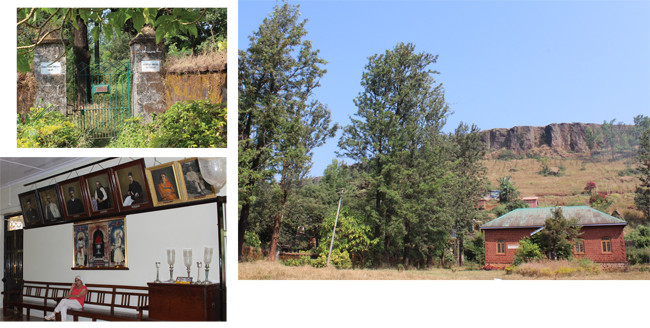
Clockwise from top left: The gate leading to the aramgah; bungli and the interior of the Nanabhai Choksi Daremeher in Panchgani
Advantage, Panchgani
The salubrious climate of Panchgani saw the birth of Bel Air Sanatorium, a fully fledged hospital today which also has a College of Nursing (see "Nurturing nursing,” Parsiana, June 21, 2011). What was started by Dr Rustomji Billimoria as a 12-bed sanatorium in 1912 over 44 acres, today sees knee replacement and other complex surgeries. Billimoria’s son Bomi, also a doctor, took over but died tragically. The Red Cross then stepped in and tried to run Bel Air. By the 1980s with union and labor problems, only 45 workers remained. Locals Dr Tuhid Irani, 30, and his doctor wife Firoza, are the mainstay here today. Tuhid, consulting orthopedic surgeon since 2008, has won eight gold medals in his MBBS examinations. Firoza is consulting obstetrician and gynecologist. Erach Ghadiali, the oldest employee, joining in 1947, lives on the premises. He recouped from tuberculosis. Sir Dorab Tata Trust is the main donor and it is on Tata land that this hospital lies. The hospital today caters to current needs and is the main hospital for HIV and AIDS patients in this area. Dr Mehroo Patel of Chicago, who had worked with Rustomji, and her husband Prof Minu support the hospital with networking and generous donations and rewards from the USA.
Tatas again donated Rs 20 lakhs when Fr Tomy took up the challenge of resurrecting the sanatorium as a hospital. One crore seventy five lakh rupees generously came from Mehraban Zartoshty for modernization, an ayurvedic and nature cure centers. This money helped transform Bel Air into a general hospital.
Renewing the faith
The Nanabhai Choksi Daremeher of Panchgani has been renovated and refurbished in its 80th year. Ervad Rustomji Pavri, its longest serving priest for 40 years, elicited interest in devotees with his lively and philosophical discussions and social ways. The renovation was done by Zoroastrian men aged from 30 to 70 who rallied round well-wisher Bomi Mistry’s call to serve. Some of them took leave to work on the Daremeher, others supported themselves having done over-time at their work place. The Daremeher is the only one serving this region the nearest ones being in Belgaum or Poona. Several navjotes have been performed here. Shireen Vakil, a do-gooder resident took it upon herself to run dharam classes over students’ exeat weekends, which were the long weekends that boarders were entitled to; she taught Zoroastrian students of St Peter’s and Kimmins High Schools their prayers. Those days were always rounded off with Parsi bhonu which no boarder would ever voluntarily miss.
The aramgah built in 1890, stands on land donated by the Bhedwar family. Anyone can come and mourn their loved ones here. As Jal of Dina Hotel, Mahabaleshwar says about Zoroastrianism, "If you have something good, why not share it? Look at everybody equally. If we don’t inculcate interest, it’s our fault, not theirs.”
◆ ◆ ◆
From the archive