
Education
Educating educators
The Institute of Integrated Education is developing its property in Kharghar to offer training, research and documentation facilities
"Education is education... All children should be special — what is this special children demarcation? Systems should be created to fit children and not children made to fit into created systems,” states Roda Billimoria passionately. Over the last 13 years since she introduced Research in Integrated Training and Education at the center now named the Institute of Integrated Education (IIE) in Bombay, she has learnt that 25,000,000 children in India are said to have special needs. Services are available for a paltry one percent! Fifty-five lakh teachers in India teach in 10 lakh schools where knowledge of special needs is simply not known. "How do you pay attention to 60 children (in a class) with a huge syllabus?” Billimoria questions.
To fill this lacuna, IIE had been offering a two-year diploma course to students who have passed their 12th standard. But functioning from residential premises which was proving too cramped for regular classes, plus a library and administrative office they have had to restrict the number of students to 10 per batch. This scenario will soon change as they have commenced construction on their property in Kharghar, New Bombay. The Institute, promoted by the Sir Shapurji Billimoria Foundation (SSBF), commemorating Billimoria’s paternal grandfather and role model, is envisioned to have four divisions. Besides the Teacher Education Centre (TEC) which conducts the two-year diploma course there will also be the Resource and Study Centre, Research and Documentation Centre and a demonstration school.
TEC principal Usha Bhatia has researched, designed, supported and streamlined the course to suit Indian needs. Bhatia’s expertise also shaped education for Bohri women for nine years at the Saifee School in Bombay. This gave her an even broader perspective on life than she had acquired from the renowned educator Madhuriben Shah, her mentor and former Vice Chancellor of Shreemati Nathibai Damodar Thackersey (SNDT) Women’s University. In fact it is the SNDT University which saw merit in running this diploma course. The Bombay University was approached twice to recognize the course but declined, reports Billimoria.
Included in the course is a paper on "Human Life Span Development” that familiarizes students with human evolution. "Diversities in Development” extends to collaboration with family, community and health care. The paper on "Theoretical Perspectives in education” is "heavy,” according to Bhatia, covering education philosophy, trends in education, educators in India and abroad. Multiple teaching methodologies showcase the diversity in children which both Billimoria and Bhatia are so spirited about. The course also imparts lessons in school management complete with budgeting, planning and exposing students to special skills such as Braille, sign language, mobility techniques, et al.
After its inception in 1999, the course was offered gratis to a variety of schools — municipal, aided, non-aided, special, non-governmental organizations, colleges of education and volunteers. Keen to induct as many persons in the field of education as possible they offered vacation and weekend courses. They collated these lectures and transcribed them to start an experiential library. This also became the base of the Teachers’ Training Program for a two-year Diploma in Education (DEd). Parents and care givers of visually impaired, physically challenged were all involved in providing inputs to formulate the program.
Bhatia adds that 12th standard students come so raw that it is an uphill task to mold them in accordance with their demanding syllabus at TEC. Students from eight batches who have completed the program join mobile crèches, remedial teaching, special and general education schools offering SSC, ICSE, CBSE, etc. The ladies give their support staff — Usha Iyengar, Jignesh Raithatha, Minal Gurao, Vijay Arsud and Dhara Dedhia — an excellent report card for multitasking and going about their duties diligently.
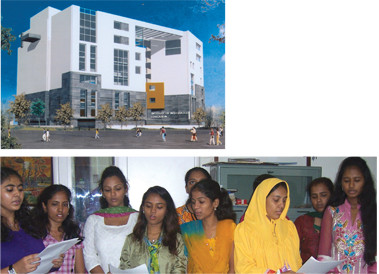
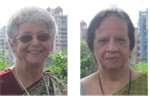
Top: Roda Billimoria (left) and Usha Bhatia (right); (above) model of proposed Institute and (right) trainee teachers making a presentation
Integrated education (IE) is a Swedish concept of the ’60s based on the Principle of Normalization, which influenced United Nations policies on the rights of a child, states Billimoria. It is designed to equip students and teachers with knowledge, skills and attitudes to facilitate a total learning experience. IE believes "a child is first and foremost a child and ability, disability, giftedness is secondary.” It is when "teachers don’t know how to teach” that children are labeled as "too smart or too stupid,” claims Billimoria.
Viewing a school as "a miniature society,” Billimoria argues that if society can cope with the brilliant, dull, average, gifted and even behaviorally nonstandard children, why not education? "My concern is about the entire fracturing of our (education) system,” she reiterates. "Should we only be geared to 100 percent results (also termed success syndrome)?” she questions, wondering what would then be the fate of those with learning and ambulatory problems, retardation, visual and hearing impairment.
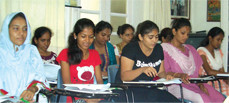
Students attending workshop on autism at the Teacher Education Centre
Billimoria thanks Ahura Mazda that she has the complete support of her entire family. Ratnakar Desai, her husband of a little over a year, is gung ho about this dream as well. Her mother, Silloo, supported her cause by creating the SSBF with an initial corpus of Rs 1,00,000.
For the Zoroastrian with deep faith but few ritualistic practices, a divo is often Billimoria’s companion in the bedroom as are silent prayers. "God doesn’t frighten me… I believe He is gentle, benign, kind and benevolent. I fear Him in only one sense for He knows what you are or what you are not.”
The educator is affronted with the current perception that the Parsi community is resting on its past laurels. "We seem to laud our past, and belittle our achievements today,” believes Billimoria describing the community "as charitable and entrepreneurial.” She cites the example of Sir Shapurji himself — a man of charitable disposition, a trustee of the Bombay Parsi Punchayet for more than 25 years, a Rotarian, a founder of the chartered accountancy firm S. B. Billimoria and Company that is still in existence.
Billimoria and Bhatia, both around 60, are raring to move to their own premises in Kharghar. They pride themselves that every license has been obtained without graft — whether for acquiring land, constructing the building or course approval. Among several others, Sir Dorab Tata Trust has been their prime supporter but they would welcome contributions by cheque to Sir Shapurji Billimoria Foundation at 2/24 Nanik Niwas, Warden Road, Bombay 400036. They have already walked the first mile of a long "course” and would like others to join their march.
◆ ◆ ◆
From the archive