
Law
Police performance
Maja Daruwala and Julio Ribeiro stress the necessity to reform policing
"Eighty percent of the complaints made (regarding government officials) are against the police,” said Maja Daruwala, executive director of the Commonwealth Human Rights Initiative based in New Delhi. "Sixty percent of arrests are unnecessary,” she added addressing a gathering at K. C. College’s Rama Watumull Auditorium on January 30, 2009 on the subject of "Modern Policing for a modern India.”
We should "fetter the discretion of the police when making arrests,” states the civil rights activist. The police are used by politicians to serve their ends. Due to interference from politicians, poor service conditions, lack of skills, the police are "unable to be effective in the streets (tackling) crime,” Daruwala notes.
Politicians utilize the police to hound those who oppose them. They "use the criminal justice system as a bargaining tool,” she says. Critics can be silenced by threatening them with death in fake police encounters.
Police are reluctant "to punish their own” when at fault, she observed. While overseeing the police was necessary "somebody (also) has to look after the police.” Soft skills, such as how to investigate crimes, need to be strengthened. Budgets are sanctioned for hardware but not for training, etc.
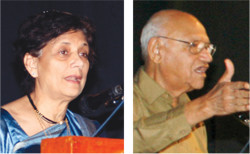
Maja Daruwala and Julio Ribeiro: Police have to uphold the law
The police must "act according to the law… provide a service not only force.” A policeman/woman is "a citizen in uniform.” In colonial times their duty was to subjugate or keep in check the populace. "Today their role is to protect our lives, property and liberty.” Instead, while "reading a report on torture in India in 1903… I thought it was today,” she observed.
"Do we have a cure” for the problem? she asked. "What kind of police do we need?” Besides "law enforcement, they also had to uphold the law.” New structures had to override the colonial ones. "The Commonwealth has some of the best and some of the worst policing,” she noted.
In the aftermath of the emergency imposed by the late Prime Minister Indira Gandhi from 1975 to 1977, "good recommendations” were put forward to reform police functioning. Unfortunately "nothing was done” to implement the reforms.
In 2006 the Supreme Court laid down directions to be followed by the states which included increased accountability, curbing illegitimate interference by politicians, bureaucrats, the mafia… a fixed tenure for the director general of police, merit rather than patronage in determining promotions and transfers, formation of state security commissions consisting of independent parties, experts, ruling and opposition party candidates in order to make it a non-partisan body.
The commission should lay down policy and serve as a "buffer body” between the police and those who seek to influence them for personal gain. "From 2006 to now nothing has happened,” rued Daruwala. "Bihar is even behind the 1861” Police Act regulations.
"People must protest. Make (it) a premier election issue. There is huge resistance.” Compliance is absent. In Maharashtra a security commission was set up comprising 61 members. It had held only one meeting,” she remarked.
Former Bombay police commissioner, director general of police in Punjab during its most turbulent years and executive chairman of the Public Concern for Governance Trust (PCGT), Julio Ribeiro said any movement for change "requires the support of citizens. Twenty-sixth November (the day the terrorists attacked Bombay) was a watershed.” The police were ill-equipped to fight the trained Pakistani gunmen but even "if good weapons” were to be supplied "I don’t know who they would have shot!” The police "require training” to shoot straight. Most of them "have not fired (a gun) for years,” Ribeiro noted.
One needed "good leaders. Without leaders the men are not going to work,” he said. Ribeiro inquired why capable people "were not chosen? We do not want corrupt leaders. If corrupt people are at the top, there will be havoc below. The government has power to eliminate such people. They must ensure the best (persons) come up. Give (them) operational independence.”
Regarding granting independence to the police force Ribeiro noted, "no police force in the world is independent. They have to be accountable.”
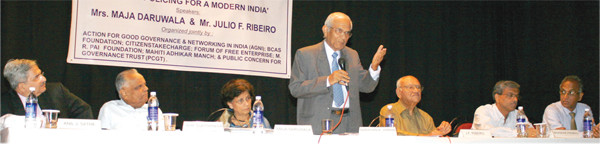
From left: Anil Sathe, D. M. Sukthankar, Maja Daruwala, Narayan Varma, Julio Ribeiro, Bhaskar Prabhu and S. Diwakara
He referred to the "partnership between corrupt politicians, the police and bureaucrats.” He called on politicians not to "interfere in postings and transfers.” Police personnel build up "a pipeline to some politician. Do what he likes” in return for favors. Policemen "dismissed for absolute thuggery are reinstated.” Politicians are only interested in transfers. That’s where they get their clout and money.” It’s been made "into a business… value systems have changed,” he observed.
"How does (the Maharashtra Navnirman Sena fascist leader) Raj Thackeray get away” with breaking the law? he asked. The answer lay in the number of seats he could help the Congress-Nationalist Congress Party ruling conclave to win by dividing the opposition Shiv Sena-Bharatiya Janata Party combine votes.
The public has "a right to have service. They (the government) have to enforce the law. If they don’t we will go to court,” should be the citizens’ recourse, advised Ribeiro. "The supervision (of the police) is under government. Things are going out of hand… The professionals have to be given a chance to function professionally.”
Narayan K. Varma, a trustee of the M. R. Pai Foundation and the PCGT called for citizens "to be involved.” Anil J. Sathe, a trustee of the BCAS (Bombay Chartered Accountants’ Society) Foundation while offering a vote of thanks, bemoaned the less than expected turnout of the public.
The talk was organized by Action for Good Governance and Networking in India (AGNI) (agni@agnimumbai.org), BCAS Foundation (bca@bcas online.org), Citizens Take Charge (citizenstakecharge@gmail.com), Forum of Free Enterprise (ffe@vsnl.net), M. R. Pai Foundation (ffe@vsnl.net), Mahiti Adhikar Manch (mahitiadhikar manch@gmail.com) and the PCGT (publicconcern@gmail.com).
◆ ◆ ◆
From the archive