
Law
“Speak up, be involved”
Active, informed citizens can make the government deliver on its promises, says Maja Daruwala
"When I selected the topic of accountability for this lecture, I didn’t know I’d be speaking in a season of scams!” noted Maja Daruwala, honorary director of the Delhi based NGO (nongovernmental organization) Commonwealth Human Rights Initiative (CHRI), adding, "These scams are only the tip of the iceberg. We haven’t seen everything yet. Things will probably get worse before they get better!”
Addressing the audience gathered at the Walchand Hirachand Hall of Bombay’s Indian Merchants’ Chamber on December 13, 2010 to listen to the 22nd Bhogilal Leherchand Memorial Lecture, she referred to the ills of corruption, misgovernance and unfettered discretion that had led the country to a stage where "as a people we feel a bit ashamed and shrunken,” and very far away from the ideals of the founding fathers.
Rising from strained circumstances, Leherchand had emerged as a leading diamond merchant of Bombay who believed in high moral values and ethics in business, preferring a life of simple living and high thinking like Mahatma Gandhi and others of his ilk. The public lectures had been instituted under the Forum of Free Enterprise (FFE) by his son Pratap Bhogilal, as noted FFE president Minoo Shroff in his welcome address.
Defining accountability as "all about knowing your rights and entitlements and being able to realize them and holding people who owe you, to account,” Daruwala noted, "It is inextricably linked to morality and ethics, responsibility, answerability, liability and standards of performance” though it has not been specified in the Indian constitution.
Giving an example of how common people can be defrauded, Daruwala spoke of a rural Rajasthani woman — poor, illiterate — who with her husband worked to dig wells, build roads, etc. She kept a record of the number of days she worked with two marks on her wall, one for herself and one for her husband. Each time she went to collect the money owing to them, she found herself deprived. This went on for months; there were single marks on the wall after her husband died, but she persisted in her demands. A couple of NGOs tried to help her but nothing happened. Then, all those who were similarly deprived, grouped together to demand a meeting with the village pradhan and asked to see the muster rolls. With the evidence corroborated by each other and the muster rolls, they managed to get the sarpanch punished and got their full wages. "This is accountability on the ground by collective action,” noted Daruwala, adding, there are millions like them in rural India who, though powerless, succeed by banding together to get their dues.
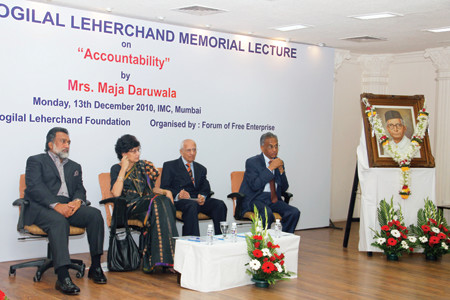
From left: Leherchand’s grandson Nirmal Bhogilal, Maja Daruwala (also inset), Minoo Shroff and S. Divakara
But it is the accountability of the government and the political and administrative machinery which is "seminal to democracy… It is woven into its DNA… If this is lacking, the universality of the value is lacking. In India, the police, the politicians and bureaucrats are getting away.” Accountability is a means of curbing unbridled power and unfettered discretion; it is part of the distribution of power in India. "How can powerful entities be made accountable? My talk is really about the struggle for accountability.”
The main mechanisms for the job as recognized by the constitution are the Parliament and the State Assemblies as they are expected to apply their mind to the bills which, once passed, become law. They are also expected to examine the workings of the ministries before sanctioning their budgets. "But every year Parliament is diminishing. More than 20 percent of its members are those with criminal records, some with heinous crimes such as rape and murder. It is using only 60 percent of its time” with sessions getting shorter and bills not scrutinized. For example, TADA [Terrorist and Disruptive Activities (Prevention) Act] was passed without proper consideration, she noted. "Question hour, central to Parliament, collapsed when those who had put the questions did not turn up.”
Noting that Parliament costs Rs 24,000 to 25,000 thousand a minute, was the demand for a Joint Parliamentary Committee important enough to stop an entire session? she asked. Moreover, everything of importance gets relegated to committees whose discussions are not open to the public. "The fear is that if they are open, people will play to the gallery… But even the rural people know very well when wool is pulled over their eyes.”
Apart from the laws, punishments, processes and standards on the statute books which are barely enforced, Daruwala referred to the CVC (Central Vigilance Commission) and the CBI (Central Bureau of Investigation), two prominent agencies who are supposed to act on their own but under the supervision of the Central Government. "Their stories are instructive.” The CBI was set up to look into corruption. Daruwala stated that the CHRI has analyzed the history of their debilitation. Each time the government of the day has made it change its stance, viz the fodder scam, the Mayawati Case, Mulayam Case, etc, earning it repeated chiding from the courts. How politicized is the agency is borne out by a report in the national Press which quoted one of its bosses saying that the CBI wanted to act against the 2G spectrum scam but since the government did not want it, they went slow so as not to embarrass the government. "The agency has lost its credibility.”
The CVC was first envisaged in1964 as a wholly independent body with diverse people of impeccable credentials. "The attorney general said there are no such people. I challenge him. There are millions,” said Daruwala, adding for good measure, "I don’t see myself in any other category than impeccable.” However, it was the Jain Hawala Case involving terrorism, money laundering and the security of India that finally led to the promulgation of the CVC Act in 2005. But provisions for the prior permission of the government to investigate the doings of senior officers/politicians, plus their protection from prosecution, abused the mindset of people of good conscience who have challenged this "wholly discriminatory” law which defeats the purpose by delays, she noted.
There are all sorts of commissions at the Central and State levels — such as the National Human Rights Commission (NHRC), the Lok Ayukta who needs help from civil society — but they all have to battle for space and money and have to rely on the same police force which may be the subject of the complaints, to investigate them! Created by small groups (NHRC was demanded by the international community), mangled at birth, lacking the resources, independence and power to punish, Daruwala quoted a hearsay figure of 60,000 pending complaints. "The weight of the need for these institutions destroys them,” she said. Another reason why complaints are not pursued to the bitter end is the tendency of these commissions (e.g. the NHRC) to provide interim compensation which becomes like blood money for powerless people who are unable to take the case to its logical conclusion. The perpetrators then get away unpunished. In other countries such commissions are set up with vast finances and independent rights. "Putting someone behind bars has a chilling effect!”
Most states have not instituted the police reforms ordered by the Supreme Court (SC) in the course of the Pratab Singh Case in 2003. The Court gave a series of orders. It wanted the establishment of a Police Complaints Authority at the local level whose members would be independent people who would look at the complaints and wrongdoing in their area because the investigation by the police of themselves is not satisfactory. The chief secretaries of West Bengal and Maharashtra who had not set it up were summoned by the SC on December 6, 2010 to explain why it has not been done.
The major problem of the police is that they are neither being punished for wrongdoing nor for inadequate policing. "The police is too close to political power. We need a buffer body, a bipartisan body comprising the chief minister, the leader of the opposition, a retired judge, and members of the public with expertise to talk to the police, the public and the government and come up with a policing plan and a policing policy. Choose the police chief differently. Give him manpower, money and security of tenure but hold him accountable.
"Having State Security Commissions has been resisted by every single state.” Maharashtra is due to make such an appointment but well respected former police chief Julio Ribeiro is not satisfied with the credentials of the people being appointed nor their terms of reference. It would be like giving money to non performing people, Daruwala noted.
A natural optimist, Daruwala felt there was hope because there is natural tension in a democracy between business and politics, between different ideologies, between the haves and the have nots. These tensions lead to more and more revelations, to debate and discussion. "The active, informed citizen is a very important ingredient of accountability. But sometimes people don’t want to be active. The media is not always wise but it is strong — and sensation hungry. You can make your point. The RTI (Right To Information) has been a game changer in this country. By looking at file notings you can x-ray the workings of government. The CAG (Comptroller and Auditor General website) is another huge but undervalued source of information.”
The Judicial Standards and Accountability Bill addresses the delicate balance between the higher judiciary’s independence and accountability. A lot of other administrative reforms have been promised but are slow in coming. The electoral commission wants electoral reforms. "Join in, speak up, be involved,” Daruwala urged the gathering.
Another source of her optimism lay in the "game changer” reelection of the government in Bihar. Having provided an 11 percent growth rate, one percent better law and order, one percent better delivery of services, one percent more roads, "it had won the election in the teeth of casteism.”
Lastly, the old lady in Rajasthan wasn’t recovering crores of money. She didn’t have the media backing her but had help from friends, and she consistently asked for "my money, my account.” Bhogilal Leherchand would have approved, concluded Daruwala.
◆ ◆ ◆
From the archive