
Cover Story
Antiquity of an atash
The oldest fire temple in Bombay, the Banaji Limji Agiary enters its 301st year with a calm celebration
It embodies both tradition and transition. The Banaji Limji Agiary at Fort in Bombay was consecrated on June 25, 1709 (roz Adar, mah Adar, AY 1078) when Bombay was little more than a series of small settlements spread over its seven swampy islands. The fury of the great fire of 1803 almost destroyed it, as it did much of Fort area. The structure was rebuilt and the fire reenthroned in 1845. In the early years, the sea had been almost at its doorstep; the shifting sands of time have carried it a good distance away.
The Banaji Limji Agiary is the community’s oldest place of worship in Bombay today, though not the oldest in India. Its fortress-like external wall keeps out the clutter and congestion of Flora Fountain’s mean streets. The Agiary itself is small, the ethos quiet. Sepia memories of the founder’s descendants and consolidators abound on the walls, in frames oval and rectangular. The white clear glass of the candelabras and the hanging divas reflect the brightness of the flames. On April 24, 2009 (roz Adar, mah Adar), the trustees celebrated its tercentenary (300 years) with a jashan and simple felicitation function. As the mobeds chanted the benedictions, devotees young and old streamed in to pay homage, despite it being a working day.
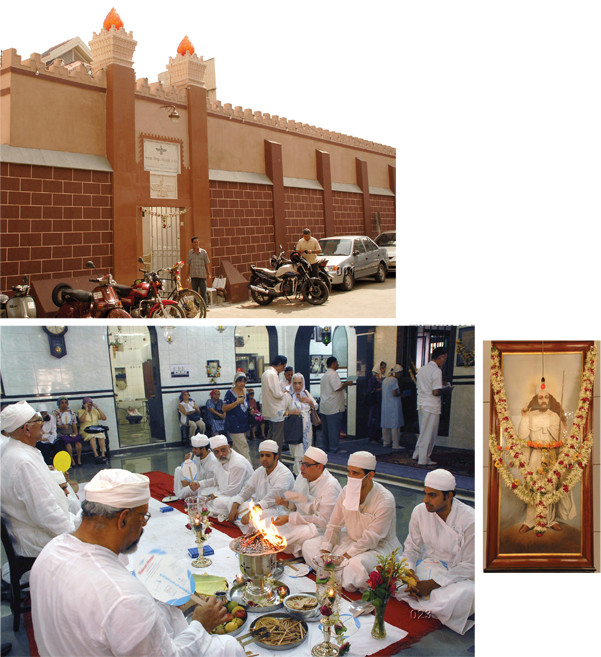
Fort’s Banaji Limji Agiary: exterior wall (top), 300th anniversary jashan in progress
"The fire has been reenthroned after completion of the repairs and renovation,” said Adi Banajee, trustee of the Seth Banaji Limji Agiary Trust who has been associated with the fire temple since 1987. Banajee expressed his thanks to the donors, big and small, to his fellow trustees and to all the priests including Ervad Godrej Panthaki, who had served the agiary for 48 years (25 of them as panthaky), and his son Ervad Hoshedar who is the present panthaky. "My knowledge of prayers is very little compared to other people,” stated seniormost trustee Dady Banaji whose association with the fire temple spans well over 30 years. "I only know that manashni, gavashni and kunashni are of great importance. I want to pass on the mantle of chief trustee to Adi whose knowledge of prayers is much greater than mine,” said Dady Banaji for whom health has been a cause of concern for some years. On the board is Dady’s son Jamshed who is an architect like his father. Dastur Meherji Meherjirana of Navsari is also a trustee of the Agiary.
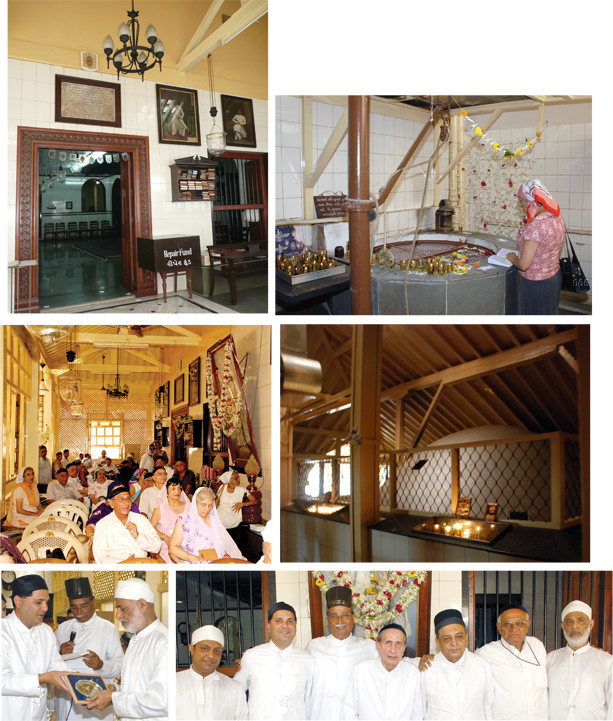
Clockwise from top left: entrance to hall (Photo: Jasmine Driver); worship at the well; divas at gumbaz; trustees, priests and staff (from left) Ervad Hoshedar Panthaki, Jamshed Banaji, Adi Banajee, Dady Banaji, Hoshang Wania, Bejan Gandhi, Ervad Godrej Panthaki; Jamshed Banaji honors Godrej Panthaki, as Adi Banajee conducts proceedings at the felicitation function
"In earlier years this had been a Parsi mohalla (precinct/neighborhood) with Parsi vaataavaran (ambience),” remarked trustee Hoshang Wania. The founder Banaji Limji, a prosperous trader, was an akabar (leader) of the community and punchayet affairs were handled from the agiary premises; the first batch of trustees used to meet here, Wania stated. Emphasizing that prayers are done in the agiary with sachaii (sincerity), he said chaaltaa aavéla reet rivaj (old customs and traditions) would be preserved. An old picture showing a priest seated on a wooden chair praying to Avan Ardavisur (the sea visible in the background) was unfortunately not available with the Agiary any longer, he observed. Old kadas (metal rings) driven into the ground along the verandah where the goats would be tethered were removed recently to provide behdins more place to sit, as shortage of space was one of the agiary’s major constraints, he said.
The trustees presented mementos (received in person or in absentia) to several large donors, to the priests and to many others who have given voluntary service — architect Porus Master of Porus Master and Associates, advocates Ronnie Mirza and Pervez Rustomkhan, auditors S. B. Bharucha and Company, Dinshaw Electric Works, Bejan Gandhi, accountant, Farokh Dumasia (miscellaneous work) … Among the priests who were felicitated were Godrej and Hoshedar Panthaki, Maneck Ji-jina (of 61 years’ standing), Ho-shang Bhada (49 years) and the late Kobad Gowadia (37 years). Pervez Driver (non-praying staff) who joined the agiary as a schoolboy was also felicitated for his long service of 37 years.
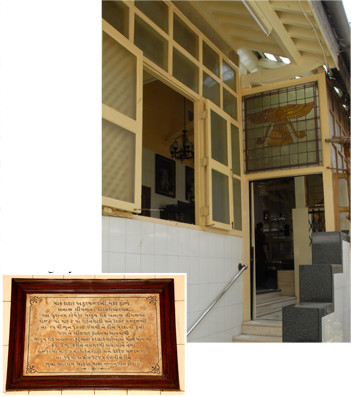
Stained glass over entrance steps; (inset) historical narration on plaque
Acknowledging the honor bestowed on them, Godrej Panthaki recalled that he had thought long and hard before he accepted the position of panthaky a quarter century ago. "Jokhambhariyu kaam chhè (it is very responsible work),” he asserted. With fewer mobeds available for prayers, "pochivarva mushkil chhè (it is difficult to cope).” One can’t tell what the situation will be 25 years hence, but there is no need to be pessimistic, he added.
Hoshedar Panthaki promised to revive and continue the pav mahal (higher liturgical) ceremonies. The location and the space available for the nirangdin ceremony has not been suitable but "this is not an obstacle. We have taken it in our stride,” Hoshedar asserted. Added to that was the problem of smoke "but that has been solved with the installation of three chimneys in the hall,” he said. The shortage of mobeds can be minimized with the cooperation of the behdins, he believed. The panthaky thanked the trustees, especially Adi Banajee, for their "unparalleled cooperation.”
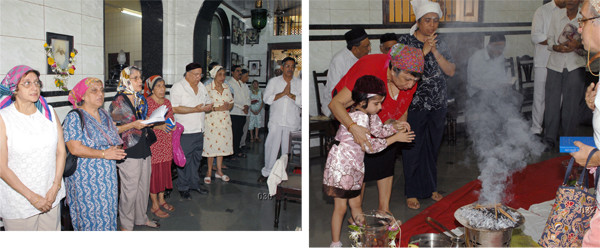
Faith and the followers
"In my tenure of 22 years, besides looking after the administration of the trust on a day-to-day basis, the Banaji Limji Agiary has been repaired and given a face-lift twice — in 2000 (see "The benefaction of the Banajis,” Parsiana, August 2000) and 2009. Both times by the grace of our Padshah Sahib we have not faced much difficulty in raising funds. An appeal via e-mail, handouts and letters to patrons, friends, trusts and the community at large has been enough. Our sincere thanks to all the donors, big and small, and to Master who has on both phases of repair/renovation contributed his expertise and valuable time,” says Banajee.
As ventilation in the main hall and in the gumbaz area was not sufficient for the smoke to escape especially during the muktad, the trustees have on the advice of specialists erected three air ducts from the false ceiling of the prayer hall to the main roof and installed three 900 r.p.m. exhaust fans, he describes. The gumbaz area, which is frequently visited by patrons to light divas, now has a centrifugal exhaust fan. The trustees appeal to the laity not to climb up to the gumbaz carrying two-three divas in hand because of the risks involved. (In a recent unfortunate incident, the robes of one of the priests had caught fire. He recovered from the burns but died later from a lung infection. The trustees state they have borne the hospital bills). Repairing the kathi room so that the fire could be temporarily shifted, a face-lift to the total tiled area, polishing of the flooring, attending to the boundary wall, etc which were some of the tasks not completed earlier, were attended to this time.
Interestingly, though it is not commonly known, the Banaji Agiary is not the first fire temple to be set up in Bombay. The Modi Hirji Vachha dar-e-meher predated it by 37 years, having been established in 1672. It was burnt down in the great fire of 1803, reports Marzban Giara in his book Global Directory of Zoroastrian Fire Temples, making the Banaji Agiary the oldest surviving fire temple in the city. Banaji Limji himself came to Bombay around 1690 from Surat, where the East India Company had a trading center but had not yet established its rule in India (which happened after the Battle of Plassey in 1757). In the year of the Agiary’s establishment (1709) it was still the age of "le Roi Soleil” (Louis XIV of France who called himself the Sun King), Sir Isaac Newton and Johann Sebastian Bach in Europe, in India the Emperor Aurangzeb had been dead just two years and the walls of the fort in Bombay had not yet been fully built!
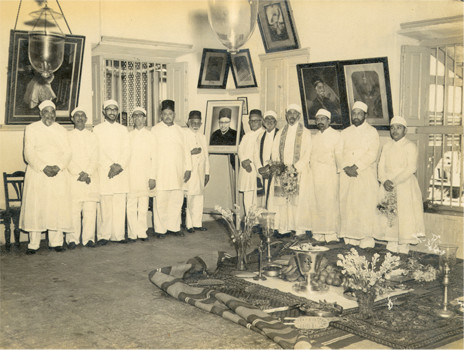
At the 250th anniversary in 1959: Dasturs Meherji Meherjirana (ext right), Nadirsha Sena and Kaikhushroo Kutar (4th and 5th from right) with other trustees and priests
Banaji Limji started a firm in Bombay in his own name, carrying on trade with the Malabar coast, Madras and even with Pegu in Burma which he visited personally, write Giara and Dr Viraf Dhalla in their booklet A Brief History of Banaji Limji Agiary published by the trustees in the year 2000. "He owned a number of ships and became very rich within a short period of time …and while the Parsi Punchayet in Bombay was still in its formative stage, he rose to the status of Davar (dispenser of justice) … he was also a treasurer (of the) funds of the Parsi anjuman.”
After consecrating the Agiary, Banaji Limji also acquired the neighboring property through a public auction, paying 380 Zirfin coins amounting to Rs 328-8-8, report Giara and Dhalla. Banaji died in 1734 at the age of 80, having celebrated the Agiary’s silver jubilee. Above the entrance to the main hall is a tablet in Gujarati which says that the gentlemen of the Banaji family later raised a fund among themselves and had it newly built and the old adaran saheb reenthroned on roz 20, mah seven, AY 1214 (April 15, 1845). The poorer sections of the community reportedly poured into the foundation innumerable eggs and mugs of toddy to strengthen it! Banaji’s descendants established the Cowasji Behramji Banaji (Kadmi) Atash Behram at Charni Road as well as numerous charitable ventures in other parts of India, such as Calcutta where the family became well-known. The Banajis are also linked by ties of blood or marriage, say Giara and Dhalla, to the Readymoney, Dadysett and Wadia families, also renowned for their charities. As the Banaji Limji Agiary enters its 301st year, portraits of the past remain strong and are reminders of resilience.
◆ ◆ ◆
From the archive