
Trusts
Baria’s benevolence
Having lived through hard times, community activist Dhan Baria redeemed her promise to her mother to assist the poor by setting up a charitable trust
The redoubtable Dhan Baria who sent a frisson through the ranks of the community with her crusade a few years ago against the less than satisfactory functioning of dakhmenashini at Doongerwadi, has bent her considerable energies to alleviating the lot of the underprivileged. Her work involves helping commercial sex workers, an activity which, she told Parsiana over the phone, "I wonder how Parsis will react to.”
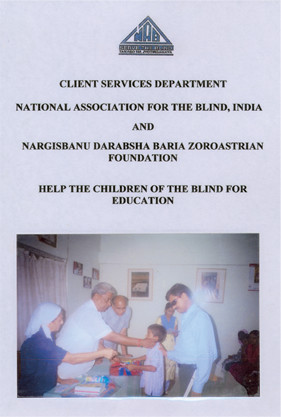
This she has done outside the glare of publicity through the Nargisbanu Darabsha Baria Zoroastrian Foundation (NDBZF) for underprivileged children, the blind and handicapped which she founded in 2005-06 in memory of her mother. The trust was registered under the Bombay Public Trusts Act 1950 in 2007. In addition to herself, the NDBZF trustees are solicitor and community commentator Berjis Desai, accountant Kerssie Wadia, solicitor Nosh Modi and chartered accountant Shiva Iyer.
Working initially out of her home, the NDBZF is now housed on the second floor of the Chandanwadi Municipal Primary School Building, Chandanwadi Lane, next to the H. B. Wadia Atas Bahram, Princess Street, Bombay 400002, where Baria is to be found on most days. The trust receives generous donations from other trusts, solicitors’ offices and individual donations. Coin boxes have also been placed in shops to collect funds. The trust enjoys exemption under Section 80G of the Income Tax Act, Baria mentions. She can be contacted on the telephone at 23009359 (residence), 22084995 (trust office) or on her mobile, 9987844471.
Baria says her trust liaises with the National Association for the Blind (NAB), helping to provide hostel fees for blind students who come to Bombay for training from other cities. Deserving students are given school books, school bags and water bottles. Canteen fees for the year are covered for some of the poorest ones. Though the NAB provides free braille cassettes, NDBZF gives them cassette players so that they can study. At the Alpaiwalla Work Centre at Reay Road where blind women are taught to sew, the NDBZF gives them sewing machines to help them become financially independent. However, she is most involved with the lot of poor, vulnerable commercial sex workers and their innocent children in the red light areas, where she works along with an NGO, Social Integrated Activities (SIA). She shares a symbiotic relationship with SIA, using its expertise and manpower along with NDBZF funds to mitigate the lot of the unfortunate.
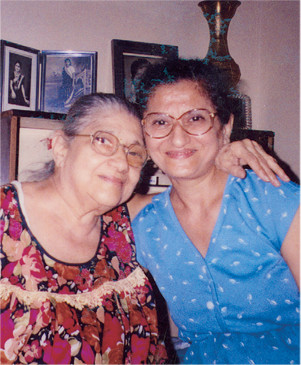
Top: promotional literature distributed by NAB and NDBZF. Above: Dhan Baria (right) with her late mother Nargisbanu
Visiting the sex workers personally and counseling them, Baria is most concerned with the welfare of those who are HIV positive or suffer from tuberculosis. Many have lost heart and become suicidal. Baria talks patiently to them, explaining that it is not the end of the world and urges them to take their medicines every day so that they can live a near normal life for many years. The children of these women hold a special place in her heart and she assists in getting for them admission in schools using their mother’s name (in most cases they don’t know who their father is), and they are "very, very poor.”
Baria’s NDBZF organizes meetings to train the mothers as she believes that children benefit when parents are enlightened. If the women wish to improve their lot, Baria is happy to provide them seed money to start small businesses. Through her partnership with SIA she helps sex workers to open bank accounts where they can deposit their savings. While providing them with blankets, utensils and food grains, she cautions the women against evils like alcohol abuse and domestic violence. They are also taught how to deal with unsavory elements like pimps, thugs and police personnel who harass them, with Baria making them aware of their legal rights.
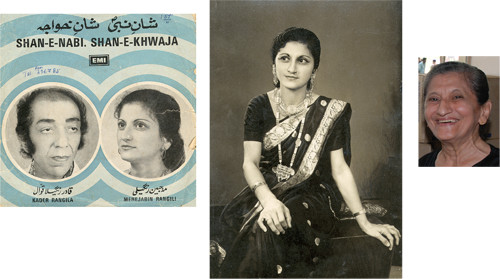
Record cover, the young songstress and Baria today
"My mother came from an affluent family, the Mashruwalas of Surat. Her father Jamasji, who owned 18 houses and a shop that sold ice cream and cold drinks, would tell his children ‘aapré charity nahi lévanu, pun karvaanoo (we should not take charity, but give it),’” Baria informed Parsiana. However, when her mother came to Bombay after marriage, she faced hard times and had to approach Parsi trusts to pay the school fees. To make ends meet she also worked at the Sir Ratan Tata Institute. When Baria, who was fond of singing, began to give stage performances, she reassured her mother that the good times would return. But that was not to be, for Nargisbanu’s health deteriorated necessitating a number of operations, the money for which was obtained from charitable trusts. When Nargisbanu became paralyzed, Baria gave up her stage career to look after her parent.
Baria says she never touched any of the money that arrived for her mother from charitable trusts, but managed to earn her own living from "the share bazaar.” Rather than keep the unused portion of the money at home, she placed it in her mother’s bank account. As the end drew near, she asked her mother what she would like done with it. "She asked me to use the money for myself as I had done so much séva (service) for her, but I declined,” Baria said. Her mother then suggested, "Garibo né madad karjé (help the poor),” and Baria promised to give back to society some day. This she has now done after her mother’s demise through the NDBZF, using Rs 5.5 lakh from the estate and another Rs 50,000 which she contributed after selling household items and from her savings.
"It gives me great satisfaction to be able to do this,” Baria says. "There was little I could do for my mother during her lifetime, but now the trust will serve as a permanent memorial to her.”
◆ ◆ ◆
From the archive