
Cover Story
“A lot to be worried about”
The politician-bureaucrat-police nexus must be broken and only strong public opinion can do it, says Maja Daruwala
"Government is finding itself unprepared for the degree of queries coming from within its own ranks through the Right To Information (RTI) Act. Many supervisors are saying that all this frivolous stuff must stop but it is a measure of the silent discontent and unfairness that has been simmering for years within the system, an indication that those at the helm are not trusted.”
Parsiana’s email-ed queries on the efforts to dilute the RTI, on police reform, on the rule of law (or lack of it) in India and the stance of the highest court in the land evoked honest responses from Maja Daruwala. Like her late father, Field Marshal Sam Manekshaw, she does not mince her words.
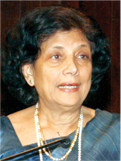
"It’s a corny saying but true that eternal vigilance is the price of liberty. RTI is perhaps the best thing that has happened to this country since independence... I think this will be the savior of governance in India. It is shining a light on corruption. There is a huge nexus from top to toe where corruption and abuse of process and abuse of discretion are concerned. Those invested in it are hurting because of disclosures. So naturally there is strong resistance to this and powerful voices wanting to take away what rights have been provided under RTI. So under the guise of curbing time-wasting and frivolous questioning — and there is bound to be some of that — they would like to close the new transparency which has only just begun,” she notes.
The Supreme Court’s attempt to place itself beyond the reach of RTI has upset a lot of people who see it as the bastion of civil liberties in India, observes Daruwala, a barrister from Lincoln’s Inn, London. Disclosure of individual assets or matters concerned with appointment of judges, etc would in no way impact on the judiciary’s independence, she believes, particularly since the Act has delineated those areas where disclosure can be denied, where it is in the larger public interest to do so.
Daruwala’s assessment of the health of our civil liberties — whether they have increased, decreased or remained static since Independence — is bleaker than expected: "By and large, at today’s date, I would say there is a strong tendency to claw back on freedoms that we have long taken for granted. More and more laws are being brought onto the book without any consultation with the wider public, without public white papers or reasonable explanations, as knee jerk reactions to passing circumstances. I think the fear of violence, militancy, terrorism more than the actuality of it has given governments the ability to play fast and loose with our rights and in part the public is to blame as well: for its tolerance to state violence and partisan lawlessness.”
To Daruwala "good governance is the realization of rights and civil liberties.” There is no conflict of interests, in fact they are complementary.
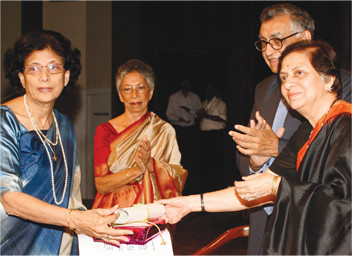
Maja Daruwala (Top and above) with Shirin Bharucha, Yezdi Malegam and Justice Sujata Manohar
We cite the example of Gujarat which by many accounts is better governed than other parts of India. There is electrification of the villages, cooking gas in modest homes… "I think you have to examine the record of Gujarat more closely to get at the whole truth. We must examine for instance who is better off; who is reaping the benefits of ‘development.’ Is it being evenly spread? Is it fair or discriminatory? A premier part of good governance is justice. Do all sections of the population experience justice equally? Is response to their concerns even handed? Do they feel that they will get fair treatment? That is the test. There is no trade off. Injustice today will come and bite you tomorrow,” writes Daruwala whose Commonwealth Human Rights Initiative (CHRI) activists had had a difficult time in 2002 as they tried to bring a measure of justice and security to the riot-affected Muslim community of the state. "It is not a question of whether the riots were an aberration but a question of finding the guilty, not victimizing the innocent, placing responsibility, taking responsibility, reforming structures of government, police, community that allowed so much tragedy to take place in so short a time, and making public apology and giving recompense about what took place. Today there is only denial!”
The lay mind often questions the value of civil liberties when food and clean water are scarce in large areas of the country and corruption stalks the land. "I think there is a misconception that to get at basic rights like food, water, housing, education you have to give up on freedoms like free speech, the freedom to move about, the freedom to participate in government, the right to be equal before the law. It is because we have those, demand them, have the constitutional right to fight for them that strengthens the battle to get food, water, housing,” she counters.
Daruwala’s experience in human rights work across the Commonwealth (see "The unfinished agenda,” page 20) gives her a wide perspective on where India is headed. She feels that as India develops more rapidly and becomes more confident of itself it could embrace "best practices from across the Commonwealth and indeed across the globe,” in the interests of better grounding for its own liberal democracy. "We often behave as if only we have the answers and no one knows better,” but change and innovation are working elsewhere and they could, for India.
The rule of law also mandates "much better leadership and management and above all accountability for wrongful and neglectful policing,” notes Daruwala. Referring to the judgment of the Supreme Court in 2006 in the Prakash Singh case, she says the Court’s deadline for comprehensive police reform has come and gone but, strangely, the Court itself has been in no hurry to ensure that the States and Centre obey. Some states "are rushing into legislation as a way of avoiding the Court’s directions. The legislation pretends sometimes to be in conformity with the Court’s directions but all too often the new law is so fractured, so badly thought through, so carelessly drafted that it is destroying even the design there was before the Court’s intervention,” rues the activist, adding, "I think we have a lot to be worried about. The only counter to these trends is strong public opinion. It must be informed; but it is hard to interest the public in the technicalities of policing.”
She would have us ensure that control over the police is non-partisan and that answerability and involvement is at the local level and not with politicians alone. The crying need, she emphasizes, is to "trump the present unhealthy relationship between politicians, bureaucrats and the police.” Indeed, she feels that India needs to overhaul its justice system which she describes as "broken and unfit.”
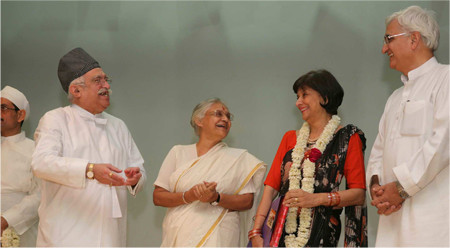
At the Navroz celebration in Delhi: (L to R) Dadi Mistry, Sheila Dixit, Daruwala and Salman Khurshid
"Whites only”
The daughter of Sam and Silloo (née Bode) Manekshaw grew up in small garrison towns as well as large cities with "a very safe feeling… We were surrounded by a feeling of security which is very empowering for a child.” Not living in Bombay except for holidays with her maternal grandmother, Daruwala learnt to speak several languages and "know and love the differences in other communities, other classes besides my own. It showed me the excitement of difference and also a realization of my own privilege,” she reflects. We ask if her father was her role model and she replies, "Not really. And yes absolutely. It wasn’t as if we imagined we were in the presence of a great man or charismatic leader. He was just our father. He had great values, a tremendous sense of humor, huge reservoirs of affection and patience, a liberal inclusive outlook and now I recognize that this came from a strong inner confidence in himself that came out of his own childhood. My mother was equally strong and principled so we had all this benefit and naturally it molded us.”
She traces her social activism to the way her parents spoke of being of service to others and the need for the privileged to notice the deprivation of others around them. "But more explicitly I think I had an epiphany when faced with seeing apartheid in South Africa when I was 11 and had a day out in Cape Town. I saw signs that said ‘Whites only’ and realized that it was me they were excluding. Till then I had hardly any awareness of personal injustice or discrimination though I had a lot of awareness of disparity from a long time before that. Once I studied law which was after I got married — and I recommend continued education to all women — I had the tools and the words to take my inchoate thoughts and try to put them into action,” notes Daruwala who feels that what she does is not enough, that it doesn’t have enough impact, that she needs to strive more.
Married to Dhun, a flight engineer (now retired) who had worked with several airlines, the Daruwalas lived in Singapore, Sri Lanka and London for long periods of time. They now live in Delhi. Their elder son Raoul-Sam lives in New York and works with Google. The younger son Jehan is a theater professional and has his own company in Bombay, she informs us. Dhun "is supportive and long suffering of my timings and the volume of work; my sons I think approve of what I do; they are always giving me advice and encouraging me to do more. My sister Sherry Batlivala (a travel industry professional in Madras) and my cousin Shirin Bharucha (a former Tata executive and a busy social activist in Bombay) are very protective of me; I am very lucky in my family both immediate and extended,” her appreciation is palpable for the family separated by distances but closely connected through technology.
Her colleagues attest to her workaholic ways: "Receiving an email from Maja at 4 am — about an idea or the next step forward is a usual feature… Her patience and perseverance is something I long for.” "She is not the typical boss. She is instead a friend to all her colleagues. She guides; she mentors; she teaches; she shares everything she knows. She believes in human beings — in human potential and thus it becomes all the more important for us to not let her down.” "Maja is living the finest of what we believe in — manashni, gavashni, kunashni (Good thoughts, words and deeds),” notes Navaz Kotwal, recipient of the first Nani A. Palkhivala Civil Liberties Award in 2006. Adds Jehan, "I just like the fact that while she’s out doing a damn good job of improving everyone’s lives in ways that most people don’t even realize, she still has time for a game of on-line scrabble with me.” The comments fit in with her own stated policy: "Please don’t worry about disturbing me; I have a thing about not turning anyone away! No one is that busy!”
Daruwala is happy to be a Parsi, indeed, "honored to be born into the community.” She believes that "our traditions of nurturing and the ethical teachings in our homes shape our public lives. The liberalism allows us to have initiative and achievements. I am deeply sad that we are diminishing in numbers and as we are diminishing our leadership is lost in pettifogging and dissention instead of consulting widely and seriously on how to best manage our wealth and talents to the benefit, not only of ourselves but those less fortunate around us. It is saddening to see the vision of greats reduced to this.”
Despite doing the work she does — entirely voluntarily — the soldier’s daughter says she has no sense of personal danger or intimidation. "Not to me or my family but to people working with me in Gujarat I have felt a strong sense of danger and the worry of that was enormous at the time and the experience lingers with me,” she acknowledges.
◆ ◆ ◆
From the archive