
Books
Saving India’s legal system
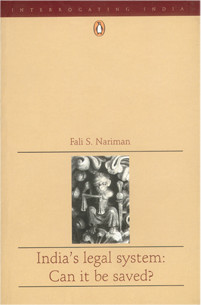
India’s legal system: Can it be saved? by Fali S. Nariman. Published in 2006 by Penguin Books India Private Limited, 11, Community Centre, Panchsheel Park, New Delhi 110017, Pp: 173. Price: Rs 195.
India’s legal system: Can it be saved? by Fali S. Nariman. Published in 2006 by Penguin Books India Private Limited, 11, Community Centre, Panchsheel Park, New Delhi 110017, Pp: 173. Price: Rs 195.
This delightful little book in the series "Interrogating India,” traces the history of the Indian legal system from pre-British times. Society was originally governed by moral laws, followed by Manu and his Manusmruti. The functioning of the legal system in British India ultimately led to the Indian legal system under the Constitution of Independent India.
In tracing this history the author quotes a few insightful stanzas from the Manusmruti: "Justice, being violated, destroys;/Justice, being preserved, preserves;/Therefore justice must not be violated;/Lest violated, justice destroy us.”

Fali Nariman: for justice
The book discusses the new trend of dispute resolution outside the established court system which has developed in recent times like settlement by conciliation and arbitration; setting up of Lok Adalat which the author describes as an indigenous mode of alternative dispute resolution; and specialized tribunals functioning outside the court system. Nariman feels that these alternative mechanisms have been reasonably successful and have played some role in lessening the burden on the conventional system of justice.
Considerable importance has been attached to the criminal justice system. The figures provided show that between 1999 and 2001, on an average approximately 50 lakh crimes were registered each year. However, the strength of the police force over the years from 1995 onwards stagnated between 12 to 13 lakhs. The book also talks about the pendency of the criminal cases in subordinate courts (about 1,32,00,000 cases). The effective strength of judges in the subordinate courts being only 12,205, the courts are able to dispose on an average only 19 percent of pending criminal cases each year. That over 2,00,000 undertrial prisoners are overcrowding prisons is cause for grave concern. Concern is expressed over the low ratio of convictions secured in criminal offences and also over the fact that the budget for legal services in this area is a mere three crore rupees a year for the entire country.
The book refers to the Malimath Committee Report (2003) which recommended investigation by experienced police officers trained in forensic methods, leaving law and order to be dealt with by a separate and distinct enforcement wing. Mention is also made of another recommendation of the same Committee, now accepted — the concept of plea bargaining. The author proceeds to deal with the remedies by stating that penal laws are out of date and no attempts have been made to reform them. There is no comprehensive system of payment of compensation to victims. Mere long terms of imprisonment for certain offences is not the answer; sometimes very stringent mandatory punishment creates a situation where the court chooses to acquit offenders rather than inflict such draconian sentences.
In the reviewer’s opinion, one of the most important points that the author raises is about the right of the accused to remain silent and whether it should be treated as sacrosanct. The author proceeds to argue that the accused is perhaps one of the best sources of information about the commission of an offence, but this source is not tapped for fear of infringing the right to silence guaranteed by Article 20(3) of the Constitution which states that no person accused of a crime shall be compelled to be a witness against himself.
The book further states that although the basic rule of law — presumption of innocence, importance of a fair trial and guaranteeing the right of an individual accused — can remain constant, in a grave situation, as for instance in a heinous crime or terrorist related situation, the author believes that rule of law should take into account the importance of what is at stake, while maintaining the basic right of defence. The concept of justice should be elastic enough to devise the means which would help maintain a balance of justice for the victim as well as for those charged. Victims of acts of terrorism should not be treated on par with victims of other offences and social guarantees are simply not enough. The author recommends that serious consideration needs to be given to the proposal that in terrorist related offences the right of the accused to remain silent should give way to the larger interest of society and of victims affected by the criminal acts. This is a remarkable suggestion which marks a departure from the age old principle but is required in the changing times with the threat of terror looming large. This is perhaps one of the most important aspects which the book addresses.
The book reveals that the sanctioned strength of the Indian judiciary — subordinate courts: (civil and criminal) 12,205 judges; High Courts: 676 judges; Supreme Court of India: 26 judges — is abysmally low for India’s population.
A part of the book is devoted to lawyers and their functioning, as their performance determines whether the ends of justice are served. At times the author is critical of the behavior of members of the profession. He states that lawyers become dishonorable when they treat the profession as a business, giving the impression that they will do anything for money. By doing this they become disreputable and dispensable. Another action whereby lawyers demean themselves and their profession is when they call for strikes and for stoppage of work in courts.
However, the book has a word of praise for lawyers as well. It says that without the support of a legal guarantee the lawyer in India has shown his true mettle and is at his best when the going gets rough. During the Emergency of 1975, the majority of those who stood up were the country’s practicing lawyers. Organizations established during the internal emergency for upholding civil liberties such as Citizens for Democracy and People’s Union for Civil Liberties, manned and led mainly by lawyers, are still flourishing today.
What the book does not address is the sad state of legal education in India where a so-called part-time legal course is good enough to secure a law degree to practice in any court, even the Supreme Court. As a result, many choose legal education because they have failed to secure admission in other professions. Present day legal education encourages mediocrity which will ultimately pervade the lawyers and judges and ultimately the entire legal system. To save India’s legal system, a full-time competitive law degree must be introduced. The second aspect which the book does not even remotely discuss is the falling standard of honesty amongst the dispensers of justice. Over the last 15 years or so the level of honesty amongst the judges, more particularly of subordinate courts, has gone down drastically and the reluctance of higher courts to confront this problem and rectify it by stringent punishment has resulted in a system where justice has become the casualty and people’s faith in the system has been severely eroded. If the Indian legal system is to be saved, the judicial system must devise ways and means to cleanse itself of this rot.
Through the pages of this book there emerges the picture of an author committed to the cause of justice and not to the mere process of law. At one place he quotes the legendary Justice Denning by saying: "Decide as you must – according to law – but never forget that law without justice is like an egg without its yolk, and much of its salt.”
I leave the reader with a wonderful paragraph with which the book ends: "In this country of ours the judiciary is the salt of earth. My wish for the third millennium is that, if it please God, there may be no occasion when it is said that the salt has lost its savor, because as the Bible warns us: if the salt ever loses its savor, then wherewith shall it be salted?”
◆ ◆ ◆
From the archive