
Books
Law for the layperson
“I am amazed to read the style of English used in the book. We are used to writing edicts; so it is good to learn that a practicing lawyer can use spoken English!”
"I am amazed to read the style of English used in the book. We are used to writing edicts; so it is good to learn that a practicing lawyer can use spoken English!”
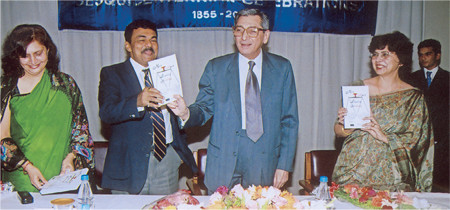

Former Chief Justice of India Sam Bharucha was referring to Not Just Legally Speaking, a book by practicing lawyer Armin Wandrewala, which he had just launched at Bombay’s Government Law College. A compilation of 91 articles contributed by Wandrewala to the Bombay Times between October 9, 2001 to August 19, 2003 they cover a diversity of topics that have bedeviled Indians at large and Bombayites in particular. The lady who practices as counsel in the Bombay City Civil and High Courts specializes in criminal law and is forthright in her opinions, legal, communal, et al.
The function, on January 18, 2006, was also addressed by joint commissioner of police Arun Patnaik and Dr Nilufer Bharucha, head of the English department of the University of Bombay. Each of them spoke about the book from their individual perspectives.
Thus Patnaik, who was standing in for police commissioner A. N. Roy who was scheduled to speak but was called away at the last minute, pleaded that he had read only 10 pages before facing the audience. "You know what the media is like, what they can do to you,” he noted in mock horror, adding that political action can rectify a published report but "the damage is done!”
Professing to know Wandrewala better as a writer than as a lawyer, Dr Bharucha referred to the lady’s first novel, The Turning, which she said has been translated into several European languages and dwelt on the author’s "felicity with the English language.”
(From left) Armin Wandrewala, Arun Patnaik, Sam Bharucha and Nilufer Bharucha at the launch
Justice Bharucha paid Wandrewala the ultimate compliment, comparing her to A. P. Herbert, a barrister in the 1930s who was a regular contributor to the famed British satirical journal Punch which specialized in poking fun at various aspects of British society. Herbert too, like Wandrewala today, had sought to educate the British public regarding various idiosyncrasies in the law, and in some cases, even succeeded in getting Parliament to amend the law. Referring to the general confusion between libel, slander and defamation the Justice harked back to a famous case of libel that reached the Privy Council. Of the five judges from the House of Lords, two held it was a case of libel; two held it was not; one suffered a heart attack and died. "The law was never settled there as here,” Bharucha noted the irony. "The objective of these articles (in the book) is the same: that in law there are idiocies. People need to know that that’s why courts deliver the judgments they do. The general public should appreciate why.” Referring to the hue and cry when a rape accused was exonerated, Bharucha was at pains to explain that "the court must act on such evidence as is presented. It is necessary that Armin have the opportunity to write more such articles.”
Thanking the dignitaries who had graced the occasion Wandrewala noted, tongue firmly in cheek, "I knew I was asking for trouble in asking Justice Bharucha and Commissioner Patnaik to speak!” and reiterated what she has noted in the Foreword to the book – that you cannot do justice to any issue in a 600-word column. But the purpose is to "encourage debate, deliberation, action…”
Not Just Legally Speaking by Armin Wandrewala. Published in 2005 by English Edition, 5/10, 11, 105, Jogani Industrial Complex, V. N. Purav Marg, Chunabhatti, Bombay 400022. Pp: XI + 284. Price: Rs 150.
The collection of articles which graced the Bombay Times for 91 weeks has been dedicated to "the legal profession in all its glorious complexity.” In the initial column Wandrewala notes, "We all have a stake in the law, and we need to have at least nodding cognizance with the laws: on the one hand, to help us resist encroachment – be it on our rights, our persons, our properties, even our feelings and dignity and on the other hand, to ourselves desist from such encroachment; to also be aware of how some of our actions may have legal consequences which we may not even be aware of, which may, nonetheless, have considerable impact on our lives…
"The law affects all of us, and yet it is perceived as being not accessible to all. The reality is, that it is not so inaccessible as it is assumed to be, if only certain demons could be exorcised and mental blinkers removed, some trouble taken, a modicum of effort made.”
Wandrewala: "felicity with English”
What is ‘public nuisance?’ The term comprises a slew of minor though socially regressive transgressions which are not only detrimental to public health e.g. spitting, bathing, urinating in public places, but clearly against the law dating back to the Indian Penal Code of 1860. Yet the relevant section of the Act is brazenly and publicly scorned day in and day out. The puny fines are no deterrent, says Wandrewala, arguing that the lawbreakers should be made to clean up the area he/she defiles. But when the guardians of the law, the police, are also the lawbreakers? "Ultimately it all boils down to ‘We the People.’ How much trouble are we prepared to take, how much effort will we make to ensure that our basic right to a clean, nuisance free environment is not trampled upon?...it may perhaps not be fair to leave the cleaning up of Bombay to the police and the BMC (Bombay Municipal Corporation) alone.”
The book explains the complexities of certain laws, like for example, the Special Marriage Act of 1954 which "was a small step towards a uniform civil code.” Wandrewala goes on to explain some of the consequences of marriage under this Act. Other chapters deal with the iniquitous institution of dowry; sex choice at birth; matrimonial nightmares involving three individuals — or more — where the judge is as perplexed as any layman; the impact of law’s delays on witnesses and evidence produced in court when the case is finally heard many years later. Do women enjoy equal justice with men? And how do the dastardly deeds of a few women who use laws for female empowerment as tools to blackmail or otherwise terrorize the men they want to ‘fix’ affect the fate of many other women who genuinely need the help of the law for their very survival?
The short pieces, covering a variety of legal experiences, especially in the urban environment, are not only well argued and informative, but are laced with Wandrewala’s gentle humor even when the underlying tone is one of indignation. Not Just Legally Speaking addresses many of the common problems and perplexities that bedevil us all. It is a good preprimary introduction to the Indian legal system.
Arnavaz S. Mama
◆ ◆ ◆
From the archive