
Awards
The unfinished agenda
The seventh Nani A. Palkhivala Memorial Lecture and the fifth Nani A. Palkhivala Civil Liberties Award demonstrate the gap between India’s constitutional rights and the real life scenario
"The freedom to move around, to speak, (the right) to a fair trial, to protection… The rich usually take civil liberties for granted. The poor are unable to do so. The burden of working for it must fall on us. However, in India, it’s the poor who get together to work for civil liberties…” Maja Daruwala, honorary director of the Commonwealth Human Rights Initiative (CHRI) and recipient of the fifth Nani A. Palkhivala Civil Liberties Award, responded to the citation and accolades at the Tata Theatre on January 14, 2010.
Daruwala has been "one of the very early advocates of the Right to Information (RTI) Act for India. Guided by (her), CHRI worked to ensure that the Indian law was strong and progressive. Today this law is recognized as one of the best acts of its kind in the world. CHRI has worked tirelessly to broadcast this Act and protect it from attempts at dilution. It is not for nothing that this law has been called the ‘Oxygen of Democracy.’ It is now working its magic across the country from the highest echelon of Government and the Courts to the common man…
Prof C. K. Pra-halad: "a crisis of leadership”
"Through training modules for government functionaries, and a slew of publications and films in many languages in the simplest format, CHRI has reached out to the maximum number of people, opening their eyes to their rights, and liberties, which are often cloaked in secrecy by the powers that be,” notes the citation read by Shirin Bharucha, member secretary of the Nani A. Palkhivala Memorial Trust (NAPMT) which has instituted the award. Daruwala has designed and conducted seminars and workshops for judges from across South Asia including the Supreme Court of India, the High Courts of Mumbai, Andhra Pradesh and Tamil Nadu and the District Courts, notes the citation, adding that at the Commonwealth level she holds parallel civil society meetings at each Commonwealth Heads of Government Meeting, to draw their attention to the situation of human rights across the Commonwealth, the value of the work of human rights defenders and the dangers they face.
A passionate advocate of the need for police systems that answer to the law and not to persons in power, Daruwala noted her anguish at the brutal murder of Satish Shetty and the attempt on the life of Naina Katpalia, both noted civil rights activists, and promised to use the prize money that accompanies the award, "for the defense of people who defend civil liberties but who are oppressed and killed.” CHRI has been part of drafting the Government of India’s Model Police Act and is presently monitoring Government’s compliance with the Supreme Court’s directions ordering governments to put in place institutions that will reform policing, states the citation.
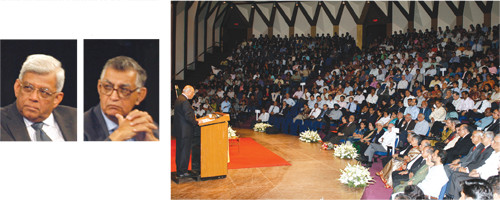
L to R: Deepak Parekh, Yezdi Malegam and Prahalad addressing the audience
"We are on the side of law, of the Constitution. We use constitutional abilities to promote the idea of India,” noted Daruwala adding that many hardworking, idealistic, persevering young people work with her. "Their families cannot understand them!”
It was after 10 years of marriage and two children that Daruwala (née Manekshaw) started her legal education, emerging as a barrister from Lincoln’s Inn, London. A 10-year stint as program officer for Rights and Social Justice for India, Nepal and Sri Lanka at the Ford Foundation, Delhi, "gave her an overview of the many problems that beset the realization of rights in South Asia and convinced her that the way to make people realize their rights was to assist them to understand their rights, to find their voice and learn how to seek justice. If people are not aware of their rights and civil liberties, no advance is possible, especially when an obdurate bureaucracy is ranged against them,” notes the citation.
Daruwala’s energy and expertise are not confined to the working of the CHRI. She has been "chair of the Minority Rights Group, London, chair of the People’s Watch, Tamil Nadu, which has created a movement for human rights education in schools, particularly targeting teachers, and chair of MARG, a Delhi based NGO (non-governmental organization) which works to spread legal literacy particularly for women. She is on the board of the International Women’s Health Coalition, New York, is an external advisor for the World Bank’s Governance and Anti Corruption task force in Washington and is on the board of Open Society’s Justice Worldwide Initiative,” records the citation.
According to Daruwala, once Indians learn to enforce their rights, "there is no country in the world as good as India. But we have to gain momentum. Despite sustained effort, momentum comes only from cataclysmic events like 26/11…But everyday policing has to get better. (We need) democratic policing for a democratic country.”
Daruwala was selected for the award by a distinguished panel of judges comprising former Chief Justice of India M. N. Venkatachaliah and retired judges of the Supreme Court Justices Sam Variava and Sujata Manohar who announced the winner. Registering her dismay at "more and more instances of fake encounters” and other transgressions against human rights, Manohar noted that Daruwala had interacted with civil society groups, seeking access to justice and prison reforms. "At this difficult time when social concerns tend to override human rights, we need the right balance. Civil liberties organizations must be more analytical, more forthcoming. They must analyze experiences and suggest appropriate steps. Nani Palkhivala spent his entire life fighting for human rights and against corruption in society. We need to work to promote Palhivala’s fundamental values,” said the judge.
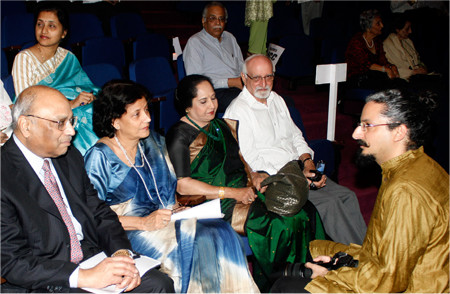
L to R: Prahalad, Maja Daruwala, Gayatri Prahalad, Dhun Daruwala and Raoul-Sam Daruwala
7th NAP Lecture: Sampurna Azadi
Despite the Tata Theatre’s substantial capacity, nearly 300 people sat outside the auditorium to watch Prof C. K. Prahalad on specially hooked screens and listen to him speak on "Sampurna Azadi: the Unfinished Agenda.” Renowned author and distinguished university professor of corporate strategy at the Stephen M. Ross School of Business at the University of Michigan, Prahalad, who gave the seventh Nani A. Palkhivala (NAP) Memorial Lecture, was introduced by NAPMT chairman Yezdi Malegam as one who has been consistently ranked among the top 10 thinkers in management and public administration by management surveys in the US over the past decade.
Paying tribute to Palkhivala for authoritatively establishing that "‘We the People’ and not ‘We the Parliament’ continue to be the guiding light of the country,” Prahalad went on to describe how "the reality of India of 2010 is a far cry from the guiding principles set forth in the Constitution. Every constitutional principle is violated on a massive scale across the country.” Emphasizing the fact that the immense scale of democratic India’s population, physical size and composition of a myriad communities needed innovative solutions, Prahalad said, "India must have the courage to chart its own path” because nothing that works elsewhere can apply to India.
Describing how each of the building blocks of our constitution — the rule of law, democracy, secularism, federalism and judicial review — has been undermined, Prahalad spoke of the endless wait for justice as cases pile up by the thousand in the High Courts and the Supreme Court and by the million in the lower courts and wondered, "Is this a measure of Indians’ unshakable belief in the rule of law? Or do delays create the incentive to file more cases?”
Noting that 77 percent of the population believes that the system is very corrupt, the professor called it "an implicit tax on the poor” as they cannot get a ration card or a birth certificate or a caste certificate (necessary for their children to get admission into educational institutions) without monetary appeasement.
The increasing number of political parties whose only agenda is to capture power on behalf of certain castes or groups had been foreseen by the architect of India’s Constitution, Dr B. R. Ambedkar. Prahalad quoted from Ambedkar’s speech introducing the Constitution to the Assembly: "Will history repeat itself? It is this thought which fills me with anxiety. This anxiety is deepened by the realization of the fact that in addition to our old enemies in the form of castes and creeds we are going to have many political parties with diverse and opposing political creeds. Will Indians place the country above their creed or will they place their creed above country? I do not know. But this much is certain that if the parties place creed above country, our independence will be put in jeopardy a second time and probably be lost for ever…”
While secularism as the equal treatment of all religions under the law has been India’s heritage since the time of Emperor Asoka, sectarian violence and tension between religious and caste groups has become palpable in present times, noted the speaker. He explained it thus: "The proliferation of the number of castes and those classified as other backward classes (OBC) is an indication of the wide-spread scramble to access sources of economic power — education and jobs.” Growing urbanization, however, may deflect this process somewhat as people get better service and access to jobs in the cities on the basis of skill rather than caste.
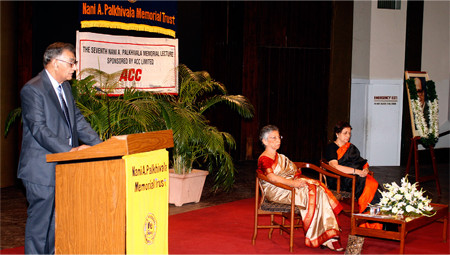
(From left) Malegam, Shirin Bharucha and Sujata Manohar: promoting Palkhivala’s values
Federalism, a part of the Indian constitution, has also suffered because the growing tendency towards coalitions weakens the center and regional parties take a parochial stance. The number of states has been increasing but the criteria for separation has changed. While the first reorganization of states was on the basis of language, the current demand for Telegana does not fall in the same category for Telegana and Andhra speak the same language. "What criteria should we use — governability and responsiveness of the government (based on size of the population), or deepening identity politics?” asks Prahalad.
Not discounting India’s many attainments, the professor chose "to focus on the incipient dangers to India’s continuing success... Most people take corruption as a ‘way of life’ and do not believe that it can be solved in our lifetime. There is a sense of resignation and acceptance of the status quo. This corrosive influence, if not corrected in time, can make a mockery of the Indian Constitution and its basic architecture which Palkhivala so valiantly defended…
"The Naxalite problem may be an indication of the corrosive influence of apathy, callousness, and denial of basic requirements of social justice, the rule of law, and access to opportunities such as education, healthcare and jobs… The Naxalite movement is the strongest in areas where the human development index is very low and the corruption index is very high…
"Too much of the national focus is on ‘inequality of incomes’ but not the root cause, which is inequality of opportunity,” said Prahalad.
Addressing the cost of elections, Prahalad estimates the share of private spending for the Lok Sabha elections of 2009 at Rs 8,000 crore. "If we include the cost of elections in the states and in major metros, the overall private spending in India, in elections, could easily exceed Rs 25,000 crores. I cannot but assume that private funding of elections of this magnitude is predicated on making an appropriate return. Given the risky nature of the investment in elections, we can assume that politicians as venture capitalists will not settle for less than a ten-fold return. The cost to the country in corruption can exceed Rs 250,000 crores. The economic and developmental impact of this level of corruption is even harder to estimate… Corruption, in an interesting way funds and supports the electoral process while subverting the rule of law and the basic social justice that the government of ‘We the People’ is supposed to uphold.”
Noting that citizens of a democracy need to be well-informed and to diligently enforce their rights, Prahalad stated that increased and instant information thanks to the site ITC eChoupal, a web based service in regional languages from ITC’s agricultural division, which offers the farmers of India all the information, products and services they need, has changed their lives as they cannot be duped by middle-men any more. Added to that is the RTI which enforces a measure of transparency. However there is also the need to make laws simpler to understand and enforce, to update them to 21st century requirements. As for politicians, bureaucrats, the judiciary, etc, he believed they should be ranked according to performance. "I am sure we can think of simple and clear measures of accountability for almost all functions of the government. Measurement of performance is not enough. There must be clear consequences for poor performance,” he emphasizes.
All innovation however needs to start with the basic concept of what it means to be an Indian — what are the ideals we stand for, what are the traditions we will defend at the cost of life and limb, what Prahalad called "a sense of Indianness” and which Home Minister P. Chidambaram had called "the idea of India” in his NAP lecture in 2009. Endorsing the Unique Identification Project of the Government of India, Prahalad described it as "the basic building block of the social justice that the framers of the Constitution had in mind …a massive job whether technically, politically or socially. The task is not in just issuing identity cards that are tamper-proof but in managing the massive database that this entails. The challenge is in architecting a unique system that is low cost, that allows for multiple current applications and is flexible enough to accommodate new applications as it evolves…India will be the first country to issue a single ID on such a scale in the age of mobile phones and ubiquitous connectivity.” Not only will the UID eliminate the middle-men who have profited at the expense of ordinary people, it will focus on the rights of the individual as against the rights of the group as hitherto.
Noting that more than 300 million people in India are still illiterate ("this represents a population nearly as large as the entire population of India at the time of independence or the population of the entire United States today”) the professor noted categorically that India’s citizens will remain unequal as long as they do not get equal opportunities for a good education. Pointing out the difference between Kerala’s 90 percent literacy and Bihar’s 45 percent, he noted that states with a larger percentage of Dalits and tribals are the most affected and ascribed the inequalities to a failure of the public delivery system.
"Why can’t a student in rural Bihar get access to the best teacher in physics in the country? Why can’t she or he download a lecture, a problem set and work with their peers to learn? Why can’t learning be modularized? Why can’t a student test herself against her cohorts not just in her village but also in the district or the nation? All this is possible today. The technology is available.”
Stating that people are ready to adopt e-governance as demonstrated in Andhra and Karnataka if it is easy to use, Prahalad predicted that an educated, connected India on the basis of UID and the RTI will find that transparency and accountability are easier to safeguard in such a system.
"When we focus on individual rights and meritocracy, we are better able to achieve collective goals. When we try to focus on groups, we are essentially accountable to no one… The Universal ID, the focus on literacy and skill development, e-governance, and local management with national standards are all building blocks of a society that focuses on improving individuals and as a result contributes to the collective progress.
"The crisis in India is a crisis of leadership. .. Leaders in India, in fact all Indians, have to ask themselves ‘What will be the judgment of history? What will be our legacy?’ I also believe that people want to be heard more than anything else. They hunger for opportunity more than handouts. I draw inspiration from Mother Theresa’s words: ‘When I look at the masses, I feel I cannot do anything. When I look at individuals, I know I have to do something.’”
Three months after delivering the above NAP lecture, Prof Coimbatore Krishnarao Prahalad (68) died after a brief illness in San Diego on April 16, 2010.
◆ ◆ ◆
From the archive