
Awards
Honoring integrity
Julio Ribeiro’s unblemished record of public service wins him the Dadabhai Naoroji Memorial Award for 2008
"By honoring me the committee has sent a message to other police officers, many of whom are present here today, and to other government servants, that they have a role to fulfill and if they do it, they will be rewarded, not necessarily in cash or in kind or by promotions but by public recognition and acceptance which is much more satisfying than any other reward that could come their way.”
Padma Bhushan Julio Ribeiro, a man who has been an "exemplary example of probity in public life,” as notes the invitation from The Dadabhai Naoroji Memorial Prize Fund (DNMPF), acknowledged the Award for 2008 bestowed on him at a well attended event on April 7, 2008 at the Indian Merchants’ Chamber in Bombay. Allotted the Indian Police Service (IPS) according to the All India Public Service Commission rules though it was not his "chosen profession,” Ribeiro noted, "I have not regretted this quirk of fate! I think policing came naturally to me.” Starting in the Bharuch District of then Bombay State on January 1, 1955, Ribeiro went on to become the police commissioner of Bombay, director general of the Central Reserve Police, director general of police, Gujarat, special secretary to the government of India, ministry of home affairs, director general of police, Punjab and advisor to the governor of Punjab, ending his official career as India’s ambassador to Romania.
"It is to his credit that though the Government of India was keen on appointing him as the governor of Jammu and Kashmir, he chose to return to Mumbai. Following the communal violence and riots that shook Bombay in 1992-93, he initiated the Mohalla Ekta Movement which helped in building bridges of understanding between communities in the city,” notes the citation signed by DNMPF chairman Adi Godrej.
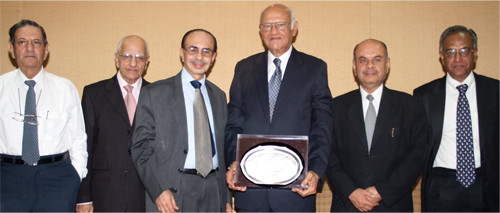
From left: Jamsheed Kanga, Minoo Shroff, Adi Godrej, Julio Ribeiro, Dinesh Vyas and S. Divakara
Associated with several charitable institutions in Bombay, he has been fighting corruption and propagating the effective use of the Right to Information Act, 2005 in his capacity as executive chairman of the Public Concern for Governance Trust, notes the citation, adding, "Thanks to the inspiration and motivation provided by him, hundreds of fellow citizens have now joined the movement, thus paving the way for better governance and accountability and a corruption-free society…It is a tribute to his concern for his fellow citizens that even long after he retired from his chosen service…he has been a valiant crusader for better governance, greater accountability and communal harmony, and above all, integrity in public affairs.” Ribeiro is also associated with the Happy Home and School for the Blind, the Pragati Kendra, Muktangan and the Bombay Mothers’ and Children Society.
In the course of his acceptance speech Ribeiro remarked, "It is neither bad nor immoral to be rich, but the means used for acquiring these riches are very relevant not only to an individual’s character but also to the character of a nation…where half the people today are deprived of the most basic necessities of life…If these means are not ethical and more so if they are not legal, the effect of such examples on the less fortunate will not but be felt.”
According to the acclaimed policeman whose career spanned 36 years, "there is no greater opportunity to do good to the people than in the police because you deal with people all the time…Even when you are dealing with a file and not an individual sitting before you, you have to remember that at the end of the file is a human being with a problem and that human being expects justice from the person empowered to decide.” In a telling comment on the perception of the populace, Ribeiro noted, "There were many villagers who used to remark that I must be an Englishman! When I pointed to the color of my skin they would agree that I was not an Englishman but added that I administered ‘English’ justice — a remark that made me conscious of the fact that many of my own countrymen in the police were not dispensing justice as they were bound to do by law.”
Underscoring the change in values since the time he was a commissioned officer "living up to the oaths we took to uphold the constitution,” Ribeiro rued, "Oaths are not taken very seriously these days.” Skirting the sociopolitical reasons behind the change, Ribeiro noted that the "standards of probity in the public services have deteriorated drastically over the years to the great consternation, dissatisfaction and sense of wellbeing of the common man. If false cases are made, if big criminals are let off, if wrong people are arrested, if money is extorted for every transaction in the government office, the people lose confidence in the entire system and feel cheated of their rights as citizens.”
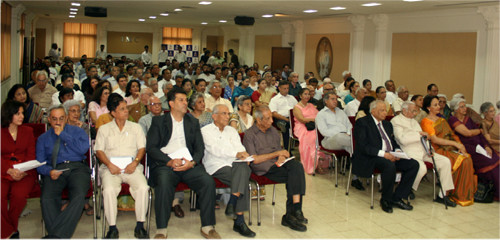
A distinguished audience at the IMC’s Walchand Hirachand Hall
A Christian raised with values inculcated by his Jesuit teachers at St Xavier’s School and the eminent principals of the Sydenham and Government Law Colleges where he studied, Ribeiro attributed his sense of integrity to their example and to those of his teachers like "the beloved Nani Palkhivala, contact with whom inculcated in me a set of values that lent itself to probity and good conscience in my dealings with others.” Before concluding Ribeiro stated, "I am committed to public service like Adi’s uncle Sohrab (Godrej) who continued right up to the time of his death.”
Bombay Parsi Punchayet chairman and management guru Minoo Shroff, in his avatar as trustee of the DNMPF, briefed the audience on the trustees’ decision to honor the exemplary citizen: "While debating a candidate for the prize this year, the trustees unanimously agreed that Ribeiro Number 2 made the most compelling nominee. I address him as Number 2 for the body of work he has undertaken during the two decades since his retirement, and not for his first duty as supercop.”
When Dadabhai Naoroji died in 1917 the citizens of Bombay raised a fund to erect a statue as a tribute and a mark of gratitude. After the magnificent statue was erected and installed at Flora Fountain, there were Rs 45,000 still left in the kitty. So the DNMPF was established in 1929 with this amount as its corpus and Dinsha Wacha as its first chairman with the purpose of honoring from time to time an Indian who had contributed to the advancement of the interests of the country in any sphere of national life except politics. Among the earlier recipients listed in the invitation to the event are the irrepressible civil servant A. D. Gorwala, constitutional wizard Hormasjee Seervai, the man who made Amul a household word in India and abroad Dr V. Kurien, cricketer Vijay Merchant, renowned birdman Dr Salim Ali as well as our own J. R. D. Tata, Nani Palkhivala, Dr Homi Sethna and Ratan Tata.
◆ ◆ ◆
From the archive