
Comment
Digging into our past
The World Zarathushti Cultural Foundation excavation in Sanjan has unearthed some interesting artifacts and information
It was with the express aim of proving the veracity of the Qissa-i-Sanjan and to unearth details about the early history of the Parsi community that the World Zarathushti Cultural Foundation (WZCF) undertook an archeological project to excavate the ancient site of Sanjan and to conserve the Bahrot caves. Spearheaded by Dr Homi Dhalla (founder-president of the WZCF), Dr Mani Kamerkar, historian, and under the guidance of Dr S. P. Gupta, chairman of the Indian Archeological Society, New Delhi, this project has completed two seasons of archeological excavations at Sanjan (2002 and 2003). The team working on the excavations comprises of archeologists Dr Kurush Dalal (field director), Dr Abhijit Dandekar, Rukshana Nanji, Rhea Mitra and site supervisors Rohini Pandey, P. Aravazhi and Suresh Bhonde.
The five main objectives of the excavations are: to establish the existence and location of the ancient settlement of Sanjan, to determine the date of its founding, to unearth the nature of its occupation, to ascertain the date of its desertion, to explore the role of Sanjan in the maritime trade of the Indian Ocean.
The exploration and excavations have brought to light the fact that the ancient settlement of Sanjan was situated about 2.5 km away from the Sanjan railway station, on the northern bank of the Varoli river creek. It extends over a vast area, indicating that when occupied, Sanjan would have been a thriving large city. Today, the ancient site is greatly disturbed due to human occupation, commercial and agricultural activities and construction work.
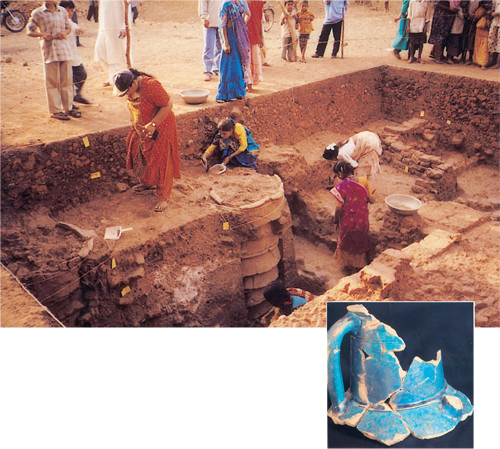
A view of the excavation of the ringwell (top) and a turquoise glazed ware three handled vessel
Prior to the commencement of the actual excavation work in January 2002, explorations were undertaken and a suitable area was demarcated for the laying of trenches. This area is on what is locally know as the ‘Bandar.’ While the horizontal area of this excavation covered 5 m x 7.5 m, the vertical depth of the trenches went to 5.35 m. From these trenches emerged the tangible evidence of a history, which so far had remained oral.
The excavations revealed two structural phases with numerous features, large quantities of diverse ceramics and various artifacts. These finds have generated much interest and excitement since a lot of this material is being reported for the first time in India. The first phase of occupation rests upon layer seven and is represented by a large structure of burnt bricks. Parts of walls — some with up to 15 courses of bricks still extant, and a ringwell are the constituents of this structural complex. The ringwell has nine terracotta rings, each fitting into the other and going down vertically to a depth of 3.2 m. This is an extremely important feature since ringwells or soak-pits denote a sophisticated drainage system and are indicative of urbanization. Moreover, the practice of building and using ringwells was current during the early historical period in India and was abandoned in the medieval times. Finding ringwells at a supposed early medieval site like Sanjan is, therefore, unusual.
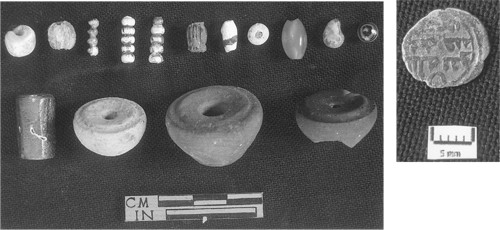
Excavation findings: glass, carnelian and terracotta beads (far left) and a silver coin bearing an Arabic legend
The second phase, overlying the first, consisted of fragmentary walls of burnt bricks, floors made of rammed brickbat and cobbles and two more ringwells. A large number of glass fragments, glass vessels, beads, bangle pieces, metal artifacts, coins, animal bones and pottery were found. Prominent amongst these finds were two complete glass bottles, an iron ladle, antimony rods, eye beads, nails and even a small coil of gold wire. Several copper and silver coins were retrieved. Dr Shobhana Gokhale, the well-known numismatist has studied these and identifies one coin as a probable Satavahana issue, one as a coin of the Sultan of Sind, one as an Indo-Sassanian Gadhiya coin and another fragment as a Sassanian issue. One small silver issue with an elephant on the obverse and a Brahmi legend on the reverse may in her opinion, belong to the Rashtrakuta period.
Undoubtedly, it is the ceramics at Sanjan that have proved to be a big discovery, causing quite a stir in the archeological world. While West Asian ceramics have been reported from the Far East by archeologists like Glover, Ho and Carswell and Chinese wares have been found in excavations in West Asia, it is for the first time in India that West Asian pottery, Chinese celadon and porcelain and indigenous slipped and coarse wares have all been found at a single site within a stratified context. From large storage and transportational vessels to small cups and bowls, from the elaborately decorated to the starkly plain, the range of vessel types and wares indicate a complex social structure and a sophisticated lifestyle. Some of the wares of particular note are Chinese celadon, porcelain, glazed grey/stone ware, glazed buff ware, glazed pink ware, pink ware, Sassanian-Islamic turquoise glazed ware, slipped glazed ware, slipped red ware, coarse red ware, etc. Apparently trade contacts existed with West Asia on the one hand and the Far East on the other. As there is no precedent to such a find in India, there is a serious paucity of material for cross-reference or study. However, the material is being painstakingly analyzed. Some diagnostic turquoise glazed ware sherds from Sanjan find an identical match with pottery found in the excavations at Susa and Nishapur in Iran (seventh-10th century AD). Of the large quantities of glass fragments and vessels, mention must be made of two particular bottles which are identical to those found in the Al Sabah collection (Kuwait) and which have their origin in the Mesopotamian region.
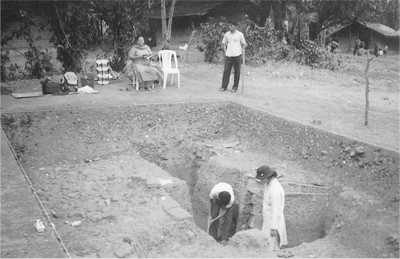
Unearthing our past
After a year of post excavation work, the team returned to Sanjan in January 2003 to continue the work of the previous season. Due to circumstances beyond the control of the team, it was not possible to work on the Bandar. Hence another relatively undisturbed site was selected for excavation. This site is located on a hillock-like high mound on the western bank of the Koli-Khadi creek, about half a km away from the trenches of the first season. The mound showed no signs of recent human activity, other than a few fruit trees and shrubs. Excavations at this site turned up some very unusual and dramatic finds, although the habitational deposit was not very thick. Unlike the excavations at the Bandar the excavations here covered a far longer area horizontally and less depth vertically.
Structural remains and features started to emerge almost immediately as the digging commenced. Brick platform and floors extended in most of the trenches that were opened. Antiquities much like those of the previous season were retrieved. A coin of Allaudin Khilji and a small elephant shaped zoomorphic bottle made of terracotta are of significance. A surprising difference in the distribution of pottery was noticed at this site. There appeared to be predominance of slipped and coarse wares and a low representation of the glazed wares found so profusely on the Bandar. On the other hand, a significant amount of porcelain was also found and unlike the porcelain found on the Bandar, some of these sherds have painted designs on them. Three large storage jars/water troughs were found sunk into and fixed in a brick floor.
However, the singularly most important and dramatic discovery of this season was the uncovering of six human skeletons. These were found to be lying in an extended position, due north south, with the head in the north. The faces are all turned to the right and the arms appear to have been crossed over the chest midriff section. They are all adult individuals. No discernable burial pits can be seen. Five out of the six skeletons were carefully exhumed and exposed. They are currently under the study of Dr Walimbe and Dr Veena Tripathi of Deccan College, Poona who will also subject them to DNA analysis and other tests. The results of these tests are eagerly awaited.
The excavations of the second season came to a close at the end of March. Post excavation analysis of the material and reference work is now underway. Study of the artifacts, pottery, animal and human remains, etc and tests such as carbon dating and DNA analysis will help us put together the jigsaw pieces of our history in the near future.
From the evidence that has so far emerged, it is clear that Sanjan was a thriving large urban center with distinct West Asian contacts and possible trade with China. The population had an apparently complex and urban life style. The numismatics, ceramics and structural evidence point to a prosperous culture that can be tentatively dated from the seventh century AD to the 13th century AD. The hypothesis that the Parsis settled at Sanjan and set up an elaborate trade network with the Persian Gulf bears out very well when we look at the physical evidence.
Plans for the excavations of the third season are already being finalized. The archeologists hope to concentrate on the excavation of the dakhma mound at Sanjan and the conservation of any structural remains that may be found. The WZCF is also planning an exhibition to enable the public and particularly the Parsi community to see the tangible, physical remains of our rich historical past.
(For a long while, it had been my intention to embark on an excavation project at Sanjan with a view to obtain fresh insights about our early history. Fortunately, this opportunity arose after some renowned archeologists and other experts came to study the Bahrot caves. These excavations were made possible due to grants received from the Archaeological Survey of India and the Indian Council of Historical Research, New Delhi.)
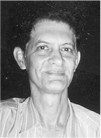
Founder president of the World Zarathushti Cultural Foundation and a scholar of Zoroastrianism, Dr Homi Dhalla has represented the community at various international conferences and interfaith meets. Among the community projects he is involved in are the conservation of Bahrot caves, the Sanjan excavation, documentation of Parsi history and the introduction of solar concentrators at Bombay’s Doongerwadi.
◆ ◆ ◆
From the archive