
Events & Personalities
WZCF’s root concerns
Whilst spearheading the conservation work on the Bahrot caves and the excavation of the mound in Sanjan in his capacity as founder of the World Zarathushti Cultural Foundation (WZCF), Dr Homi Dhalla has been strengthening his ties with the International Association for Religious Freedom (IARF), the 102-year-old body which has 90 member groups in 25 countries. In early August he was in Budapest, Hungary to attend their 31st World Congress on "Religious freedom: Europe’s story for today’s world.” Besides giving an introductory talk on Zoroastrianism and leading certain group discussions Dhalla was made a member of the international council of the IARF in recognition of his contribution to the interfaith movement, mentions a press release.
In early September Dhalla was in Palermo, Italy to attend an international conference on "Faiths and cultures within conflict and dialog.” As the Zoroastrian delegate Dhalla spoke on the "Zoroastrian view of harmony” in the seminar on "Eastern religions and their commitment to peace.” On the final day he gave a discourse on Zoroastrianism and recited Avestan passages, along with their translation, on the subject of peace. Religious representatives then walked through the main streets of Palermo in a peace march and the meet concluded with the delegates lighting the lamp of peace, reported Dhalla.
The initiative shown by the WZCF and the grants received from the Archaeological Survey of India and the Indian Council of Historical Research, New Delhi has helped in the preparatory work to preserve Bahrot caves and to establish Sanjan’s significance. The reports submitted by four professional teams to Dhalla and Dr Mani Kamerkar of the WZCF and Dr S. P. Gupta, chairman of the Indian Archaeological Society (IAS), stress on the urgency of conserving the Bahrot site.
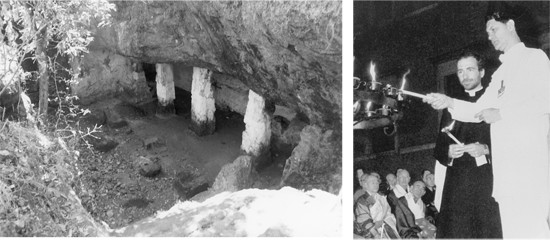
Dhalla (right) as the Zoroastrian delegate lighting the lamp of peace at Palermo, Italy Left: Main cave at Bahrot where damaged pillars need to be reinforced
As conveyed conservation architect Pankaj Joshi, architectural and photographic documentation for historical, architectural and archeological interpretation should be undertaken. His team of six persons visited the site comprising of seven caves on three occasions, clearing the debris to facilitate photo documentation, land and contour survey. Between the fortification and the cave complex they noticed plinths suggesting the existence of settlements around the cave site. Plinths in bastion/watchtower like formations were also observed at some locations on the hilltop. Ramesh Nagvekar and his four ![]() assistants made a thorough two-dimensional contour survey of the hill comprising of 50 acres along with the adjoining access path and outer fortification using electromagnetic distance measurement technology. They recorded two sets of fortifications. Porus Master and Associates have recommended a two-meter wide all weather stone pathway, about six kilometers long, connecting Aswali village to the hilltop, embracing three hills and rising to a height of 1,700 ft. Senior conservationist Devendra Sood urged that percolation of water into the caves be stopped, small outgrowths be cleared, cracks be sealed, walls of the caves be cleaned, fallen debris be cleared. He pointed out that a huge rock between the second and third cave which seems detached should be bolted and strengthened. The third cave being the largest, where the Iran-shah was probably housed, he felt the need to reinforce the pillars which are damaged there. To implement all these recommendations, clearance was awaited from the Maharashtra Government Forest Department.
assistants made a thorough two-dimensional contour survey of the hill comprising of 50 acres along with the adjoining access path and outer fortification using electromagnetic distance measurement technology. They recorded two sets of fortifications. Porus Master and Associates have recommended a two-meter wide all weather stone pathway, about six kilometers long, connecting Aswali village to the hilltop, embracing three hills and rising to a height of 1,700 ft. Senior conservationist Devendra Sood urged that percolation of water into the caves be stopped, small outgrowths be cleared, cracks be sealed, walls of the caves be cleaned, fallen debris be cleared. He pointed out that a huge rock between the second and third cave which seems detached should be bolted and strengthened. The third cave being the largest, where the Iran-shah was probably housed, he felt the need to reinforce the pillars which are damaged there. To implement all these recommendations, clearance was awaited from the Maharashtra Government Forest Department.
When excavating the mound near the bunder in Sanjan the potteries and glassware unearthed indicated they were very familiar to the Sasanian wares coming from Iran and Iraq. Archeologists Kurush Dalal, field director, his wife, Rhea Mitra, Roxanne Nanji and Abhijit Dandekar are making a detailed study of all the artefacts under the guidance of Gupta and Prof V. N. Misra at the IAS. Sanjan seems to have been a very flourishing urban center trading with the Persian Gulf region and the Zoroastrians who settled along the Gujarat coast were probably traders from Iran familiar with the local populace.
Solar concentrators, the brainchild of Dhalla, are fast gaining acceptance in different regions of India after their successful installation at Bombay’s Doongerwadi. Anjumans in Poona, Navsari, Bulsar and Baroda too are adopting this mode of disposing the dead. This breakthrough is making news in the international media as evinced in the Time magazine, July 30, 2001 and the interview with Dhalla over the BBC radio service. A film on the ecological and environmental effectiveness of solar panels was screened on the National Geographic Channel in their program "Hot Science” where Ronnie Sabawalla of Baroda who implemented this idea explains the scientific basis of the device that helps in disposing corpses effectively.
◆ ◆ ◆
From the archive