
Books
“The Zoroastrian world”
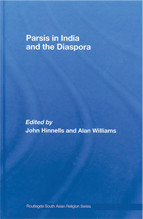
Parsis in India and the Dispora edited by John Hinnells and Alan Williams. Published in 2007 by Routledge, 2, Park Square, Milton Park, Abingdon, Oxon, OX14 4RN. Pp: XIV + 290. Price: Not mentioned.
A research workshop sponsored by the School of Oriental and African Studies (SOAS), University of London, and Liverpool Hope University in 2006 brought together active researchers in the field of Parsi studies from six countries. Their papers span five centuries starting with the Qesse-ye Sanjan (QS), the quintessential beginning of recorded history of the Zoroastrian migration to India.
The researchers’ contributions have been divided into three parts: the settlement of the Parsis in India, their 19th century persona, and the developments of the 20th century which marked the spread of the community and the religion beyond the shores of India.

John Hinnels (l) and Alan Williams: active researchers
Dr Alan Williams, reader in the Department of Religions and Theology, School of Arts Histories and Cultures, University of Manchester, whose scholarship focuses on pre-Islamic and Islamic Iranian studies, makes a strong case to rescue the late 16th century QS by Bahman Kay Kobad from the popular community assessment of it as a rough history of Iranian Zoroastrian migration to India. Studying the original Persian text as against its mediocre translations in English and Gujarati, Williams says it has been largely underestimated as religious poetry and recommends that it be read "with the tools of literary, religious and social as well as historical, criticism… If modern day scholars are irked by the lack of recognizably historical detail, and by Bahman’s apparently casual account of history and the passing of time, it is because they have not appreciated that the purpose of this story is to articulate a collective memory of survival and evolution in a memorable poem, not to transmit a historical record of the past, as we conceive it in modernity.”
To shore up his argument Williams notes that only the first 191 of the 433 verses deal with the physical journey to India. The rest tell of "how the émigré community had to undergo a process of religious and social evolutionary journeys in order to become Indian (a process unfolding into the 20th century and) the underlying Zoroastrian eschatological myth of struggle against evil.” Presenting his own blank verse translation of the original Persian, Williams declares, "Bahman is a more sophisticated poet than has been hitherto acknowledged.”
Archeologist Rukshana Nanji of the Deccan College University, Poona, and Dr Homi Dhalla, founder president of the World Zarathushti Cultural Foundation write about their excavation work in Sanjan, the Bandar or port settlement which seems to have functioned as a thriving entrepot, as well as the unearthing of a dakhma. Collating their finds with the QS narrative they note, "While there is no doubt that there would have been people of all trades and professions, the mainstay of the group does not appear to have been agriculture. The Qesse does not record any other migrations from Iran to Sanjan but there is every likelihood that there may have been several such subsequent migrations after the settlement was established and that the numbers of Zoroastrians grew large enough to necessitate the construction of structures such as the dokhma. The Qesse goes on to describe the invasion of the settlement by Sultan Mahmud and its abandonment after a fierce battle. There is no evidence about the identity of Sultan Mahmud in the excavations. The equation of this Muslim king with Mohammed Begada, the ruler of Champaner, is not validated by the archeological records, since the 15th century date of his rule is not reflected in the dates of the settlement. No 15th century levels can be seen in the trenches, nor are the diagnostic pottery types found. The attack on Sanjan appears to have taken place earlier, probably in the late 13th or 14th century. The battle may have taken place in the outlying areas of the settlement since the excavated trenches on the Bandar itself give no evidence of violence, nor do the human remains in the dokhma show any signs of a massacre.”
Recording that "the site does show signs of abandonment,” Nanji and Dhalla ascribe it to the silting of the Varoli river and shrinkage of the estuary resulting in the port becoming inaccessible to sea going vessels. The resulting commercial decline of the port as witnessed by the ceramics unearthed at the site has been dated to the middle of the 13th century and may be, earlier. According to archeological evidence, occupation of the settlement had declined by the 14th century. The paper also notes that even in the earliest Revayat of 1478, there is no mention of Sanjan: "It is by omission that the Revayats provide evidence for the terminal dates for Sanjan.”

Jesse Palsetia: colonial culture
Writing about Parsi prayer and the devotional song Atash nu Git Sarah Stewart, deputy director of the London Middle East Institute, SOAS, traces the way oral texts are compiled and transmitted through the generations. Traditionally sung at weddings and sometimes at navjotes, the song, composed circa 1765, initially describes the founding of the Navsari atash behram, the second in India, she notes. "The reason why the song became so popular may be that at the time of its purported composition it referred to events within living memory. Its subsequent evolution over the next 200 years, in keeping with its character as an oral text, reflected the transition from rural Gujarat to industrialized Bombay and the changes in society which accompanied that transition. The song thus became a symbol of identity for the Parsis of Navsari and Bombay at an important point in their respective histories.” Hence different versions of the song refer to different events in the life of the communities, continuing to develop until the end of the 19th century, she adds. Stewart also observes that a characteristic of oral transmission is that themes and events crisscross religious and popular texts so that ideas from Pahlavi religious tracts have found their way into epic poetry and been reflected back into popular devotional literature.
Describing Parsis as "a most socially adaptive community safeguarding an orthodox faith,” Jesse Palsetia, associate professor in the department of history, University of Guelph, Ontario, Canada examines the contribution of Sir Jamsetjee Jejeebhoy (JJ) in the context of the culture of 19th century Bombay. Noting that the "imperial experiment in India… depended on Indian cooperation,” Palsetia examines how the Indians in Bombay sought to shape a political culture sensitive to their concerns and how the collaborative relationship was exemplified by Jejeebhoy. Western style charity, promoted by the British led to the development of public culture as well as promoted personal recognition and advancement, a field of activity where JJ was recognized as the "leading Indian in Bombay colonial society.” By founding the JJ Hospital — the first civilian hospital in India — JJ had "aimed to transform Indians from minor donors of charities into executive partners of the British in the establishment of public projects,” writes Palsetia. But it seems the British were not exactly ready for a public-private partnership with Indians. JJ was "relegated to the role of a mere donor… Jejeebhoy’s frustration over the difficulties, revealed in his private papers, illustrates the underlying tension between British and Indian interests (but) Jejeebhoy had resolved that the goal of improved medical care in Bombay superseded any personal difficulties in the project,” records Palsetia. His 17-page contribution on the life of the community’s most outstanding leader is full of details, not only of JJ’s many public involvements, but also of the behind-the-scene machinations that led to the appointment of the first Indian baronet.
John Hinnells, research professor at Liverpool Hope University, examines the changing perceptions of authority among Parsis in British India. Apart from such community stalwarts as Changa Asa who led the Navsari community in the 15th century and later, JJ in 19th century Bombay, the community with a history of controversy preferred to settle issues through the samast anjuman meetings or the arbitration of local political masters. Thus when two atash behrams were sought to be established in Surat, the Modys and the Vakils went to court to establish who could be the first to do so. The court found in favor of Vakil but the Modys appealed to the High Court in Surat which agreed to their claim. Accordingly the Sheheshahi D. N. Mody Atash Behram was consecrated on November 19, 1823 and the Kadmi P. K. Vakil Atash Behram a week later on December 5. But the settling of religious issues by Muslim, Hindu and British secular courts goes back to 1788 when the Punchayet complained to the Mayor’s court that the heirs of Maneckji Seth were not administering their trusts properly, notes Hinnells, citing many other instances in his chapter.

Homi Dhalla (l) and Rukshana Nanji: Sanjan settlement
Rusheed Wadia, a PhD aspirant at the Jawaharlal Nehru University traces the economic activity of Parsi merchants in the 18th and 19th centuries. Their initial dominance in trade and industry witnessed a change in their fortunes as early partnership with the Brits collapsed under the changing financial and banking patterns of the western world. "In this complex web of relations between Parsi, Indian and European merchants over a century, it is possible to locate cooperative business associations that Parsi merchants formed exclusively amongst themselves…There is (besides) a history of Parsi business families forming an extensive network of marital alliances in the 19th century. The Jejeebhoys were related to the Petits, Wadias, Camas, Readymoneys and the family of Jeejeebhoy Dadabhoy…” According to Wadia the Parsi commercial network "facilitated the secure circulation of market information and trade secrets,” and enabled the movement of credit based on trust. While depicting the Parsi trade network Wadia also looks at the social and religious events of the time such as the protest against the government sanction for the killing of stray dogs, the Tower of Silence Case of 1873 and the Parsi-Muslim riots. "This integration of merchants who headed family firms with cultural processes was a matter of economic significance,” claims Wadia.
Sir Muncherjee Merwanjee Bhownaggree’s efforts to commemorate his 19-year-old sister Awabai, fondly called Ave, is an object study in Victorian mourning and Zoroastrian philanthropy by John McLeod, chair of the department of history, University of Louisville, USA. Bhownaggree had raised Ave as a well educated and progressive young woman ever since she was three years old when their father died. Her sudden death had left him devastated. His efforts to construct a building with a statue of her in Bombay faced many vicissitudes despite his friendship with successive governors of Bombay. Eventually agreeing to a government proposal — he had originally intended a building on the Esplanade where extension lectures could be held for the continuing education of women — Bhownaggree funded a student nurses home, built over the Grant Medical College tennis court. Inaugurated in 1891 the two-storey home to accommodate 20 nurses was inaugurated by the governor’s wife, Lady Harris. McLeod notes that until the British nurses and sisters had acquired familiarity with the Marathi and Gujarati languages, the training was conducted through interpreters!
Bhownaggree had had a more elaborate memorial in mind which never came to pass. However, on a visit to London in 1893 when the Imperial Institute was opened by Queen Victoria, Bhownaggree proposed a gift of £ 3,000 which was eventually used to construct a corridor between the main building and The East Gallery which housed exhibits of the products of India, Ceylon and the Straits Settlements. When Bhownaggree’s plea to name the corridor after Ave was rejected by the Institute, he used his friendship with the Prince of Wales who supported Bhownaggree. On the fifth anniversary of Ave’s death, former Governor of Bombay Lord Reay "unveiled a memorial to Ave in the room that in her honor was henceforth called the Bhownaggree Corridor,” records McLeod.
Mitra Sharafi, assistant professor of law and history, University of Wisconsin-Madison, USA, goes behind the scenes of the Parsi Punchayet Case (Petit vs Jejeebhoy 1908) whose ruling continues to affect the question of Parsi identity and conversion to Zoroastrianism. She examines the career and character of the two judges of the Bombay High Court, Dinshaw Davar and Frank Beaman, who heard the case and the extra-judicial impact of scholar priest and Punchayet secretary J. J. Modi and orthodox solicitor Jehangir Vimadalal and comes to the conclusion: "The Davar-Beaman relationship was an inversion of the stereotypical one between European and South Asian judges… In a period when Parsi lawyers and judges were starting to take control of cases involving Parsi litigants, the Davar-Beaman interaction is significant not just for the substantive outcome of Petit, but also as an indication of changing dynamics within the colonial legal profession. The fissure between the two judges was coated in understatement and deference for the sake of maintaining the appearance of a unified judiciary, a symbol of the rule of law. Within the Parsi community, the legal profession and in the larger colonial context, the influence of personalities and politics underscore the contingent nature of Petit’s final outcome.”

Mitra Sharafi (l) and Sarah Stewart: legal rulings and sacred songs
Professor of Central Eurasian Studies, of History and of Religious Studies at Indiana University, USA, Jamsheed Choksy looks at the Iranian connection of Ceylon, long known as Serendip, through eons of seafaring trade and suggests that "Zoroastrian presence on the Indian subcontinent and communal designation as Parsis predate the landing of Persians at Sanjan.” The cultivation of spices and coconut, coffee and tea occupied the Parsis who migrated during British rule as did the harvesting of pearls and the construction of ships. Choksy has found two Parsis in the proceedings of the first meeting of the Ceylon Chamber of Commerce in 1839. Framjee Bhikhajee and Company exported coconut oil and coffee using its own ships, he records. The company built houses for its managerial staff, owned a shopping mall and imported European liquors for sale in Ceylon. "The company became the largest recruiter of Parsis from India, east Africa and southeast Asia…Its mercantile and banking networks spanned the globe.” Choksy, himself born and raised in Ceylon, sums up the evidence: "Within Sri Lanka, Zoroastrians have been counselors who served ancient kings and ministers who guide modern governments, soldiers who served the country and physicians who cure the masses, traders who exported resources and industrialists who shape the economy. Their endeavors have been shaped by personal, communal and altruistic goals — seeking betterment for themselves and for the country in which they live.”
Gillian Mary Towler Mehta’s survey of the Zoroastrian communities of Europe in 2003 had earned her her doctorate. Currently with the Department of Theology and Religious Studies at the Liverpool Hope University, she collaborated with Hinnells on the World Wide Survey of Zoroastrians so her findings are familiar to readers of Hinnell’s Zoroastrian Diaspora. Her findings as recorded here relate to the observance of purity laws and vary substantially on the basis of age, education, marital status, rural or metropolitan background, etc.
Professor in the Department of the History of Religions at the University of Bergen, Norway, Michael Stausberg moves "beyond the frame of established Zoroastrianism” to examine Zoroastrian institutions outside the ethnic frame. Referring to them as "‘memes’ (representations, ideas, names, artifacts, etc)” he traces the growth and development of Zoroastrian names and themes since Achemenid times, "a process speeded up once Greek came to be used as a common language in the Hellenistic age” and the area of influence seems to have been the Eastern Mediterranean. The most prominent was the advent of Mithraism. A thousand years later Georgios Plethon, in an attempt to rejuvenate the Byzantine Empire, made Zoroaster the author of a collection of the so-called Chaldean Oracles. According to Plethon (and Plutarch) Zoroaster lived 5,000 years before the Trojan War and was the fountainhead of a chain of memory and wisdom.
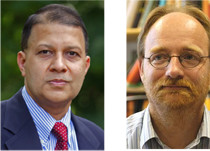
Jamsheed Choksy (l) and Michael Stausberg: trade and ethnic concerns
In comparatively modern times Friedrich Nietzsche’s Also Sprach Zarathushtra gave a new fillip to an ancient name which but three years ago sparked a controversy when Australian sculptor Peter Schipperheyn created a four-meter high bronze nude male figure and called it Zarathustra under the influence of Nietzsche’s book. The resulting hullabaloo on the Internet from the various Zoroastrian communities forced the sculptor to rename it Thus Spake Zarathustra, notes Stausberg.
Stausberg casts light on the Mazdaznan organization in Chicago and California using Zoroastrian terminology without claiming to represent historical Zoroastrianism. The Mazdayasni Zarathusti Anjuman/InternationalMazdayasnan Order on the other hand was inspired by two Zoroastrian priests, writes Stausberg — India’s Dastur (Dr) Framroze Bode and Iran’s Rashid Shahmardan. Their recruits consisted of ethnic Iranians seeking to return to Zoroastrianism. The most recent, more powerful and hence more vilified Zarathushtrian Assembly has several founding members who are prominent ethnic Zoroastrians but the Assembly’s moving spirit is Ali Akbar Jafarey whom Stausberg describes as "one of the most controversial figures in modern Zoroastrian history (at least from a Parsi point of view).” His "Gatha-Zarathustrianism is the sum of everything that is deemed to be politically correct from the point of view of a modern, enlightened worldview… individual responsibility and freedom of choice… commitment to a certain ‘way of life’ rather than membership in an ethnic community.”
Stausberg also refers to the impact of Alexander Bard in his native Sweden: "In Bard’s view Zarathushtra had anticipated the revolutionary thoughts of 20th century natural sciences, particularly the Big Bang theory and quantum mechanics, the former... necessitating the assumption of a Wise Spirit setting the frame for the process and unfolding of the laws of nature (Asha) and the latter requiring a non-deterministic worldview.” Swedish Iranian priest Kamran Jamshidi and Russian astrologer Pavel Globa are other players on the non-ethnic Zarathusti scene that Stausberg examines in his field of para-Zoroastrianism.
The concluding chapter by Hinnells on the Parsis in India and the diaspora examines their place in recent Indian history. Starting with Parsi involvement in the Indian National Congress like that of Sir Dinshaw Wacha, Khurshed Nariman and Firoze Gandhi, Homi Taleyarkhan and Sir Homi Mody, Hinnells goes on to Minoo Masani and Karachi’s Jamshed Mehta and more recently Jamshid Marker. He traces Parsi involvement in sports and science, in the professions, in arts and industry and briefly refers to religious change and the calls for the acceptance of the children of Parsi women married outside the fold. "There is widespread awareness of the huge contribution Zoroastriansism has made to the world from the time of Cyrus the Great… Zoroastrians can rightly claim they have contributed to any society in which they have lived. Despite the internal divisions between orthodox and reform… there is nevertheless a sense of ‘the Zoroastrian world’ united both by heritage and by contemporary interaction,” concludes Hinnells.
Every chapter of the book is replete with notes and bibliography. Maps, photographs and old cartoons liven some of the chapters. The index compiled by Nora Firby adds to ease of reference. The multifaceted compilation makes for interest and enlightenment.
◆ ◆ ◆
From the archive