
History
Searching in Sanjan
A team of archeologists excavates a dakhma and other artefacts in the west coast city
The sleepy little town of Sanjan is staking a historical claim as an important trade entrepot of the early middle ages (eighth to 14th century). Those were the days when Sasanian Iran traded with India and countries further afield in the Indian Ocean as students of history have consistently noted. Now a team of archeologists working under the stewardship of Dr Homi Dhalla and Dr Mani Kamerkar of the World Zarathushti Cultural Foundation (WZCF) have unearthed evidence that corroborates the theory. And the excavation of a dakhma has authenticated the Zoroastrian connection with this once thriving city.
Three seasons of excavation on the banks of the Varoli River have brought to light a large settlement having well constructed brick structures, advanced drainage systems, coins, artifacts and ceramics from the Persian Gulf and China as well as locally crafted ware, reports Rukshana Nanji who is working for a PhD based on the excavations at Sanjan at the Deccan College in Poona.
Every ring, every glass bangle, remnants of pottery, chemical residues, charcoal or grain located and later identified by washing or chemical analysis has been a source of joy. Remnants of liquid identified as wine or oil give an idea of fluids transported and/or stored. Rice, wheat, masur dal, channa, awla seeds, charcoal, have floated up when the dug up soil is put in water and stirred. The precious debris is laid out on the ground in well demarcated slots to indicate the precise location where they were found.
The piece de resistance however is the location of the dakhma some distance away from the settlement area. It is located on a high natural mound or small hill to the north of the port city, on land that now belongs to the Bombay Jashan Committee which has given the permission necessary for its excavation. Initially covered with shrubs, trees and other vegetation where the bulls of a local fisherman were given free rein, the spot when cleared presented a vista of a hill top with a deep crater, writes Nanji. "The rim of this crater was presumably the outer wall of the dakhma. The diameter of this circle is an approximate 35 m. This circle or rim was broken in the east, where, we are told from the notes and observations of 19th century visitors and by Sir Jivanji Modi, that the entrance and steps of the dakhma were located. Though the steps are no longer in evidence, the gap of the gateway or entrance is clearly seen,” states Nanji. Reverend John Wilson is said to have observed the steps and bricks in 1861 and Mlle Delphine Menant in her book The Parsis mentions Bhikhari Machhi living there who appears to have been the grandfather of the present occupant.
Though the traditional belief is that there existed nine dakhmas in Sanjan, this has been the only one located to date. Modi is said to have excavated a part of a dakhma at Sanjan in 1917. Exploration by the archeologists in 2002 led to its location. But instead of the normal high outer wall, the excavations revealed that the architects of old had scooped out the mouth of the mound, leaving the periphery as a natural wall. A sloping, parabolic floor of rammed mud and lime led to an inner well (bhandar) five meters in diameter. The dakhma had been enforced and riveted within with brickbats to check erosion and weathering, reports Nanji. The unusually shallow bhandar, one meter deep, lined with bricks and lime, must have been convenient for periodic cleaning, note the archeologists. In comparison, the bhandar of the Anjuman Dakhma in Bombay is said to be four times this size.
Small pieces of broken pottery, a few coins and beads were among the finds at the dakhma site. Even more interesting, says Nanji, were the large quantities of glass bangles and rings that were found. "A gold foil bead and a single gold earring also tell us something about the type of jewellery it was customary to wear. Most importantly, these finds indicate that the bangles, toe rings which all Parsi women wore then, following the normal custom in Gujarat, and various other jewellery were left on the bodies after death” — probably in deference to the adopted Hindu custom to die suhagan (while a husband is still alive as against the then dreaded status of widowhood when the woman was shorn of all finery), as note the archeologists. In Bombay today the dead body is customarily denuded of all jewellery before being consigned to the dakhma.
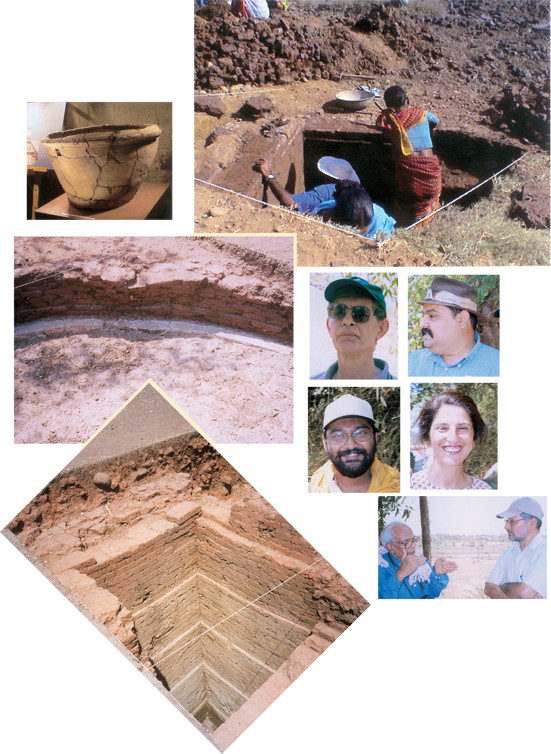
Top right: Excavations in progress Left: Reconstructed storage vessel Below: Inside of the bhandar ; Bottom right: Square well at the Bandar on the banks of the Varoli Center (clockwise from top left): Dhalla, Dalal, Nanji, Master, Gupta and Dan-dekar
Professionally led by Dr Kurush Dalal, ad hoc lecturer in archeology at Bombay’s K. C. College, the team is aided by Dr S. P. Gupta of the Delhi based Indian Archaeological Society which has also provided the seed money for the project. Other members of the site team include Dr Abhijit Dandekar, a research associate in archeology at Poona’s Deccan College, Suresh Bomble and Shivendra Kadgaonkar. Helping them behind the scene, studying the various items dug up are other experts: Drs Walimbe and Veena Tripathi who are studying the human remains; Dr Rajagura providing information on the geo-archeology of Sanjan; paleobotanist Dr M. D. Kajale with his expertise on botanical remains; Dr Pramod Joglekar studying animal remains and Dr Vishwas Gogte conducting chemical tests and analyses on pottery, etc.
Dalal took time out to acquaint Parsiana with the nitty-gritties of the profession. The three-year excavation on the two kilometer by one kilometer site on the banks of the Varoli is on privately owned land so the digging can only proceed by permission. "We can’t always excavate where we want to excavate,” he notes. Dandekar told us that the entire Bander site is in the hands of local fisherfolk and Muslims and that initially there was much local hostility to the WZCF team. The poor superstitious people would say "If you dig in my land my children will die,” recounts Dandekar. Three years of seeing them at the job has however changed perceptions and now "they love the interaction and seeing us work.”
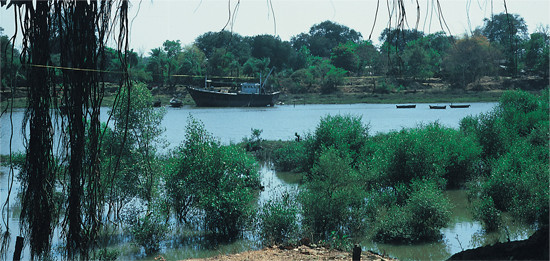
View of the Bandar on the Varoli River
Ideally, excavation work proceeds after a topographical survey which in this case cost Rs 60,000 but is incomplete as the cost for the entire region would amount to Rs 2,00,000. What you need is a ground penetrating radar (GPR) system in place whose minimum cost is Rs 10 lakhs and hence "practically impossible.” Dalal notes that they only buy equipment on a "need to use” basis and are lucky to have a friend’s flat available for use in the town which has eliminated the need for the enormously more expensive tents. Though Nanji voices the pride of the team that the WZCF is the first NGO to be given official permission to excavate in India, a "very prestigious” recognition, the project has a crying need for funds. Dalal credits Dhalla with performing a heroic job and the Sir Dorab Tata Trust has given four lakh rupees towards it, but the team needs at least two large rooms (about 1,000 sq ft) to lay out the 20 trunk loads of material they have unearthed, both for study and for display purposes.
Their imminent concern at the end of March 2004 was to find an affordable way of protecting the dakhma site against the coming monsoon. Dhalla hoped to provide "a permanent canopy so that it remains as a permanent monument.” Accordingly architect Porus Master and Gupta were on hand to discuss and advise on possibilities. Noting that "the greatest danger for any monument is water,” Gupta advocated strong steel supports, adequate underground drainage and sufficient space above the structure for the flow of air. But when Master estimated that even a barn-like shed of polycarbonate sheets on a steel frame with little by way of aesthetics would amount to nearly Rs 25 lakhs, there was no option but to pack up the painstakingly dug up site — one of the oldest dakhmas in India dating back to the ninth or 10th century — in tarpauline until sufficient funds could be forthcoming.
According to Dandekar, there is enough excavation work at the Bandar (port) site for 10 seasons. "A series of trenches are required to understand the settlement. We need to excavate 10 to 12 trenches horizontally to understand the structures, the houses, the town planning, (to learn something about) the social strata... You need a large trench to know the context of the structure, otherwise we too get confused. (But) to excavate horizontally requires a lot of expertise and a lot of labor,” he notes. He believes that what they have found is largely discarded material which "shows a general decline (of the commercial activity in the town) and that people have deserted the place which was once an important trading center. When a place has been ransacked it throws up different parameters. There would be a lot of burning, a lot of charcoal samples, dead bodies. There is also a different breakage pattern of the houses. There would be much more debris because people run away with (only) what they can carry...”
When the process of carbon dating — the best way of ascertaining the age of antiquated material — requires the material to be sent to Oxford, UK, and costs £ 400 for a 20g sample, much will depend on the liberality of community purse strings and the Parsis’ own commitment to their history.
Cheques/demand drafts for the "World Zarathusti Cultural Foundation” may be sent c/o Dr Homi Dhalla, 4, Ivorine, 154, M. Karve Road, Bom-bay 400020.
◆ ◆ ◆
From the archive