
Awards
The will to win
Seventeen achievers were presented the Federation of Parsi Zoroastrian Anjumans of India awards for excellence
"It is heartening to note that the pioneering spirit and yearning for excellence is still alive in our community,” noted Air Vice Marshal Adi Gandhi surveying the 17 awardees lined up to receive the Federation of Parsi Zoroastrian Anjumans of India awards for excellence. Military service, community service, education, professional competence, academic studies, the performing and fine arts, outstanding youth activity and sports were the fields in which they had shone as recognized by the gathering at Bombay’s Banaji Atash Behram Hall on the evening of June 7, 2003.
Commodore Aspi Dhunjishaw Marker, currently commanding officer of INS Angre and Commodore of the Naval Barracks in Bombay had shown exemplary leadership as Naval Officer-in-Charge of Gujarat when that state was devastated by a major earthquake on January 26, 2001. Moving from his base in Porbunder to Kandla he masterminded the conversion of two survey ships into hospitals complete with sterile operation theaters within 12 hours. "Kandla port became operational in a record time of 72 hours, naval establishments in Gujarat became premier frontline forward operating bases and successfully carried out assigned tasks with the utmost operational efficiency despite numerous constraints,” reads the citation. As member of the Gujarat Maritime Board, trustee of the Kandla Port Trust and director of the Gujarat State Shipyard — Alcock Ashdown Limited, Marker is said to have acquitted himself with remarkable credit. For his excellent performance, dedication and devotion to duty Marker was awarded the Nao Sena Medal on Republic Day 2003.
A masters degree holder in defence and management, Bombay born Marker had schooled at Delhi, Poona and Agra as his Air Force officer father, Group Capt Dhunjishaw Marker, subsequently president of the Mhow anjuman, was posted in various locations. Commodore Marker was commissioned in the Indian Navy in 1971 and took part in the Indo-Pak War that year which led to the independence of Bangladesh. He has commanded several Indian naval ships, INS Agnibahu, a shore based naval establishment and the 22nd Missile Vessel squadron. He has served as chairman of the Naval Public School in Bombay, and on the faculty of the National Defence Academy at Khadakvasla, the Defence Services Staff College at Wellington and the College of Defence Management at Secunderabad, further notes the citation.
Marker received the Federation’s Lt Col Adi B. Tarapore Memorial Award for 2002 at the hands of Gandhi who hailed the "dedicated mariner (as a) good friend and entertaining companion.”
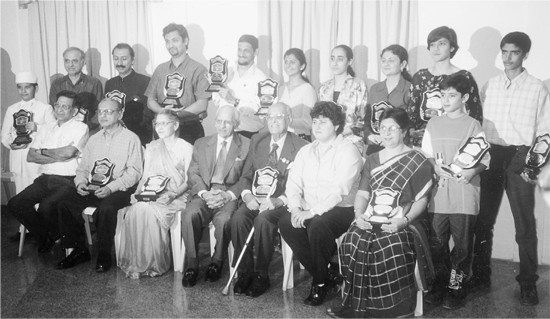
The awardees pose with Federation president Minoo Shroff
Himself a former Federation laureate, who had been awarded the Mahavir Chakra by the Government of India, Gandhi recalled the legendary heroism of the late Tarapore whose "pure selflessness, disregard of personal safety (and) indomitable fighting spirit” won the ultimate accolade — the grudging respect of the enemy (who referred to him as) Fakr-Hind, a title now adopted by (Tarapore’s regiment) the Poona Horse as a proud prefix to its regimental name.
Gandhi was sad that "our community that had provided the country with outstanding achievers in all fields was now unable to live up to our history.” He blamed lack of parental and community encouragement for the "static inertia that has engulfed the community” and called for "attitudinal changes in ourselves.” He urged his co-religionists "to open up to the challenges awaiting us.” The raison d’être of the Federation awards he said, should be the "single-minded purpose to spur (the community) to greater effort.”
A mechanical engineer from Baroda’s MS University with a penchant for research, Ronnie Rumi Sabawalla’s pioneering work at harnessing solar energy to quickly dehydrate corpses in vultureless dakhmas won him the Shiavax D. Nargolwala Memorial Award for social and community service in 2002. Prior to Sabawalla’s reflectors the stench of bodies rotting over several months had been a source of grave anxiety to the community and its leaders.
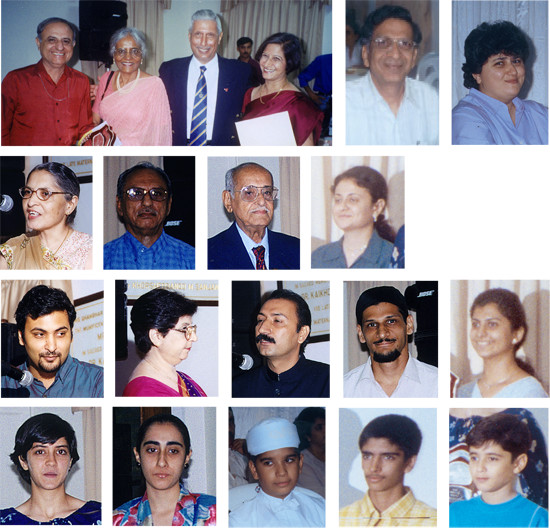
L to R (1st row): Marker, Ms Gandhi, AVM Gandhi, Ms Marker, Sabawalla and Godiwalla (2nd row) Kapadia*, F. Patel*, alamkote* and Shethna* Photos by Sarosh Daruwalla Mazda Audio and Video Labs; (3rd row) Marfatia*, A. Patel*, Debara*, Mehta and Rana (4th row) Billimoria*, Bhadha*, Dastur, Suratia and Cooper
Deep and diverse was the knowledge gained from 25 years’ experience in machine designing and manufacturing of heavy-duty metal forming machinery under the corporate name of Himalaya Machinery Private Limited. Then Sabawalla and his partner essayed the manufacture of eco friendly products like solar heaters, solar cooker, pedal power generators, etc under the name Rashron Energy and Auto Private Limited. Their products included electric bicycles and tricycles for the use of the invalids and the physically challenged, notes the citation.
Though their solar cookers reached boiling point, they were incapable of frying and other uses which require higher temperatures until they met the German scientist Wolfgang Schettler. Thereafter they succeeded in creating a solar crematorium reaching 700°C to save wood used for cremation. With the aid of Schettler, a solar concentrator was created where, despite the long distance from the reflector to the body in the dakhma, the right temperature was achieved at the focal point ensuring the required dehydration, the citation traces Sabawalla’s product development.
The Mazda Education Foundation Award for education in 2002 was conferred on Dr Gahver Godrej Kapadia.
A PhD in education from Baroda’s Maharaja Shivajirao University, she has worked as a research fellow of the University Grants Commission at its Centre for Advanced Study in Education, then gone on to Hyderabad’s Princess Esin Women’s Educational Centre, working there for the next 20 years as lecturer, deputy director and director, notes the citation. Thereafter she returned to Gujarat to work as director, resource mobilization and public affairs, of the Consumer Education and Research Center and as consultant to the Child Resource Centre and Women’s Health and Development Resource Centre of the Centre for Health and Education Training and Nutrition Awareness (CHETNA). During these years Kapadia lectured and published papers and research articles on the education of pre-schoolers, underprivileged children, adolescent girls and minority community females.
Kapadia’s "contributions in the sphere of education and research related to ageing has received international recognition. She was sponsored by the United Nations Population Fund to participate in the Expert Group Meeting on Population Ageing and Development held at Malta in October 2001... The Valencia Forum Spain (invited her) in April 2002 to present a paper on Ageing Women in Rural India,” states the citation. She also attended the United Nations’ Second World Assembly on Ageing in Madrid in April 2002 at the invitation of the Spanish NGO World Forum.
Receiving the award Kapadia acknowledged her debt to former teachers, colleagues and well wishers and promised professional assistance to the community.
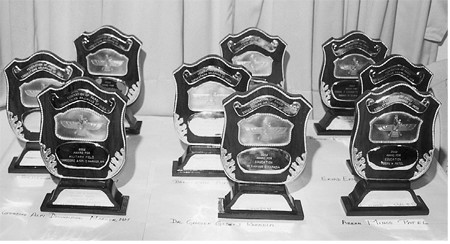
The Federation Awards conceived by Bodhanwalla, designed by Rustomji
Principal of Bombay’s Sir Cowasjee Jehangir High School Abban Minoo Patel received the Gharda Chemicals Award for Education for 2002. Five eventful years on the job were recognized when she and the School were respectively conferred the Jewel of India Award and the Vidya Rattan Award by the International Institute of Education and Management, and the National Mahila Excellence Award and the National Gold Star Award by the International Business Council in December 2002, states the citation. "Under her stewardship 92.6 percent of the students were declared successful in the Secondary School Certificate examination held in March 2001. In March 2002, the school bettered its performance with the success ratio being 95.5 percent.” The citation further notes the appreciation of parents in the all-round development of the children and their participation in social service activities.
The Ajmer-born Patel had worked in a bank in Jaipur before realizing her true vocation. Getting her BEd degree she taught at St Joseph’s High School, Vikhroli, for 17 years before taking on her present assignment.
Delnaz Behram Shethna of Ahmedabad who secured the second rank at Gujarat University in her first and third LLB examinations was presented the Jamshed and Shirin Guzder Award for best youth in 1999, notes the citation. That was the year she graduated in commerce earning a merit certificate from the National Scholarships Scheme. Trophies in elocution, debating and moot court competitions also came her way from 1999 through 2002, mentions the citation. Editor of her college magazine H. L. Times for three successive years, essay writing, creative writing and dramatics are listed among other activities in which Shethna has excelled.
The Jamshed and Shirin Guzder Award for best youth in 2002 went to Ervad Eric Zarir Dastur, a seventh grader at the Athornan Boarding Madressa. Securing 79 percent marks in standard VI earned Dastur merit certificates for proficiency in mathematics, English and the social sciences and the first prize in school studies, computers and bhantar (prayers). Having completed his navar and maratab initiations and the "samel examination” at Udvada, Dastur qualified as sampurna mobed at the age of 11, performed the boi ceremony at the Iranshah on December 20, 2002, and initiated another young candidate into the priesthood before the end of the year, notes the citation.
Also declared best youth for 2002 was entrepreneur Porushesp Hosang Debara of Agra. He received the Aloo Noshirwan Cama Award.
A graduate in commerce and law, Debara holds a diploma in animal by-product utilization from the Central Leather Research Institute at Madras. In charge of production and purchasing in his father’s business of manufacturing animal based organic fertilizers and other animal by-products, after an initial period as apprentice trainee, Debara has chalked an annual growth rate of 63.6 percent for the 20 years he has been with the business, notes the citation.
Managing committee member of the National Chamber of Industries and Commerce, Uttar Pradesh, Debara is vice chairman of its development, telecom and law and order subcommittees. He was appointed Honorary Special Police Officer in September 2002. Debara is vice president of the Federation of Zoroastrian Youth Associations (FOZYA) which he helped to found.
Ranked fifth on the merit list of the Company Secretaries Examination 2002, Bakhtavar Aspi Bhadha was presented the Saraswati Dhanuka Memorial Award by the Institute of Company Secretaries of India for securing the highest aggregate percentage among women candidates, passing all eight papers at one go in her first attempt. She also received the WIRC cash prize and past president Chinubhai R. Shah Award from the Institute, notes the citation. Bhadha had received the ZOSTA Awards in 1996 and 2001 as the highest Zoroastrian scorer at the SSC and TYBCom examinations respectively.
A student who has passed her elementary and intermediate grade drawing examinations and won the first prize in the All India Camel Colour Contests in 1993 and 1994, Bhadha has won prizes in quiz, essay writing and Gujarati language organized by the Iran League.
Bhadha, who is also said to be proficient in Marathi, received the Dhunjishaw R. Gheyara Memorial Award for academic studies in 2002.
The Jamshed and Shirin Guzder Award for performing and the fine arts in 2002 was bagged by documentary filmmaker Heeraz Noshir Marfatia. His directorial debut with Birju, a 16-minute color film in 35 mm made it to the final round of six nominees for the Students’ Academy Award (Oscar) 2002 and was also selected from among 4,500 short films entered at the Sun Dance Film Festival 2002 — the biggest film festival in the US, notes the citation. Other awards Birju won in his category in 2002 include the Jury Award at the New York Film Expo, the Academy Award at the Big Bear Film Festival and Best Short Film at Tellurede Indifest. The film was also the recipient of the Special Jury Award 2003 at the Berlin International Film Festival. Marfatia received the Outstanding Achievement Award 2002 from the Alumni Association of the San Francisco State University where he has been working for his masters degree in Fine Arts in Cinema and taught a film production class.
Currently Marfatia is in the process of completing his thesis for the MFA program. Birju, the film he was required to make as part of his course, recounts a four-year-old boy’s search for his mother in the village and the distractions that come his way.
Marfatia acknowledged that the Bombay Parsi Punchayet (BPP) had helped him go abroad three years ago and that several other trusts provided the finance to create the film that won these awards.
Twelve-year-old Azhaan Pervez Cooper features in talk shows, and music video, has lent his voice for various commercials and modelled since the age of three for press, poster and TV advertisements with the likes of Sachin Tendulkar, Saurav Ganguly and others.
Despite these distractions Cooper has been a topper in his class at Bombay’s St Xavier’s High School and has been awarded the School’s certificates for general proficiency. He sings and plays the piano. He also participates in quizzes, elocution and extempore speech competitions.
Cooper received the Jamshed and Shirin Guzder Award for the performing and fine arts for 1999.
Four youths and two veterans laid claim to six awards in the sports category. Zerwan Phiroze Suratia, an alumnus of Poona’s St Vincent High School has participated in national level equestrian meets since the age of 14 and won four medals in the First All India Sainik Public Schools and Open Equestrian Championship held in Poona in 2002. At the second edition of this event in 2003 Suratia "took part in 11 events and won a position in all of them bagging two gold, four silver and five bronze medals. His tally was the highest among all the competitors in the meet including the cadets from National Defence Academy, Poona,” states the citation. Suratia owes the development of his riding skills initially to the BEG Centre’s Army Riding School and their fine-tuning to Arjuna Awardee Col G. M. Khan, VSM (Retd) of the Equestrian Academy of Poona.
With a scoring average of 70 to 75 percent marks throughout his school career, Suratia has a blue belt in karate, has passed his A certificate National Cadet Corps exam and was the second platoon leader attached to the Third Maharashtra Armed Squadron Unit.
Felicitated by the Mancherji Joshi Trust on Jamshedi Navroz earlier this year, Suratia received the Federation’s Jiji D. Irani Memorial Award for 2003.
The Jiji D. Irani Memorial Award for 2002 was conferred on Yazneen Sarosh Rana, the 18-year-old archer from Jamshedpur. In January this year Rana "won the gold at the Junior National and silver in the Junior Asian Archery Championship,” states the citation. But she has been participating in state and national level meets since 1994. Up to 1996 Rana was "runner-up at state level in the sub-junior category in the 10 m Indian round. In 1997, she helped her team with the championship in the sub-junior category at the state level and in 1999 at the national level. In the 24th Junior National Archery Championship held in Delhi in April 2002, she bagged six medals, two gold, one silver and three bronze and helped her team to win the Team Championship Trophy. Sixty women archers participated in this National and Rana was placed second in the All India ranking,” the citation records her achievements. The archer’s skills have been honed by Arjuna awardee Sanjeeva Singh.
Apart from this overriding passion, Rana has an outstanding academic record and has bagged prizes in English and Hindi elocution, dramatics, sports and games including badminton, basketball, swimming, para-sailing and river rafting and won the Best All Rounder Award in middle school and Outstanding Extra-curricular Award in high school from Loyola School. In 2001 she won the Duke of Edinburgh silver medal for adventure, sports and social service, notes the citation.
Long distance running and participation in marathons and mini marathons earned Peshotan Jehanbux Mehta the Aloo Noshirwan Cama Award for 2002. In that year he had won the 1,500 m men’s event in the Fifth Ryan Maharashtra state level annual Open Athletic Meet on November 15 clocking 4.31 mins. In July 2002 Mehta also participated in the Thana Mayor’s Monsoon Marathon covering a distance of 42.2 km in three hours, five minutes. In November 2002 he ran the Indira Gandhi Marathon in Allahabad in two hours, 53 minutes. At the 18th All India Prize Money Indira Marathon, also in Allahabad that month, Mehta ranked 19th having covered 42.2 km in two hours, 48 minutes and 55 seconds.
Mehta, a master of commerce from Bombay University has been coached by Dr Rohinton Mehta, a veteran of state and national championships, notes the citation.
The Dr Dadi Balsara Award for 2002 was conferred on young athlete Ayesha Neville Billimora who had won the individual championship for senior girls at the 108th Annual Inter School Athletic championship 2001-2002 held in Bombay. Thereafter she broke two meet records at the Inter School (ICSE) athletic meet in Bombay in January 2003 when she clocked 100 m in 13.1 seconds and 400 m in 65.9 secs. Her tally at the meet included three golds (in 100 m, 200 m and 400 m run) and a silver in shot put. She also takes part in high jump events.
This sprinter, who completed her ICSE from Bombay’s Activity High School, participated in 12 athletic meets in 2001 and 2002, winning 11 in the 100 m run and being second in the 12th, informs the citation.
Veteran sportsman Farokh Phirozsha Patel, who struck gold in the National Veteran Championship in Thana in 1998 and in Goa in 1999 when he threw his javelin 31 m away in the 60+ age group, won the Federation’s Dr Dadi Balsara Award for 1991.
A sportsman who captained his college cricket team as well as that of Tata Chemicals 1980-82, Patel had won the Javelin Throw Championship in the Gujarat Rajya Kuda Mahotsav for four consecutive years 1964-67. After the age of 50, Patel continuously participated in the veteran category. His longest throw was 34.92 m in the National Veterans Athletic Championship in 1991 where he earned a silver.
The only living Parsi Pehelvan — Edul Pirojshaw Palamkote, now aged 83 — was conferred the Dr Dadi Balsara Award for 1989 because the Limca Book of World Records recognized on November 22, 1989 that Palamkote’s record of pulling a fully manned fire engine by his teeth for 100 yards remains unbroken, notes the citation.
For three consecutive years, 1938-40, Palamkote held the Mr Bombay title, but by the age of nine he was already one of Bombay’s strongest boys. Palamkote’s feats of strength include lifting 200 lbs of weight with his teeth, tearing two telephone directories to shreds, breaking thick buffalo chains and a thick iron bar into two while lying on a bed of nails, says the citation.
This phenomenal strength was created by an act of will when his father slapped him for taking a beating from another boy, recounts the citation.
During World War II Palamkote served as Fire Chief of the Armed Forces — the first and youngest Indian ever to be so appointed. His collection of trophies include certificates of merit and war service medals as well as 25 gold and silver medals and 15 silver cups for his performances, notes the citation. After the war he served a number of industrial houses as a fire security and safety officer. He still functions as the badge examiner for West and Central District Bharat Scouts and Guides aiming to secure fire and safety badges.
Well known solicitor and BPP trustee Dadi Engineer, the evening’s compere, had added a touch of sparkle to the awards function with humor and quotes. In a story all his own he recounted an occasion when Palamkote had performed all kinds of feats, bending bars, breaking coconuts, etc. Engineer said he capped these activities by squeezing a lemon and challenging the audience to squeeze another drop out of it. "One man took up the challenge. A new lemon was brought and the 90 pounder squeezed every drop of juice from the lemon with his first two fingers. ‘Who are you?’ Palamkote demanded to know. ‘I’m the Commissioner of Income Tax’ answered the man.” Engineer’s clincher had the audience in stitches!
Having revelled in Tannaz Rohinton Godiwalla’s cuisine like all true Parsis, Engineer had a special word of thanks and a kiss for her as he presented her the Federation’s G. K. Panthaki Award for professional competence in 2002.
Godiwalla "inherited her passion for catering from her parents Rohinton and Frenny who were the first to turn around the mundane profession of catering into an art and a science and made Godiwallas a name to be reckoned with in quality catering specializing not only in first rate food but also in excellent service at lagans and navjotes,” notes the citation.
An economics graduate from Bombay’s St Xavier’s College, Godiwalla’s "professional competence has enabled her many a times to successfully undertake and manage simultaneously three lagan/navjote functions at different locations,” states the citation. "I’m truly honored,” said Godiwalla in a brief acknowledgment.
Recalling how then Jamshedpur president Homi Bodhanwalla had conceived the awards and framed the guidelines and how Delhi Parsi Anjuman secretary Farrokh Rustomji had designed the shields, Engineer went on to thank the BPP staff for their annual exercise of organizing the event and scripting the ceremony. Quoting from Lord Alfred Tennyson’s Ulysses — "To strive, to seek, to find and not to yield” — Engineer hoped "we have more awardees and many more men and women who strive for excellence.”
The solar energizer
"It will be another 10 years before the solar reflectors become reliable. They are like the new automobiles in the early 20th century. There was no sports engine right from the start!” Ronnie Sabawalla reminded us in the course of a brief chat after the ceremony.
Nonetheless his solar concentrators, even in their present juvenile avatar, have taken the heat off the trustees of the various anjumans (especially the BPP) and focused it on the cadavers that earlier took up to five months to dispose in the absence of vultures, while emanating the foul odor that haunted Bombay’s Doongerwadi locality.
The reflector consists of several flat mirrors, individually mounted, and is equipped with sensors, a timer and a small electric motor to help change the angle of reflection with the declination of the sun, explains Sabawalla. "Each (mirror) has to be reoriented every day,” his statement emphasizes the complexity of the contraption which looks simple but is extremely technical. It has to be designed individually to suit the geographical location, height and diameter of each dakhma and takes up to two months to manufacture, he tells us. If the dakhma is too small the reflector does not work because of the shadow of the wall, he notes. The large Bombay dakhmas, need six to seven reflectors each because each reflector focuses on a single body.
Baman Cama, trustee of the Baroda anjuman, was aware of Sabawalla’s production of a solar crematorium for the Hindu community. It was Zoroastrian scholar Dr Homi Dhalla however who suggested to Cama the idea of modifying the service for Zoroastrian use, says Sabawalla recalling the germination of the idea that led to months of experimentation to regulate the temperatures produced so that the body may dehydrate rapidly but not burn. This "became a sort of challenge,” especially to his German mentor, nuclear physicist Wolfgang Schettler, notes Sabawalla.
It was Schettler who had helped Sabawalla and his partner Rashmi Shah and their enterprise Rashron Energy and Auto Private Limited overcome technical problems in their effort initially to create solar driven energy systems for the domestic sector and then in the creation of the crematorium.
In their efforts to find a way out for Zoroastrians who sought to use the traditional method of disposal of the body in the absence of vultures, Sabawalla and his company spent months experimenting on goat carcasses. The research work was completely financed by the BPP and other donors, he notes. Refusing to take personal credit Sabawalla says, "it was team work.” He thanks his partner, the scion of a "Gandhian freedom fighter family,” for encouraging him to spend so much company time and energy in developing the reflectors as well as his Muslim coworkers who helped cut and clean goats for their many experiments.
Sabawalla believes that Schettler who has his own financiers in Germany and Switzerland, must have trained more than 500 solar engineers. He describes the man as "more a saint than a scientist,” who wears khadi, reads the Bhagwad Gita, comes to India every year for four to five months and teaches others.
While his father was a lawyer, Saba-walla has inherited engineering skills from his maternal uncles who worked in the railway workshop. Work has led him to travel a lot, preferably by car even to faraway Calcutta or Agra where the Taj Mahal has lured him seven times by now. Eschewing hobbies and a social life Sabawalla prefers to concentrate on his experiments. His wife Jabiz helps with technical drawings in the factory. His daughter Jehanaz, 17, has just passed her higher secondary examination and opted for home science. Ratan, his 15-year-old son who has just finished his SSC, "plays cricket all day long!”
The community and its many controversies leave Sabawalla cold. "We are becoming lazy, we will lose our gloss,” he notes tersely. He views marriage pragmatically — the closer the cultural levels, the better the chance of the union succeeding. While such cultural closeness may be difficult in an intercommunal marriage, "Parsis also can be from very different cultures,” he comments.
As for the long-drawn battles regarding the disposal of the dead, Sabawalla says, "My common sense tells me that it (the mode used) should be inexpensive and ecofriendly. Disposing of the body is not a religious issue. If we are thinking of how to educate children, it is important. This is not important...”
◆ ◆ ◆
From the archive