
Institutions
Showcasing excellence
The Russi Mody Centre for Excellence in Jamshedpur stands testimony to the far reaching vision of the Tatas
Heads of State, government officials, collaborators, customers and guests of Tata Steel begin their voyage of discovery with a visit to The Russi Mody Centre for Excellence (more commonly referred to as the CFE). And they leave deeply impressed. The CFE has the distinction of being the first center in the country to provide a common platform to organizations of varied management disciplines, working together for the promotion of professional excellence.
Set on a sprawling 5.5 acres of land in the township of Jamshedpur, the Centre owes its genesis to the vision of J. R. D. Tata (JRD) who conceptualized it. Ratan Tata, Dr Jamshed Irani and S. Sabavala gave shape to the vision of JRD. Ten years ago when it opened its portals to the public it was named after Mody to commemorate his 50 years of working for The Tata Iron and Steel Company Limited (TISCO). Today the Centre showcases the ethos of Tata Steel.
A visit to the CFE is an aesthetically appealing, mentally stimulating and emotionally moving experience. The environs and architecture that house the CFE are as inspiring as the treasures and ongoing activity within. There is an arresting blend of modern, low-lying, planed and angled buildings juxtaposed against pyramidal structures and Greco-Roman pillars. There are undulating green mounds and valleys and serene water bodies in which can be seen the reflections of the buildings and gardens. The entire campus is designed by eminent Bombay architect Hafeez Contractor. Of the two main entrances, one has a gigantic pyramid through which one descends into a circular courtyard, edged with cobblestones. Contractor has used the pyramid to symbolize balance, peace and perfect geometry. The other entrance leads through a series of 10 huge columns, symbolic of ancient wisdom and philosophy. The total effect created is one of timelessness.
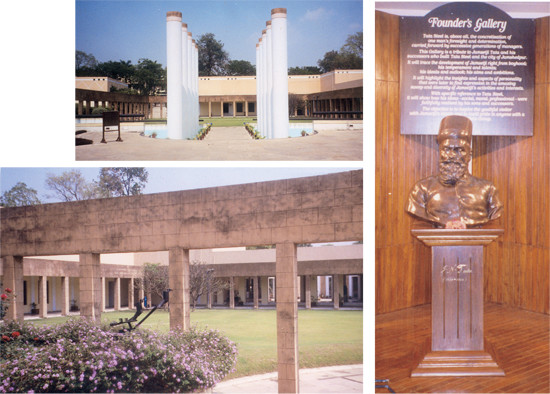
Sylvan settings (above) and one of the approaches to the CFE (below); bust of J. N. Tata in the Founder’s Gallery Photos: Dilnavaz E. Bhagwagar
A laudable aspect of the CFE is that it is not just a passive museum for a slice of history or a monument that stands mute testimony to a bygone era of excellence.
There are three permanent Exhibition Galleries and the Tata Steel Archives on one side of the beautifully landscaped valley. Opposite this is the office block of the Society for Promotion of Professional Excellence (SPPE).
The SPPE is a non-profit organization with B. Muthuraman, managing director of T1SCO as its president. Leading professional bodies like the Confederation of Indian Industry (CII), Indian Institute of Metals, Computer Society of India, are among the 17 institutional members of the SPPE. Major Tata companies are corporate members.
Offices for institutional members are accommodated on two levels of the main office block. In addition there is a well-equipped business centre, a reference library, a meeting room and an auditorium for the use of member organizations. Built to seat 80 people, the auditorium is fitted with state-of-the-art equipment and projectors. The acoustic system is so sophisticated that it needs no microphones or sound-projection aids.
If the office block of the SPPE is the cerebral center of the CFE, the three galleries and the archives are the heart and the soul of this unique complex. They have the power to move visitors to wonder and awe at how the vision of one man could affect the destiny of a country, a community and a culture.
The three interlinked galleries have effectively displayed photographs, letters, manuscripts, documents, artifacts and information. They were built with the objective of providing visitors with an understanding of the steel company’s ethos and values from the founder’s vision to the present day advance in the steel plant and the township. Bringing it all alive for visitors are the very well informed and courteous staff of the Centre. I was fortunate to have Behroze Gazder, the program manager and an articulate MBA from XLRI (Xavier Labour Relations Institute) show me around the galleries and archives.
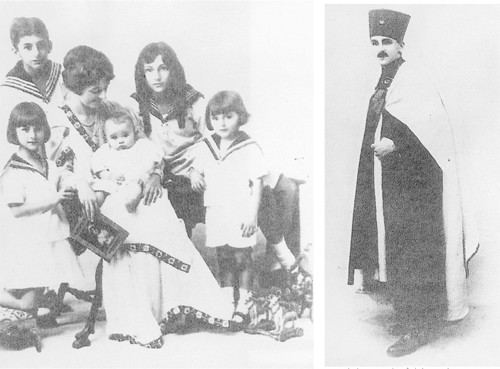
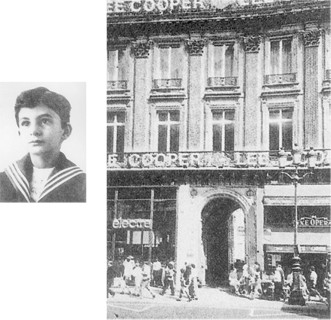
Archival treasures: Sooni Tata with her children; J. R. D. Tata as a conscript in the French army; (below) the house in Parsis where J. R. D. was born and J. R. D. as a young boy
The Founder’s Gallery has archival treasures on the life of Jamsetji Tata and his vision of a free India. He was one of the few people who foresaw what many others of his time did not — that liberation from poverty and economic independence were as important as political freedom. The freedom that Tata envisaged rested on the economic cornerstones of science, power and steel. One can browse the Founder’s Gallery for hours, reveling in photographs of a gracious era, reading in Jamsetji’s own rounded hand his letters to Swami Vivekananda and other leaders and marvel at the commitment of spirit and courtesy of tone in his letters.
Another, among the very interesting documents on display is the prospecting license given by the British to the Tatas on an eight-anna stamp paper. Dated June 14, 1904, it is hand written on a single sheet of paper, eight and a half feet long!
The Jamshedpur Gallery has photo montages to illustrate the company’s social commitment and the efforts being made in areas of community welfare, education, rural development and family initiatives. AIDS awareness, de-addiction, Well Baby Clinics and Sas-Bahu programs are just a few of the dozens of community welfare activities highlighted in this Gallery. The well-being of the workers was of foremost concern to Jamsetji and his successors.
The Technology Gallery has a detailed model of Tata Steel works with illuminated panels that take visitors on a visual tour of Tata Steel’s modernization journey to emerge as India’s foremost world-class steel maker.
One floor is given over to very interesting material on JRD and all that he accomplished in 53 years as chairman of the Tata group of companies. There are rare records and endearing pictures of JRD’s mother Sooni, with her five young children, Sylla, Jehangir, Rodabeh, Dorab and Jamshed; JRD’s house in Paris where he was born, JRD as a young boy, JRD as a conscript in the French Army, JRD’s pilot license (the first pilot license issued in India) and other fascinating memorabilia.
There is a well-preserved diary, written by Axel Shalin who was one of the partners of an engineering company in Pittsburg engaged by Tatas as construction engineers. Shalin actually sighted the location for the steel company. His diary, written sometime in 1901 when he was returning to USA on a ship, carries an interesting impression of the Parsis as he saw them. To quote, "The race now numbers about 80,000. There is no poverty amongst them. They have hospitals, schools, old-age homes and a close corporation enforcing its own laws. They do not recognize marriage outside the race and this keeps their numbers about constant and the strain pure. Many Parsis are enormously rich and well educated. Their homes are palatial. Such jewels as I have seen the Parsi ladies wear, I never saw nor dreamt of. Even on board this ship, we have one Parsi lady who every day appears with different sets of jewelry. She carries with her a very huge fortune in stones alone.” The diary goes on to say, "In the afternoon, Queens Road in Bombay is filled with their elegant carriages and automobiles. Malabar Hill is lined with their palaces and on top is seen their Pit Of Oblivion; the Towers of Silence where vultures devour their dead. Many Parsis are my friends and I think highly of them and admire them.”
As interesting as the letters, books, maps, charts and photographs of historic importance that one can see at CFE, is how these are documented and stored in the central repository of the archives.
The archival process is a long and arduous one. "When the material is first received it is fumigated and de-acidified,” explained Gazder. "Trained restorers then mend, laminate and encapsulate it. Thereafter it is stored in specially made, chemically treated, termite-proof boxes with naphthalene bricks separating the boxes.” In order to avoid frequent physical handling of the material by researchers and scholars, it is all put on microfilm. To retrieve documents accurately and speedily, over 1,00,000 of the documents and 45,000 photographs have been digitalized and put on a ‘Search Engine’ which is a specially designed software, with each document having a heading, nomenclature and number. Being aware of this long process and the dedication of those who handle it makes one more appreciative of the wealth of material that has been stored for posterity.
While most of the material for the archives is sourced from the Tata family and Tata offices across the country, they are not the only source. Individuals and organizations have come up with valuable material. Eighty-year-old Richard Harthrone, grandson of Shalin visited the CFE in 2000, along with his wife. It was a pilgrimage of sorts, to trace the beginnings and career growth of his grandfather in the steel plant. Harthrone was greatly impressed by the way in which the archival material was preserved and presented. He went back and sent a trunk full of memorabilia — personal jottings by Shalin, dhobi bills, hotel bills, railway tickets and picture albums of Kalimati camp site, hunting expeditions, social life and more!
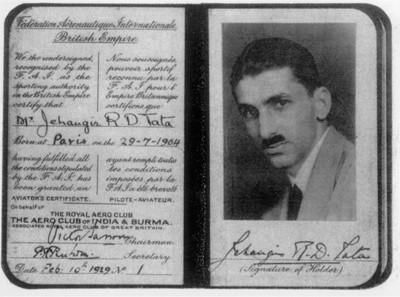
J. R. D. Tata’s pilot license Nunber One, the first in India, issued by the Federation Aeronautique Internation-ale, signed by Sir Victor Sassoon, on behalf of the Aero Club of India and Burma, February 10, 1929
"An educational tour through a slice of history. Splendidly resourced and presented,” commented N. Ram, editor, The Hindu, in the Visitors’ Book. "I salute the great heroes of Indian industry, the Tatas. Leaders in industry and leaders in humanity,” remarked Vice Admiral John de Silva, naval headquarters. "I have never felt more motivated or moved in my entire life as I have after visiting CFE!” noted Adil Vesuwala of Bombay. "As always, one leaves here inspired and rejuvenated. We are all heirs to the legacy of Jamsetji and JRD and each of us has to make our own contribution to the Tata tradition of excellence!” reinforced Farrokh Kavarana, director, Tata Sons. "I thank (the Tatas) for providing me the funds to study abroad. Tatas are also the motivation for me to come back to India. I believe that if I make it big, it will be the best tribute to Tatas and to the spirit of excellence!” declared Tata Scholar Swaminathan Iyer. And so it goes on, line after line, page after page, book after book. Through all spectra of society and cutting across communal and geographic divide, the homage to Jamsetji and the House of Tata and the pride in being associated with them, as countrymen, customer, staff, stakeholder or scholar, is as moving as it is sincere.
The Centre has chosen to utilize its vast infrastructure, facilities and resources to enrich the life of the community it stands in. It does this through the most potent "agents of change” — the school children of Jamshedpur. A variety of programs and projects have received the Centre’s attention over a period of years. The current thrust is on environmental awareness through essay, drawing and photography competitions, lectures by eminent speakers, and question and answer sessions. One prestigious program was an interactive meeting between Bharat Ratna, Prof A. P. J. Abdul Kalam (before he became the President of India) and a 1,500 strong gathering of school children.
Artistic pursuits receive equal attention. Renowned painters and sculptors are invited for workshops at the Centre where they paint and sculpt and interact with local talent. Sculptors are encouraged to walk through the steel plant and pick up any scrap as raw material to work with. A lot of paintings and sculpture from such workshops adorn the corridors and gardens of the CFE.
A visit to the CFE is a holistic experience that encompasses a preserved heritage and a projected future: it ennobles both industry and art; it inspires every visitor to greater heights of achievement. Above all it pays fitting homage to a great man — Jamsetji. Towards the end of his life, Jamsetji urged his close family and associates to carry forward the work he had started: "Go on doing my work and increasing it, but if you cannot, do not lose what we have already done. Preserve it.”
◆ ◆ ◆
From the archive