
10WZC
Separating fact from fiction
Archeologist Rukhshana Nanji narrates the significance of the Sanjan excavation
"Did we live in Sanjan? Did we (Parsis) establish Sanjan or Sindan or was it already an established town?” Rukshana Nanji an archeologist posed these rhetorical questions as she addressed the audience at the 10th World Zoroastrian Congress on December 28, 2013, in an adjoining break-away room. Her talk titled ‘Archeological evidence of Zoroastrian migrants to India,’ attempted to explore the relationship between Zoroastrians and Sanjan. Under the auspices of World Zarathushti Cultural Foundation (WZCF), the independent researcher examined the stories to determine fact from fiction as told in the Kisse-i-Sanjan (KiS). No documentation of the initial voyages from Iran to India is in existence.
"According to KiS written in Persian by a poet priest – Dastur Bahman Kaikobad in 1599 CE, Parsis built Sanjan,” noted Nanji who worked on excavations in Sanjan between 2002 and 2004. "Archeological findings place Sanjan as a prosperous port city, not a village of refugees. Lots is right (in the KiS) but there is also some romanticization.” Parsis lived there in peace for 300 years but a fierce battle of two or three days between Hindus and Muslims, saw the fall of Sanjan. "We then fled to the Bahrot Caves for 14 years, saw a threat and inhabited Bansda for 12 years,” the archeologist narrated. "Parsis then moved to Navsari. "The (KiS) story ends here,” she asserts.
"According to KiS written in Persian by a poet priest – Dastur Bahman Kaikobad in 1599 CE, Parsis built Sanjan,” noted Nanji who worked on excavations in Sanjan between 2002 and 2004. "Archeological findings place Sanjan as a prosperous port city, not a village of refugees. Lots is right (in the KiS) but there is also some romanticization.” Parsis lived there in peace for 300 years but a fierce battle of two or three days between Hindus and Muslims, saw the fall of Sanjan. "We then fled to the Bahrot Caves for 14 years, saw a threat and inhabited Bansda for 12 years,” the archeologist narrated. "Parsis then moved to Navsari. "The (KiS) story ends here,” she asserts.

Archeologist Dr Rukshana Nanji
"It was an informed decision to go from Iran to Hind,” she claimed. "You could not simply sail off.” Ships had to be sturdy and an in-depth knowledge of winds, tides, storms, astronomy and other related subjects was a necessity. Trade in the Indian Ocean was at a premium even those days, noted Nanji. Her archeological research leads to placing landing of the Zoroastrians to port Diu where we stayed put for 17 years, instead of landing in Sanjan as alleged. Nanji added that the Sanjan stambh (pillar) is at least one mile from the supposed Parsi landing.
What is clear is that Sanjan was a thriving port with a sophisticated urban lifestyle. It is also clear that Sanjan was already established and part of the Indian Ocean network in the 8th-9th century. Hence the theory of several Zoroastrian scholars that the Zoroastrian migration took place in the 10th century (936 AD is the date they derive from calculations based on their reading of the KiS roj-mah-tithi) is conclusively disproved. "A bulk of the material predates the 10th century date.”
What was unearthed
Her initial forays in the Sanjan excavations led Nanji to pursue her PhD on the ceramics unearthed there. No one had worked on early medieval pottery in India, she claims. Her research took her to the British Museum, the Victoria and Albert Museum, and the Ashmolean Museum, all in the UK.
Nanji and her team unearthed a funerary complex (resembling a dakhma) with six well preserved skeletons lying North-South with folded hands, bound feet, swaddled in cloth, aged between 35 and 45 years. Their ethnicity is undetermined. Another find is a well-constructed brick wall which can be seen in the monsoon when sand is washed away. There was also a drainage system. The excavated ceramics in the water troughs differ from those found in the bhandar (well) area, she observed.
The bhandar is built in a unique manner on a hill, the top being scooped out and paved with bricks. The one meter depth of the bhandar was full of human remains, had lime plaster and comprised 415 male and female corpses ranging from babies to 65 years old. Some of the corpses had rings of silver and mixed metal, as well as bangles and gold earrings. Some 85 years before the present archeological excavations, in 1917 Ervad (Dr) Sir Jivanji J. Modi visited Sanjan to do some clearance work of this bhandar and Dr John Wilson in 1839, extensively documented the remains of the dakhma. Neither of these scholars however, were archeologists.
Her initial forays in the Sanjan excavations led Nanji to pursue her PhD on the ceramics unearthed there. No one had worked on early medieval pottery in India, she claims. Her research took her to the British Museum, the Victoria and Albert Museum, and the Ashmolean Museum, all in the UK.
Nanji and her team unearthed a funerary complex (resembling a dakhma) with six well preserved skeletons lying North-South with folded hands, bound feet, swaddled in cloth, aged between 35 and 45 years. Their ethnicity is undetermined. Another find is a well-constructed brick wall which can be seen in the monsoon when sand is washed away. There was also a drainage system. The excavated ceramics in the water troughs differ from those found in the bhandar (well) area, she observed.
The bhandar is built in a unique manner on a hill, the top being scooped out and paved with bricks. The one meter depth of the bhandar was full of human remains, had lime plaster and comprised 415 male and female corpses ranging from babies to 65 years old. Some of the corpses had rings of silver and mixed metal, as well as bangles and gold earrings. Some 85 years before the present archeological excavations, in 1917 Ervad (Dr) Sir Jivanji J. Modi visited Sanjan to do some clearance work of this bhandar and Dr John Wilson in 1839, extensively documented the remains of the dakhma. Neither of these scholars however, were archeologists.
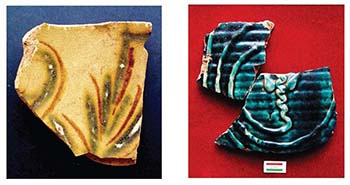
Excavated pottery from Sanjan
The WZCF team "Unearthed tons of pottery, about 2,00,000 pots.” Similarly needles, ladles of metal, coins, artifacts, Mesopotamian glassware of ninth century, West Asian beads, turquoise and redware pottery were discovered. Of particular interest was the redware pottery which straightaway infers links to Persia as it is uniquely indigenous to it.
"Ceramics give you a chronology date of sites from where they come,” Nanji continued. Turquoise glazed ware is the most commonly found trade ceramic from the Persian Gulf in the Indian Ocean ports. Sasanian and more ornate types of ceramics belonging to 8th-10th centuries were found.
The white glazed, cobalt painted, turquoise glazed wares, lusterware are from Iran-Iraq (erstwhile Persia). These are found in very prominent numbers in Sanjan and are indicative not only of the time it was occupied but also of the economy of the port and prosperity of the population. This is specific to the mid-ninth century, providing an absolute date. Unglazed wares, amphorae or oil jars are also from Sasanian times of the 10th century. Buff ware and eggshell porcelain provide similar dating.
"Changsha ware (pottery of the Tang dynasty 618-907 CE) is so chronologically specific that it acts as an absolute marker. In case of Sanjan, Changsha ware includes porcelain, stoneware, celadon etc. and indicates trade with China starting in the middle-late eighth century and continuing till about the 12th-13th century.”
The plain and the ornate
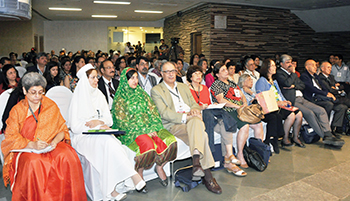
An attentive audience
Indian wares are usually quite plain, unglazed and of more utilitarian functions (storage, cooking, etc) whereas the finer Persian Gulf and Chinese wares are ornate, expensive trade ceramics which are mostly tableware (cups, bowls, dishes, plates, platters, goblets). These are indicative of a different lifestyle from the traditional indigenous habits. There was a considerable section of the population in Sanjan which specifically required this tableware. In the past as today certain communities, cultural and economic groups use varying kitchen and tableware. Chinese and Persian Gulf wares were made for practical purpose but were also regarded as works of art and craftsmanship. Indian wares were made to be used and discarded.
The archeologist deduced that "we could not have established Sanjan but we could have lived there. We were not agriculturalists; you had to produce something to establish yourself. Sailing in those days was in the hands of the Arabs but we knew how to sail and we were prosperous sailors.” The fact that we neither found Sanjan nor landed there led to an impasse at the talk between Nanji and Dastur (Dr) Peshotan Mirza who objected to these archeological claims and the debunking of KiS.
She concluded with the picture of the chalto ambo (the walking mango tree) in Sanjan. The tree "puts down its branches, which take root and the main tree dies.” It thus gets its name. Was she insinuating at Parsis putting down roots and the main tree now dying?
◆ ◆ ◆
From the archive