
Seminar
Settlements in Sanjan
Religious persecution and the freedom to trade were the prime motivators for the Zoroastrian migration to India over 1,300 years ago
Extracts from a paper titled "Sanjan excavations — Archeological evidence for the Zoroastrian migration and settlement in India” presented at the First Dastoor Meherjirana Library Conerence held in Navsari from January 12 to 15, 2013
The story of the Zoroastrian migration from the shores of Iran to the coast of India during the Early Medieval period is a familiar one, although fact and legend are so entwined that it often becomes difficult to tell one from the other. Interesting and romantic stories about adventurous sea voyages, wise priests, benevolent kings, bowls of milk and solemn promises are recounted by most Parsi grandmothers and historians alike. Most scholars have based the history of the Zoroastrian migration on the Kisse-i-Sanjan (KiS), a Persian poem written in 1599 AD by Dastur Bahman Kaikobad in Navsari. However, no archeological work had been undertaken to verify this account until 2002.
The World Zarathushti Cultural Foundation, recognizing this lacuna, undertook excavations in Sanjan between 2002 and 2004. One of the primary aims of this archeological exercise was to establish the veracity of the KiS and to better understand the nature of the earliest Parsi settlement on Indian soil. A team of expert archeologists, under the directorship of the late Dr S. P Gupta, worked at the site for three years.
The World Zarathushti Cultural Foundation, recognizing this lacuna, undertook excavations in Sanjan between 2002 and 2004. One of the primary aims of this archeological exercise was to establish the veracity of the KiS and to better understand the nature of the earliest Parsi settlement on Indian soil. A team of expert archeologists, under the directorship of the late Dr S. P Gupta, worked at the site for three years.
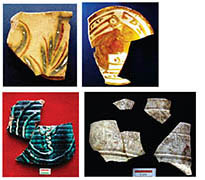
Clockwise from top left: Chinese Changsha ware, West Asian glazed pottery;
West Asian eggshell ware and glazed pottery
The excavations of the first two years established that Sanjan was a thriving port and settlement with brick-built structures and having contacts with West Asia and Iran, but they did not provide any specifically Zoroastrian evidence to establish the ethnicity of the population. It was decided that the only ethno-centric, purely Zoroastrian evidence one could hope to procure at the site would be the dakhma, which is a unique mortuary structure exclusive to this community. Local legend has it that Sanjan originally had nine dakhmas, but so far only one is known. It has not been possible to identify the others despite extensive explorations. From the excavation of this structure and the pottery found in the mud mortar, it was possible to ascertain that the date of construction was around the 10th-11th century. AMS dates procured for the remains ascertain that the dakhma continued to be used until the mid-15th century. This can be attributed to the existence of farmsteads and homesteads that may have continued to function even after the termination of the main settlement. This pattern of settlement is seen at present as well.
The pottery, antiquities, coins and other remains from the excavations of the main settlement provide an insight into the history of this port. Radio carbon dates corroborate the chronology and dates provided by the ceramic evidence, suggesting that there were settlements in Sanjan as early as the beginning of the eighth century.
The KiS narrates how a group of Zoroastrians fled to the Khorasan mountains after the Arab invasion. After living there for about 100 years, they moved to Hormuz for a further 15 years before deciding to sail to India. They landed at Diu and spent 19 years there before sailing southwards and landing at Sanjan where King Jadi Rana permitted them to settle. Here they resided, built an atash behram, consecrated the holy Iranshah and prospered before spreading out to other places. Several centuries later they were forced to leave Sanjan with the holy Iranshah due to invasion by Sultan Mahmud’s army and a decisive battle. They spent 12 years in the caves of Bahrot, 14 years in Bansda and finally found settlement in Navsari. This is an oral tradition which Bahman Kaikobad said he is committing to writing in 1599 AD.
Bahman Kaikobad made no claim that he is writing a historically accurate account. As such, to expect historical exactitude is unrealistic. One may also keep in mind that the events he is narrating are of a time distant past from his own hence some distortions and interpolations are to be expected. The dates are more or less round figures and the historical identities of individuals remain a matter of great speculation and debate amongst scholars. The issue is compounded by the fact that no individuals by the names of Jadi Rana or Sultan Mahmud occur in Indian records. The chronology that scholars try to derive on the basis of the text is also open to interpretation since the periods mentioned are in approximations. The only figures that appear to be specific are the numbers of years spent in Hormuz, Diu and, to some extent, Bahrot and Bansda. Some other discrepancies are noticeable as well. Despite these drawbacks, the information provided by the KiS remains invaluable and provides a documented record for a pact or a treaty between a local ruler and a foreign migrant community. It is also worth noting that the poem mentions the various places to which the Persian Zoroastrians spread. Almost all the places mentioned are coastal settlements along the Gujarat shoreline. It appears that there was no attempt to move into the hinterland. Another pertinent observation is that the poem never speaks of agriculture or the agrarian nature of the settlement.
The Persian Zoroastrians, or Parsis as they came to be called, never returned to the settlement of Sanjan once they had left. The relocation of the population in other towns and settlements such as Khambat, Bharuch, Surat, Randher, Variav, Navsari, etc and the installation of the holy fire at Navsari meant that Sanjan lost its previous significance as the center of religious authority by the time the Rivayets came to be exchanged between Zoroastrians in India and Iran.
If one considers other sources for the history of Sanjan, a wealth of information is found which presents a fresh perspective. Indian epigraphic sources dating back several centuries make it evident without doubt that the Zoroastrians did not establish Sanjan as believed. Sanjan existed for several centuries prior to the date of migration. It is referred to in inscriptions as Sanjayapura, Sanjjana, Samyana, Sanjanamandala, Sajanapattana, etc. Arab and Persian sources of the ninth century refer to Sanjan as Sindan and speak extensively of the port, maritime trade and its contacts with ports in the Persian Gulf. In fact they speak of a sizable Arab population settled at Sindan/Sanjan in the early ninth century and the presence of a Jama Masjid.
So prominent was their presence that the Chinchani copper plates speak of the Rashtrakuta king appointing a Muslim governor at Sanjan in the late ninth-early 10th century. Mohammed Sugatipa was benevolent and the most prominent communities were called upon to witness a grant he made to a Hindu monastery. These included Tajiks or Muslims, Modha Brahmins, Banias, Koli Mahars and the Hamjumana/Anjumana — the Parsis. The Parsis do not appear to have had any problems residing in an area governed by a Muslim. This fact is relevant in that it mentions a Muslim administrator controlling the region during the late ninth and early 10th century, which many scholars believe is the date of the migration. It is doubtful if a group of migrants fleeing Muslim persecution in their home country would seek refuge thousands of miles away in an area governed by a Muslim or with a large Muslim population. It is more likely that the migrants were well settled and established locally by the time Mohammed Sugatipa became the governor of Sanjan, i.e. before the late ninth to early 10th centuries. His benevolence to all communities is attested to in the inscription and there seems to have been no reason for the Zoroastrians to have fled Sanjan.
The Bahrot caves, which are probably Buddhist and predate the Medieval period, also attest to the fact that Sanjan existed prior to the migration. It is likely that the migrants may have established a colony but they certainly did not establish the town.
When this historical information, details from the KiS and the archeological evidence are put into place — much like the pieces of a jigsaw — a fairly detailed picture emerges, one which helps glean verifiable fact from myth.
Sanjan was a very important and prosperous trading port. Not only is this mentioned in all records but the archeological evidence also corroborates it. We find no mention of agriculture as the mainstay of this settlement in either the KiS or in any other records, but the commercial prosperity of the port is mentioned quite clearly and frequently. West Asian and Chinese ceramics found during excavations, Mesopotamian glass, West Asian eye-beads and segmented beads all corroborate this fact.
From the archeological record it is possible to infer that the small port of Sanjan with coastal trade and some limited contact with the Persian Gulf during the early occupation levels and increasing commercial activity, found an impetus with the arrival of the Persian traders. What may have started out as a small trading outpost may have grown into a full-fledged commercial hub with the arrival of the migrants. This may be seen in the increase in the volume and nature of trade.
The Arab conquest of Persia changed the history of not only West Asia but also of the Indian Ocean itself. History tells us that the first century of Arab rule under the Umaiyyad caliphs was somewhat tolerant. It was the Abbasid caliphate which proved to be intolerant of non-Muslims. Their persecution of non-Muslim subjects was not only religious but also social and certainly economic. From all accounts it appears most likely that the group of Zoroastrians who migrated to India were merchants and traders who could no longer practise their religion or conduct their trade in peace. These were people familiar with the sea and trans-oceanic voyaging, taking an informed and intelligent decision to relocate to a known hospitable land where they could have the freedom to practice both their religion and their trade.
The sea routes to India and China were well known to the Persians and Arabs from very early times. The Parthian and Sasanian contact with India and Gujarat in particular is also historically known and well documented. Hence a trading outpost with a community of foreign settlers, both Arab and Persian, at Sanjan is not unexpected. Such a trading outpost may well have existed prior to the migration, as is indicated by the presence of early ceramic types in the lowest levels of the excavations. The migrants may well have been aware of this settlement and may have made a conscious decision to migrate to Sanjan. During the 19-year stay at Diu, it is logical to suppose that they had contact with the mainland and would therefore have taken an informed decision to relocate themselves at the most hospitable and suitable point on the west coast. Later Zoroastrian settlements are also significantly coastal. Had they been agriculturists, they would have looked to the hinterland for settlement. Later groups may have consisted of people with varying skills and professions. But the mainstay of the early groups appears to have been trade. The idea that a ship-load of migrants buffeted by the winds was tossed ashore at Sanjan by sheer chance needs to be recognized as a myth.
The KiS speaks of only one migration. But it is more likely that there were several migrations to Sanjan as well as to other settlements on the coast. It is interesting to note that an account of the migration, The Religion of the Persees, as it was compiled from a book of theirs, called their Zendavastaw by Henry Lord in 1629 AD, almost contemporary to the KiS, presents a contrasting version of the event. Lord was an English chaplain posted in Surat who wrote his account based on the narrative of a priest and translated by his friend. According to Lord’s account which is regarded with some reservation by most scholars, the Parsis arrived in seven junks and landed at St. John (Sanjan), at or near Swaley and forged a treaty with the Rajah at Nuncery (Navsari). Five of the junks disembarked here while the other two went northwards to Baryaw (Variav) and Cambay. Interestingly, Lord mentions that the treaty was forged after payment of tribute. While it is well established from later historical records that Navsari, Surat, Bharuch, Khambat and several other coastal sites had large populations of Parsi settlers from an early date, almost no archeological work has been undertaken to substantiate this information.
J. M. Unvalla visited Tena, near Surat, in 1951 and noted three dakhmas in a field. Tradition has it that there were originally seven such structures but the changing sea levels had washed away all evidence of the others. The present author undertook a small exploration in 2010 and can confirm the presence of these structures, at least one of which appears to be as old as the Sanjan dakhma. It was not possible, however to locate the habitation which could have necessitated the construction of these facilities.
The migration of the Parsis to the Gujarat coast and their subsequent settlement is generally accepted as the only migration to have taken place. The truth is perhaps quite different. Recent epigraphic evidence from the Malabar coast studied by Prof Cereti confirms at least one group of Zoroastrian merchants had settled there as early as the ninth century. While there is no evidence as yet to suggest they were involved in navigation, boat-building and sailing in the early centuries of their settlement on Indian soil, it is evident that their trading activities were centered in ports and entrepots. Parsi ship-building and maritime trade during the colonial period is well documented. It is quite likely that the tradition goes back earlier than believed.

Dr Rukshana Nanji, a Poona-based field archeologist and ceramics expert holds a PhD in archeology from Deccan College and two masters’ degrees, in English literature and archeology. She has worked at sites in Gujarat (including Sanjan), Rajas -than, Madhya Pradesh, Maharashtra and Karnataka, published books and several articles and presented papers in India and abroad. She works as an independent researcher.
◆ ◆ ◆
From the archive