
Books
Fusing history and fiction
Swerving to Solitude: Letters to Mama by Keki N. Daruwalla. Published in 2018 by Simon and Schuster India, 818, Indraprakash Building, 21, Barakhamba Road, New Delhi 110001. Pp: 234. Price: Rs 499.
On one hand, Keki Daruwalla’s Swerving to Solitude: Letters to Mama is an intimate dialog between mother and daughter; on the other, as most of his novels, it is imbued with a sense of history and politics. Daruwalla, who has had a career with the Indian Police Force, was a special assistant to Prime Minister Charan Singh on international affairs and was chairman of the Joint Intelligence Committee of the union cabinet before retirement. Hence, his expertise and interest in these areas is no surprise.
In this novel, he combines two narratives (both swerving towards the Left). One narrative strand deals with the letters Seema Singh writes to her dead mother; these "will never be inserted in a mail box.” Singh is the editor of the literary page of the Lucknow Chronicle, with committed left-wing sympathies; it is ironic that she objects to the "imperial red” of the post box and does not associate it with the red flag of communism. She is married to an ambitious and rather unscrupulous Indian Administrative Service officer, Nishant Singh, who is a deputy secretary in the office of Prime Minister Indira Gandhi at the turbulent time of the Emergency (1975 to 1977). We are very soon thrown into all the excesses of this period: the throes of compulsory sterilization and the gagging of the Press. Daruwalla handles the gradual disintegration of the marriage with great skill and subtlety. Post-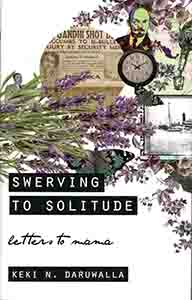 Emergency, Nishant has to accompany the minister for whom he works to West Germany but Seema finds a Swiss-Air boarding pass for Zurich in her husband’s possession. Being an intelligent woman, she realizes what this implies, but the extent of her husband’s dishonesty and her subsequent disenchantment gradually dawns on her when he acquires Swarovski crystal, a second-hand BMW and expensive pearls.
Daruwalla is more successful in perfectly fusing history, politics and fiction when he narrates the personal life of Seema and her husband and the political events around Gandhi, the Emergency and the aftermath. He is less successful in the second narrative where historical backdrop overshadows the personal. This section consists of a rather long flashback on the life of Seema’s mother, Shail, a committed communist, revealed through her diaries and letters. Shail was the secretary to M. N. Roy (1887-1954), a major leader of the communist movement in India and abroad. He was also the founder of the Mexican Communist Party. He left the mainstream communist movement after the rise of Russian dictator Joseph Stalin. Shail’s journal and letters take the reader to Canada, USA and Mexico; however, the description of these cities is a bit lifeless and pallid unlike Daruwalla’s depiction of Delhi and particularly Lucknow which are bustling with life and energy.
The entire novel is filtered through the eyes of Seema and Shail. This, to a certain extent makes the job of the novelist more difficult as the point of view is limited. The problem is more acute in Shail’s journal (1910-1920) where we get Shail’s perception of Roy and his activities. However, the complex personality of Roy himself seldom comes to life as much of what we witness or are told is through Shail’s perspective.
In this novel, he combines two narratives (both swerving towards the Left). One narrative strand deals with the letters Seema Singh writes to her dead mother; these "will never be inserted in a mail box.” Singh is the editor of the literary page of the Lucknow Chronicle, with committed left-wing sympathies; it is ironic that she objects to the "imperial red” of the post box and does not associate it with the red flag of communism. She is married to an ambitious and rather unscrupulous Indian Administrative Service officer, Nishant Singh, who is a deputy secretary in the office of Prime Minister Indira Gandhi at the turbulent time of the Emergency (1975 to 1977). We are very soon thrown into all the excesses of this period: the throes of compulsory sterilization and the gagging of the Press. Daruwalla handles the gradual disintegration of the marriage with great skill and subtlety. Post-
Emergency, Nishant has to accompany the minister for whom he works to West Germany but Seema finds a Swiss-Air boarding pass for Zurich in her husband’s possession. Being an intelligent woman, she realizes what this implies, but the extent of her husband’s dishonesty and her subsequent disenchantment gradually dawns on her when he acquires Swarovski crystal, a second-hand BMW and expensive pearls.Daruwalla is more successful in perfectly fusing history, politics and fiction when he narrates the personal life of Seema and her husband and the political events around Gandhi, the Emergency and the aftermath. He is less successful in the second narrative where historical backdrop overshadows the personal. This section consists of a rather long flashback on the life of Seema’s mother, Shail, a committed communist, revealed through her diaries and letters. Shail was the secretary to M. N. Roy (1887-1954), a major leader of the communist movement in India and abroad. He was also the founder of the Mexican Communist Party. He left the mainstream communist movement after the rise of Russian dictator Joseph Stalin. Shail’s journal and letters take the reader to Canada, USA and Mexico; however, the description of these cities is a bit lifeless and pallid unlike Daruwalla’s depiction of Delhi and particularly Lucknow which are bustling with life and energy.
The entire novel is filtered through the eyes of Seema and Shail. This, to a certain extent makes the job of the novelist more difficult as the point of view is limited. The problem is more acute in Shail’s journal (1910-1920) where we get Shail’s perception of Roy and his activities. However, the complex personality of Roy himself seldom comes to life as much of what we witness or are told is through Shail’s perspective.
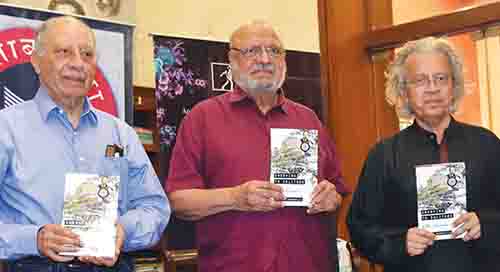
Launching Swerving to Solitude: Letters to Mama (from left): Keki Daruwalla, Shyam Benegal and Anil Dharker
Daruwalla has a remarkable ear for dialog and it is a pleasure to read his prose. Only a person with a keen sense of observation and a skilled practitioner of language could write, "Politics is not only the smog in Delhi, that decoction of diesel fumes and lies, it is a shawl and hijab rolled in one; it’s the Gayathri Mantra that you chant in the morning, the sunset azaan from the minaret also caught in the smog. During the Emergency, the surya namaskar was replaced by a namaste to Mrs G.”
The earlier strand of the novel takes place in the 1920s and the latter, post 1975. However, the strength of the novel lies in the fact that the issues which Daruwalla spoke about in these earlier periods continue to plague us even today. During the launch of the novel in New Delhi on August 31, 2018, Gita Hariharan, who won the Commonwealth Writers’ Prize in 1993 for her novel The Thousand Faces of the Night, rightly pointed out, "What is happening today is an undeclared Emergency or perhaps worse than the Emergency.”
◆ ◆ ◆
From the archive