
Books
Dark and depressing days
Emergency. A Personal History by Coomi Kapoor. Published in 2015 by Viking, Penguin Books India Private Limited, 7th floor, Infinity Tower C, DLF Cyber City, Gurgaon 122002, Haryana. Pp: 389. Price: Rs 599.
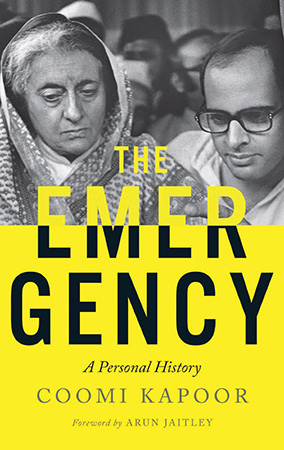 Any writing to be relevant and engrossing four decades after the event it seeks to cover speaks of the marshalling of facts and fluidity of language by the author. This is especially so when the work is not sensational and uncovers hardly any new facts and material. Coomi Kapoor’s The Emergency, A Personal History balances a fine line very successfully, recounting history as well as the personal angst and trauma of a young news reporter, mother of a newly born child and wife of a detainee during this period. To further add to the family’s involvement and suffering, her brother-in-law, Subramaniam Swamy, was the Scarlet Pimpernel of that period, making a famous appearance in Parliament signing the members’ register, attending a session briefly and then disappearing, in spite of being one of the most wanted men by the state’s police apparatus.
The darkest chapter in India’s post-independence political history was undoubtedly the Emergency imposed by Prime Minister Indira Gandhi. The 18 months from June 25, 1975 witnessed the complete disruption of the democracy with over hundred thousand opponents of the regime, including senior opposition leaders Jayaprakash Narayan (JP), Morarji Desai, Charan Singh, Atal Bihari Vajpayee and L. K. Advani incarcerated in various jails as well as under house arrest. The highest judiciary was subverted and pliant Supreme Court judges even ruled that fundamental rights, including the right to life and liberty were not sacrosanct. Censorship was introduced and the media gagged; those were the days before private television news channels and the government sought to control the flow of news. Twenty-eight years after Independence, it appeared that a nascent but vibrant Indian democracy would be permanently reduced to a tinpot dictatorship of an insecure Prime Minister under the influence of her wayward son.

Coomi Kapoor: learning from the past
The signs of disintegration were there much earlier. After the early demise of Lal Bahadur Shastri, Gandhi secured the support of a cabal of regional Congress leaders who thought she would be a pliable and acquiescent "doll,” who they could easily manipulate. Gandhi outmaneuvered them, split the Congress party and consolidated her hold on the government. She went on to win the war against Pakistan in 1971, resulting in the creation of Bangladesh, for which she was eulogised as Durga incarnate.
On the domestic front, however, things were not as positive and the dissatisfaction coalesced into a students’ movement against corruption in the states of Gujarat and Bihar. The opposition to Gandhi was then centered in the form of JP, a former associate of Jawaharlal Nehru who had taken to socialism without seeking political office. The immediate provocation for the imposition of the Emergency was the unseating of Gandhi as Prime Minster by Justice Jag Mohan Lal Sinha of the Allahabad High Court for corrupt electoral practices. Instead of taking the honorable course of resigning as Prime Minister, Gandhi was goaded into declaring an internal Emergency by her leftist advisors, Siddharth Shankar Ray and Congress president D. K. Barooah.
The Emergency saw great excesses against individuals. One of them was Virendra Kapoor, a reporter with The Indian Express (IE) who earlier worked with the Jan Sangh-Rashtriya Swayam Seva newspaper Motherland.
Coomi, née Kapadia, was a colleague when they decided to get married and subsequently move together to IE, whose proprietor Ramnath Goenka became one of the staunchest critics of Gandhi in the Emergency. In this period it was only IE and the Statesman of Calcutta that exhibited rare courage by standing up to a régime which had literally suspended the rule of law. It is the personal travails of the author, her young infant, her husband in jail and working for an organization under intense political and commercial pressure that forms the best part of the narrative. Even 40 years later, one can feel the anxiety and absolute helplessness, the unbearable suspense of not knowing when her husband would be released, when he would be rearrested and how long would this dark and dismal scenario continue. Through Coomi’s story, one senses the helplessness of a hundred thousand other families whose fathers and sons were also incarcerated. On a personal note, when I spoke to the adopted family of former Prime Minister Vajpayee about those days, they reminisced that even after Gandhi announced election in early 1977 and released her political opponents, Vajpayee himself was not sanguine about their chances at the hustings and was apprehensive that all of them would be back in prison after the elections.
The only revelation which the author makes was that the imposition of the Emergency was not a spur of the moment decision and that as early as January 8, 1975 Ray, the West Bengal chief minister had drafted a note conceiving the idea of an internal Emergency and the mass arrest of political opponents.
That is not the strong point of the book. What is, is that this is a human story, replete with facts as they happened but embellished by a personal saga that evokes feelings of sympathy and empathy even four decades after the event. There is no space for rancor and bitterness but the events as described, especially the personal trauma, evoke a picture of how politically dark and depressing those times were for those who opposed a repressive régime.
It is a tragedy that the period of the Emergency and all its excesses have been
◆ ◆ ◆
From the archive