
Books
Princes, politicians, Parsis
ancestral affairs by Keki N. Daruwalla. Published in 2015 by Fourth Estate, an imprint of HarperCollins Publishers India, A-75, Sector 57, Noida, Uttar Pradesh 201301. Pp: 244. Price: Rs 499.
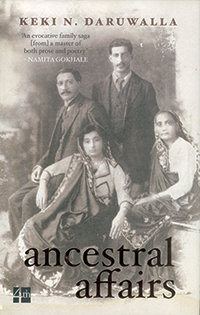 Keki Daruwalla’s second novel, ancestral affairs, is not merely a family saga as the title suggests. The very fact that it commences in 1947, at the time of the departure of the British and the advent of Indian independence, creates a vibrant historical setting for the novel.
The title is ambiguous: the word ‘affairs’ could refer to ‘amorous affairs’ or merely ‘family matters’ and the novel seems to justify both the interpretations. It has two narrators, a father and son, and their stories are clearly demarcated.
The first section, narrated by the father, Saam Bharucha, starts in 1947. Daruwalla immediately throws us into the confusion of political affairs which are skilfully presented in a manner which is immediate and gripping. The British Resident concisely sums up the situation: "Anything could happen, given the circumstances — the emotional fever pitch of Hindus and Muslims, Congress and (Muslim) League at loggerheads, Gandhi ignored by his own people. It is a proper mess.”
Saam, the protagonist, is employed with a law firm, Crawford and Hailey. He is on the verge of becoming a partner when his wife Zarine compels him to accompany her to Paris. As a result, not only does he miss the chance of becoming a partner but also is "temporarily eased out” and sent to Junagadh to become the Law Member with the primary purpose of keeping abreast of everything that is happening everywhere.
India is on the verge of Independence. It is not clear whether Partition will take place or not. The situation is further complicated by the princely states, the rulers of which are living in a make-believe world. They are unable, and probably unwilling, to face reality. The Parsi gentleman, who is the teacher of a young nawab, speaks about the apathy of all the princes who seem to be only interested in eating and driving cars; ironically, these avid hunters lack the instinct of self preservation. They are convinced that when the British depart the powers which were surrendered to the Crown will revert to them. The princes don’t realize how unworkable their hope is to carve out yet another piece in the subcontinent and create a union of Kathiawar princely states. The fact that Junagadh is the only Muslim state surrounded by Hindu principalities does not prevent the nawab from signing a declaration that Junagadh would go with Pakistan.
Daruwalla skilfully captures the excitement, the uncertainty in the air whether India would be partitioned, the intrigue, the gossip, the factions, riots in Bombay and Amritsar, frantic diplomatic journeys to London, the scheme for the transfer of power, the dismissal of Lord Wavell (much to Winston Churchill’s disgust) by British Prime Minister Clement Atlee, the appointment of Rear Admiral Louis Mountbatten and Churchill’s feeling that a government headed by Jawaharlal Nehru would be a "complete disaster.”
The confusion of the political situation is reflected in the lives of the major protagonists in the novel. At the very outset it is clear that the marital relationship between Saam and Zarine has reached the lowest level and "resentments” have been long building up. Zarine leaves Saam to himself for long periods during his stay in Junagadh. As a result, he starts an affair with Claire who unfortunately loses her husband which only results in their becoming more involved. The private lives of Saam and Zarine seem to mirror those of the country heading towards Partition.
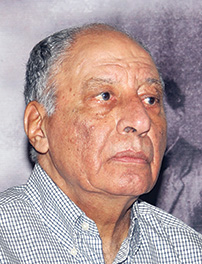
Keki Daruwalla: first Parsi novel
Daruwalla presents Saam with several flaws but one thing is certain — that is he is always true to what he believes to be right. Being a true Zoroastrian who, Daruwalla informs us, cannot tell a lie, he informs his wife about his infidelity. He is outspoken and frank and even when he is in a minority he has no hesitation in speaking out his mind and advising the nawab: "There can’t be 500 smaller countries in the belly of one large country.”
The motif of confusion is reflected in the life of Saam’s son, Rohinton, as well. His story begins in 1955 when he loses his job with a political and literary weekly and slanders his former employer. Both father and son seem to have the seeds of self-destruction within them. Saam’s forthright though impulsive nature is reflected in Rohinton who abandons his studies to become a doctor, turns to journalism and exposes a well connected man accusing him of insider trading. His relationship with his wife Feroza, who has just lost her first husband to cancer, is equally fraught with difficulties as Saam’s is with Zarine.
Interested in "ancestral affairs,” Saam goes to meet Kavarana Kaka, who colorfully tells him the story of the opium trade and his ancestor Ardeshir in a manner which can only be narrated by a Parsi. He also hints at "cleavages” in Zarine’s family, a theme which is developed towards the end of the novel.
However, we do not really feel the weight of the ancestors and their effect on the subsequent generations as one encounters them in the work of Eugene O’Neill. Rohinton feels that he being a child from a broken home has caused him to be what he is. But this is told to us and the reader does not really sense this through the events of the novel. Perhaps the weight of ancestral affairs and their effects could have been more concretely portrayed.
Daruwalla is very interested in history as is evident from this novel as well as his previous one, For Pepper and Christ. Whereas the history aspect did seem to hang a bit heavily in his previous novel, in ancestral affairs it is successfully melded in the novel and reflected in the themes. One learns so much about the politics of the period and especially in the princely state of Junagadh, in an effortless manner thanks to Daruwalla’s lucid prose.
And, of course, Daruwalla is at heart a poet, which he does not allow his readers to forget. Indianisms are introduced in a subtle and perceptive manner: "myself Salimuddin Khan,” "pay my respects” and the literal translation from the vernacular "more not go down throat.” In the very first paragraph, in a tongue in cheek manner, he describes the limits of Bombay for a Parsi for whom only South Bombay exists as "that hyphenated conglomeration of seven islands that lay between Mahim creek, with its feral stink, and Colaba, with its smell of dry fish.”
It is a refreshing change to read a novel about the Parsis without the eccentricities and the idiosyncrasies which are generally so overdone in "Parsi novels.”
◆ ◆ ◆
From the archive