
Books
“Tilting at empires”
"Fire Altar: Poems on the Persians and the Greeks by Keki N. Daruwalla. Published in 2013 by HarperCollins Publishers India, A-53, Sector 57, Noida 201301. Pp: xix + 163. Price: Rs: 350.
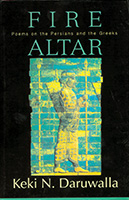 After his magnificent novel, For Pepper and Christ, Keki Daruwalla has once again decided to return to poetry with his latest volume of published verse, Fire Altar. His novel, set in the times of Vasco da Gama, encompasses one of the most stimulating and adventurous periods of history, a time of great excitement, of venturing forth into the relatively unknown, an age which certainly "catches human imagination by the forelock.” Daruwalla once again returns to history in this recent book of verse. The book germinated when Daruwalla, driving through Delhi’s Connaught Place in 1986 picked up a volume of Herodotus for Rs 10. This fired his imagination and he continued to devour Herodotus and related authors. However, it was only when he made a trip to Iran, which included Persepolis and Pasargadae, that the pieces finally fell into place and he was inspired to compose these poems which were written between 1991 and 1993. Why he waited for more than two decades to have these published is a mystery.
The poems deal with a period of history with which one is not generally familiar and Daruwalla’s excellent introduction guides his readers through the "tilting of empires as they collided with each other.” The information he provides is just enough to see the reader through the book without giving away too much of the themes and the ideas which the poems later develop.
The poems have been grouped into about a dozen sections and each poem is a masterpiece that shines like a finely polished diamond. He starts with a tongue in cheek response to Hellenic scholar and poet Constantrine Cavafy’s "Waiting for the Barbarians” which clearly asserts that the Persians were no Barbarians. The next section is the Pasargadae sonnets, which are probably Daruwalla’s favorites, as he read all nine of them for the book reading at Kitab Khana. The sonnets are beautifully wrought and the metrical rigor, the muscularity and the energy of his verse is combined very effectively with an elegiac quality. Pasargadae was the capital city of Cyrus the Great and Daruwalla quotes from historians who mention that the palaces were "exquisitely proportioned” and were "full of light.” However, nothing remains of this breathtakingly beautiful city. Daruwalla laments the total barrenness of the site by the use of a constant stream of negatives. "The ground is not crisscrossed by water channels,” there is "no thicket of saplings,” there is "no mosque dome,/ no bazzar, no casbah.” The negative images are juxtaposed with brilliant visuals of walls which must once have been painted in lapis lazuli blue or turquoise green. The sequence ends with the poignant lines:
"Here I lie, Cyrus, King of the Persians./ Stranger, don’t grudge me these few feet of space.”
The irony lies in the fact that this inscription on his tombstone is not even visible today.
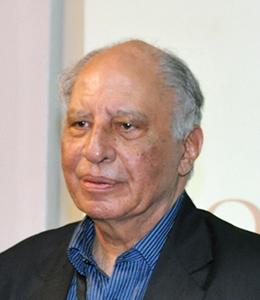
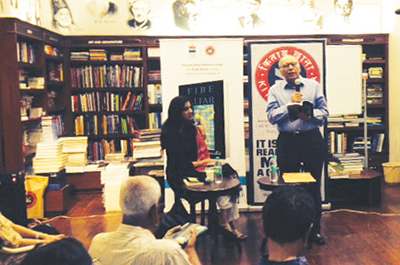
Keki Daruwalla reading his poems at book launch
In the sequence entitled "Letters from Tomyris,” the Queen of the Massagetae advises Cyrus to contain his ambitions and "Rule in peace what is yours, King,/ and let me rule over my people.” In a few sentences, Daruwalla manages to convey her strong maternal feelings. She pleads with Cyrus to release her son who has been taken prisoner "or pay with blood;/ for blood is what I’ll have if he is hurt.” So distraught is she that, "Nightmares seethe and rage around my sleep/ and salt rages in my many wounds.” This sequence ends with the messenger returning to Pasargadae listing all the various spoils of war and the simple and moving lines added almost as an after thought, "And we have brought/ the body of Cyrus.”
Herodotus was quite capable of "weaving fable into his ‘historic’ narratives” and several historians including Plutarch have faulted his version of Cambyses’ madness. Cambyses was Cyrus’ successor. Daruwalla starts with Herodotus’ account of Cambyses and his slaughter of the sacred Egyptian bull; at this very moment "the King was smitten with the sacred sickness.” In his reply Cambyses takes Herodotus to task for claiming three centuries later to be a historian and "to trot out rubbish and be acclaimed.”
In "Abul Qasim,” one of his short stories in his collection entitled Love Across the Salt Desert, Daruwalla etches a warm and lovely portrait of the poet Firdowsi who wrote the Shahnameh. It is a well-known fact that the Sultan, Mahmud Ghaznavi, reneged on his promise to pay the poet in gold, "a miskal per distich (gold coin per couplet)” and instead paid him in silver coins. In a fit of rage, Firdowsi distributed these to the needy and to mendicants and this enraged the Sultan to such an extent that Firdowsi was forced to flee. Daruwalla paints a moving portrait of Firdowsi, an elderly man with "beard blizzard-white,” "fatigued, fleeing one hideout for the next,” totally isolated as "friends shun me, informers close in, where does one go from here?”
One of the final poems describes the Parsis setting sail from Persia on their journey to India when they are forced by their own people to convert to Islam or face death succinctly captured in the line where the sword is used on "either/ the foreskin or the jugular.” Daruwalla poignantly captures the mood of the people on the boat as they realize that if they had stayed behind they would have had to watch their "daughters forced into whoredom.” The poem ends with the heart stirring prayer:
"Leaving your land is bereavement/ Arriving at this coast was redemption./ Keep us here/ Maker of Day.”
How lucky we are to have amongst us such wonderful Parsi poets like Keki Daruwala, Gieve Patel and Adil Jussawalla. Though several young Parsi novelists have made their mark during the last few years, one still has to hear of a present day Parsi poet who will take up the gauntlet. One only hopes that some young Parsi will take up this challenge and keep the fire burning at the altar.
◆ ◆ ◆
From the archive