
Books
“Wrote novels after retiring”
Recent years have seen a sudden upsurge of young Parsi novelists; however, it is always wonderful to return to the tried and tested, the famous and the celebrated. The evening of January 4, 2016 at Kitab Khana promised to be a very rewarding one: a discussion between Keki Daruwalla, Dr Vrinda Nabar and Ranjit Hoskote on the launch of Daruwalla’s latest novel ancestral affairs.
Nabar set the mood for the discussion by fondly remembering Daruwalla as "an old and dear friend, a writer whom I have always admired. He, along with Gieve Patel, Adil Jussawala, Nissim Ezekiel and Arun Kolatkar consolidated the position of Indian English poetry.”
Nabar set the mood for the discussion by fondly remembering Daruwalla as "an old and dear friend, a writer whom I have always admired. He, along with Gieve Patel, Adil Jussawala, Nissim Ezekiel and Arun Kolatkar consolidated the position of Indian English poetry.”
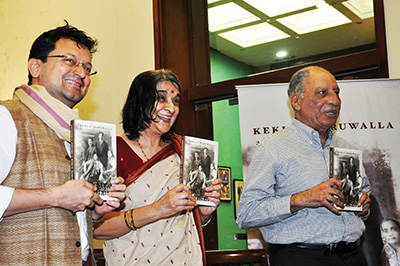
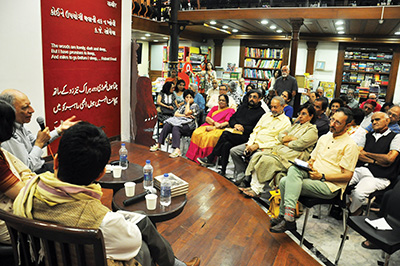
(Top, l-r): Ranjit Hoskote, Dr Vrinda Nabar, Keki Daruwalla; audience
Nabar questioned Daruwalla about the Parsiness in his novel. He admitted, "I have spent much of my life in cities like Ludhiana, Junagadh and Ranpur where there were scarcely any Parsis. In fact, Fire Altar, a series of poems in which I deal with Parsi themes was a result of a trip I made to Iran. Lots of Parsi novels make fun of our eccentric community; but I wanted to stay away from all that. Though the novel primarily deals with Saam Bharucha, what happens to his son Rohinton is also very interesting.”
Replying to Hoskote’s comment about Daruwalla’s continual engagement with history, whether it is in his poetry or his fiction, the author commented that ancestral affairs was, after all, a novel and it could not only deal with politics; he wanted to describe the routine of everyday life, what he called "the bric-à-brac” of daily life which forms a core component of his novel.
When Hoskote commented on Paul Scott and Raj fiction, Daruwalla stated that ancestral affairs was not a freedom struggle novel. The novel, which begins as a family saga, broadens out and ventures into political territory. It was, after all, 1947. The British were leaving India and it was not just the nawab of Junagadh but many rulers of other princely states in Rajasthan and Travancore who lived in a fool’s paradise, seriously believing that the British would take care of them and carve a separate state for them in India. There are, however, a few autobiographical details. He remembered nostalgically his youth in Junagadh and vividly recounted names, the four wives of the Nawab and the fact that the latter even divorced one wife to marry the fifth. Daruwalla also mentioned that his brother was at Goragully (Lawrence College, Murree) and for two months they had lost contact with him.
Nabar made a very interesting comment on the strong women which people ancestral affairs. Whether it is Saam’s wife Zarine, or his mistress Claire, or Rohinton’s wife Feroza, all have strength of character and a powerful presence in the novel. Daruwalla said this was not done consciously. The characters portrayed were all part of the story.
Having spent much of his early life in several cities, both small and large in the North of India, Daruwalla joined the Indian Police Service in 1958. It is this contact with the hinterlands of India which brought a wide range of experiences to his poetry. His tone could be cutting and blunt and his observations of the world expressed in his poems were not the ones generally found in the poetry of that period.
Recently, Daruwalla changed genre and shifted from poetry to the novel. For Pepper and Christ, set against the Portuguese colonization of India, was published in 2009 followed recently by a Parsi novel, ancestral affairs. "I wrote novels after I retired and had more time on my hands,” he said. "The writing of poetry and fiction are separate disciplines, and though it is true that there are a few lyrical sections in my novel, I don’t want the poetry to get in the way of the prose.”
Several people in the audience appreciated the charming family portrait, in sepia tones, on the cover of the novel. With the lively discussion, the launch of the book was almost forgotten but this formality was hastily done, bringing the events of the evening to a close.
◆ ◆ ◆
From the archive