
Cinema
Sanitized superstar
Capturing highlights of the band Queen and its frontman Freddie Mercury, Bohemian Rhapsody emerges as the highest grossing musical biographical film
The audience praised it. Getting their fill of haunting Queen melodies, singing along while reading the lyrics on the screen before them was reason enough to sit back and enjoy the movie. The critics panned it. They were not willing to condone factual inaccuracies in a film promoted as a biopic/drama/musical on Freddie Mercury. Nevertheless, Bohemian Rhapsody emerged as the highest grossing musical biographical film of all times, reportedly crossing over $ 553.4 million at the box office worldwide within a month of its global release in November 2018.
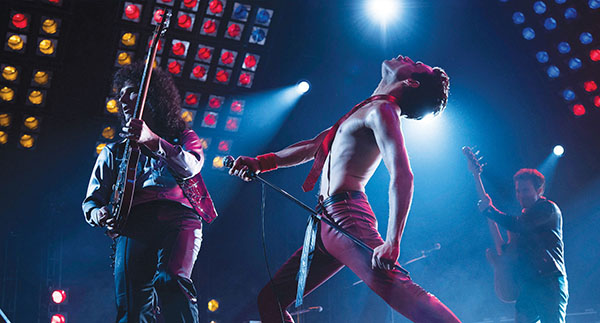
Scenes from Bohemian Rhapsody depicting: (top) Queen’s charismatic performance Photo: foxmovies.com
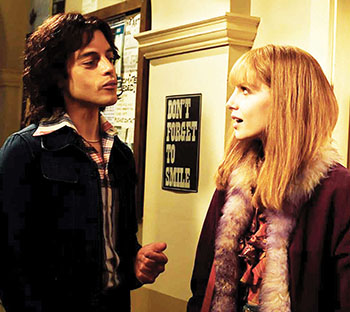
(R) Freddie Mercury dating Mary Austin Photo: imdb.com
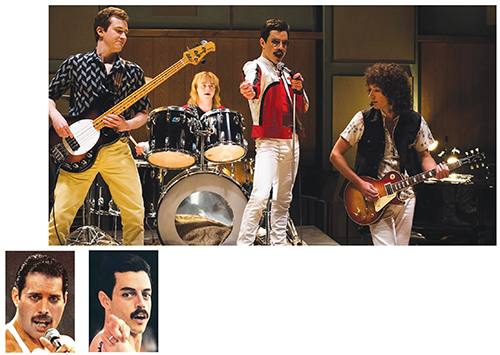
Top: Enacting the four-member Queen;
above: Rami Malek playing Freddie Mercury (far left)
In Bombay, a head count in the stalls at a night show at Regal cinema, a fortnight after the release, indicated the presence of 15 in the hall. Although the age varied from senior citizens to college students, the majority in the audience were unquestionably Parsis. In quest of a mega public image befitting a superstar, Mercury (born Farrokh Bulsara) never publicly acknowledged his Zoroastrian roots during his lifetime. On his death at the age of 45 years in 1991 he had requested for Zoroastrian funeral prayers after which the community has always proudly claimed him as their own.
There are but fleeting references to the family in the film: mother Jer who dotes on him, a wide-eyed sister Kasha who idolizes him, and father Bomi who repeatedly reminds him of his ethnic faith’s adherence to "good thoughts, good words and good deeds.” Refusing to be overwhelmed by this credo, the young Farrokh is shown to retort, "What has it done for you?” Born in Zanzibar, schooled at St Peter’s in Panchgani, seeking refuge in Britain due to upheavals in Africa, during his early life he had faced displacement and derogatory labels addressing him as "Paki.”
"Happy birthday Freddie Mercury, happy birthday to you,” the born again singer/performer who has found his niche sings the ballad to himself whilst looking into a mirror and surprising his family seated around the dining table with his new nomenclature. "So now the family name is not good enough for you?” questions his father. "I’ve changed it legally. No looking back,” responds the artist who sees in himself the making of a flamboyant star. "You can’t get anywhere pretending to be something you are not,” his father’s sedate reasoning falls on ears that are more attuned to creating offbeat, rock and even operatic music.
For the greater part of the movie Mercury is shown with an overpowering urge to create music that would appeal to the public. When the frontman is asked how his band Queen is different from the rest, he responds, "We are four misfits who don’t belong together. Playing for other misfits… to the outcasts right at the back of the room. We are pretty sure they don’t belong either. We belong to them …”
A British-American joint venture produced by 20th Century Fox, New Regency, GK Films, and Queen Films, with Fox serving as distributor, the film was shot on a budget of $ 50 million even though director Bryan Singer left the project last December, reportedly due to differences with the cast, and Rami Malek replaced Sacha Baron Cohen who was originally chosen to play Mercury. Malek’s convincing portrayal of Mercury’s on stage persona has earned him rave reviews, won him an award at the Palm Springs International Film Festival and a nomination for best actor (motion picture drama) for the Golden Globe Awards on January 6, 2019 where the film has also been nominated for Best Motion Picture.
Whilst Malek was trying to get comfortable in Mercury’s bizarre outfits, donning satin pants and lycra outfits, he was also required to wear prosthetic teeth to get his features to resemble the buck-toothed performer. So accustomed had he got to speaking and singing with the prosthetic teeth that he wore each day that when they were removed at the end of the shoot he felt "almost naked,” he revealed. To preserve them as a memento, he chose to set them in gold, reminiscent of Mercury’s ostentatious mannerisms. Malek also opted to be tutored, not by a choreographer but a movement coach who could guide him to adopt Mercury’s natural moves, whether it was the eye lift, or the use of the microphone stand as a prop whilst dancing.
Mary Austin, played by Lucy Boynton, Mercury’s first love who continued to befriend him even when he was in a relationship with other men, plays a pivotal role in his life. The film shows his vulnerable and quieter side when he is in her presence. His gay and promiscuous lifestyle that ultimately took a toll on his life is alluded to very briefly in the movie. The viewer is told that he gave his last few performances whilst he was fighting AIDS.
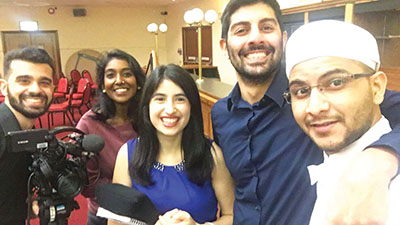
From l: Danny Master, BBC reporter, Shazneen Munshi, Yazdyar Avari and Ervad Yazad Bhadha
The grand finale for the movie was the Live Aid concert where Queen works the audience into a frenzy during their 20-minute slot, singing their all-time hits including the six-minute Bohemian Rhapsody. This was the song their then manager had earlier refused to promote, convinced it was far too long for a single, compelling him to part ways with Queen. Determined to make music on their own terms, the Queen members continued to create songs that were frequently rated number one on the music charts.
"There’s only room in this band for one hysterical Queen,” Mercury tells his band members from whom he briefly parted and later reconnected prior to the historical Live Aid concert. Whilst recreating the Wembley Stadium sets for the shooting of the Live Aid concert for the movie, Queen fans were invited to send solo sound clips of their individual rendition of Bohemian Rhapsody and the ones selected were ultimately synthesized into the final recording. This interaction with his legion fans served to increase the popularity of the movie.
On October 24, the day Bohemian Rhapsody saw its UK release, a video interview on BBC Asian Network sought to gauge what Freddie Mercury means to the Zoroastrian youth of today. The reporter met some of them at the Zoroastrian Centre in Harrow and then proceeded on a visit to the Freddie Mercury memorial, his erstwhile family home in Feltham which was awarded an English Heritage Blue Plaque (see "Asteroid for Mercury,” Zoroastrians Abroad, Parsiana, October 7, 2016).
"Being from such a small community it was such an inspiration to have someone who’d achieved so much success on such a global level,” observed Shazneen Munshi, joint communications officer at the Zoroastrian Trust Funds of Europe. Also interviewed were three other active young Zoroastrians who are avid Mercury fans: Ervad Yazad Bhadha, Danny Master and Yazdyar Avari. Master recalled his parents introducing him to Mercury’s work and later revealing that "he was a Parsi… It just blew my mind.” Observing that Mercury had "a massive, massive impact on the creative world,” Avari related, "I was the only Zoroastrian in my school of about a 1,000 kids. The main challenge I had growing up was explaining to everybody what my identity is. Speaking about Uncle Freddie (was) probably the easiest way for people to understand my religion and where I’m from.”
In the movie, Mercury is projected as a "sanitized” superstar. When particularly asked by BBC whether the star’s drug abuse and gay lifestyle detracted from his success, Avari observed, "In the grand scheme of things, what he achieved was far greater than any negative thing that he did.”
◆ ◆ ◆
From the archive