
Shaking the Tree of Time
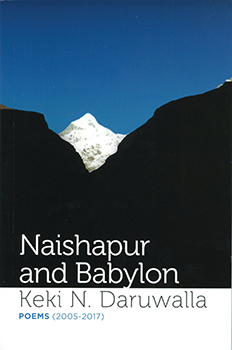
Naishapur and Babylon: Poems (2005-2017) by Keki N. Daruwalla. Published in 2017 by Speaking Tiger Publishing Private Limited, 4381/4, Ansari Road, Daryaganj, New Delhi 110002. Pp: 124. Price: Rs 299.
The importance of being Keki
Achtung!
Policeman. Poet-laureate.
Hunter of hypocrisies,
Cartographer of the tombs of the dead.
Water-diviner seeking the flash of blue
In the desert sands of river beds
Is on the prowl again.
Leavening the approaching dark
with the promise of rain.
GEETA DOCTOR
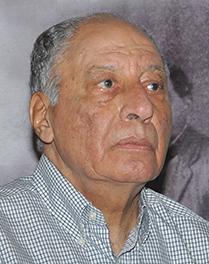 When Keki Daruwalla’s (pictured) first book of poems Under Orion (1970) appeared, there was both shock and awe in equal measure.
 "A policeman writing poems,” was the verdict. His words carried the crack of the whip, or the wooden lathi stick. In the terse summing of the dry northern plains of the people he found himself policing, Daruwalla whose mind ranged towards other shores, admonished himself: "I put a clamp on yearning, shun latitudes, renounce form,” he tells us. "Forget maps and voyaging, study instead/the parched earth of a brown people” (from Map-Maker 2002).
He did not help his cause when he explained, "All poets are incidentally not as mad as people think, though the madder the poet, the better the poetry. Regrettably I hail from the non-mad variety.”
Despite not being Dionysian (frenzied, undisciplined) in his approach to poetry, Daruwalla still managed an awesome output — 10 volumes of poetry, a novella, two novels, five short story collections and a slew of awards. He received the Sahitya Akademi Award in 1984, the Commonwealth Poetry Prize for Asia in 1987; a Padma Shri in 2014 and the Poet Laureate Award at the Tata Literature Alive 2017.
He returned the Sahitya Akademi Award in 2014 as a protest against "India turning into a Bombay local” following the murder of scholar M. M. Kalburgi. In the course of a free-wheeling interview he is reported to have said: "All spirituality is hocus-pocus, in the same category as our Indian godmen. I stick to morality — good thoughts, good words, good deeds.”
Like many people dislocated in the aftermath of Partition, Daruwalla who was born in Lahore in 1937 moved with his family to Rampur in 1945 and then to the Punjab. His early interest in literature led to him joining the Punjab University for an MA in English and to Oxford University as a Queen Elizabeth House Fellow. In 1958 he joined the Indian Police Service; was appointed special assistant to Prime Minister Charan Singh in 1979; and chairman, Joint Intelligence Committee at the Cabinet Secretariat in 1995.
Though the image on the cover is elegant enough, the beckoning snow clad Himalayan peak, beloved of the Gods, etched against a turquoise sky, what Daruwalla’s poems evoke (to this reviewer at least) are the shrouded figures in the paintings of the late artist Jehangir Sabavala. These are the wanderers from an ancient land that is evoked in the title — Naishapur. This city, former capital of Khorasan in North East Iran, is famed both for its earthquakes and for its turquoise mines. It celebrates the color blue.
Almost by chance it’s a color that flies through the lines in Daruwalla’s collection of poems one of which ends with the lines: "We thank you for colors, Lord/and lest I forget/ we thank you for the eye” (from Color).
 The poet watches the flight path of a number of birds, falcons, kingfishers, barbets, black necked cranes from Tibet, also wanderers from distant lands riding on the eddies of seasonal winds. "The kingfisher dressed in lapis-lazuli” makes a sudden entry in the midst of war-ravaged Iraq and lands almost casually in the river Tigris. Or he tells us of the flurry of "the blue-jay brilliant on the margosa tree” outside the mud hut of one of Daruwalla’s brown women. In these he could be painting word pictures like a Japanese haiku practitioner.
 On the other hand, to pick up on the legend of Naishapur, the persistence of birds reminds one of the clamor that rings through the verses of Naishapur’s most famous poet, the Sufi-mystic Attar in his The Conference of Birds. In this celebrated poem, the birds meet to discover a way of finding the mythical bird, the simurgh. The simurgh appears in various forms in the legends and iconography of Central Asia and of Persia in particular. She is always depicted as a feminine, maternal, life-giving form who lives on the Tree of Life, Hom, or Hoama in Avestan, that grows from the middle of the earth encircling waters. According to the myth, when the simurgh flies the leaves fall off the tree and sprout as medicinal herbs across the earth. Be that as it may, in Attar’s poem the birds traverse seven valleys of varying difficulty to look for the simurgh only to find that she has been there all the time. Or as Attar concludes: "The home that we seek is in eternity.”
To be fair to Daruwalla, he does not take the path of the mystic. There is in him however the seeker who like those intrepid pith-helmeted hunters, the Harrison Fords, or his shadow Indiana Jones, undertake myriad journeys into the past, notebook in hand. Like Indiana Jones, the feminine archetypes he meets dazzle the reader with their brilliance. Ishtar, the goddess of war and sexual attraction bends a knee once more on the page, as did, Daruwalla notes, the Sumerians and the Akkadians, in a poem by that name. The color of her ancient gate at the Pergamon Museum, Berlin, is lapis lazuli!
Anaheita, is invoked in a lighter vein as the deer. "Their topaz colored eyes/glowing in the dark…came, four of them/and ate up the hydrangea/and the astilbe,/but never touched the rhododendrons./Deer don’t have a taste for rodis.” Poems as charming as this one not only recall the simplicity of a Ruskin Bond, they remind us that even the most austere of poets can also get off their high horse, or at least let them prance with delight.
One cannot encapsulate the 15 years of Daruwalla’s poems into the valleys of myth and history except to say — try reading them. Every one of them is worth the journey. If there is one poem that I would signal as deserving special mention, as they say when reviewing a flower show full of blooms, it would be a shortened version of the poem Prayer for January 30. It is as epic a prayer as the famous one by Rabindranath Tagore. In the version reproduced here (see box on pg 234) the first, more complex verse has been omitted with apologies in advance to the poet. The rest speaks for itself.
There is an excellent introduction to the volume by the poet Arundhathi Subramaniam to whom the collection is also dedicated. GEETA DOCTOR
Excerpted from Keki Daruwalla’s Prayer for January 30
Doctor, a longtime contributor to Parsiana, is a writer and critic.
Let not the harsh winds of our times
Blow love away.
Let not the harsh winds of our times
blow our perceptions into a wall
behind which people are sharpening knives.
Let not the harsh dreams of our times
devour us, along with our appetites.
Lead us from the landscape of rubble
to water, but let the sound be real —
even traffic sounds like surf at night.
And let the water remain water
and not turn to blood.
Lead us from chemical colors to vegetable dyes,
from plastic to cotton,
from fractions to wholeness.
Ephemeral as we are,
let the infinite touch us somewhere.
Detach us from the tree of time.
And those with no faith,
cast them on the waters of belief.
Let the repressed be brought to light,
the hidden into knowledge.
Let there be harmony
between those who speak of shadows
and those who speak of the sun.
Let the unlit be lit.
Steer the light our way.
Let the forest leaf.
Let the lyric leaf.