
Books
Injustice to a great subject
Farokh The Cricketing Cavalier by Colin Evans. Published in 2017 by Max Books, Epworth House,34 Wellington Road, Nantwich, Cheshire CW5 7BX; website: www.max-books.co.uk; email: maxcricket@btinternet.com. Pp: 208. Price: £ 12.99.
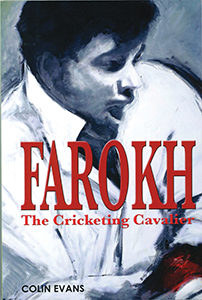 Without doubt, the greatest ever Parsi sports superstar — Farokh Engineer, earlier of the Dadar Parsi Colony and lately, Lancashire — flamboyant, outspoken, colorful, swashbuckling — is a dream subject for a biographer. However, his authorized biography by Colin Evans, a writer on cricket and author of books on forensics, is remarkably insipid.
Authorised biographies are, by their very nature, biased. Nevertheless, they often make fascinating reading of hitherto unknown personal details, which the subject readily provides to the author. No such luck here. The author has done no justice to Engineer, the subject of cricketing folklore. Apart from describing the dashing batsman-wicket-keeper’s career for India and Lancashire, the book contains not even a sentence on Engineer’s two wives or his four daughters or any other aspect of his personal life. There is a passing reference to Engineer losing money due to the collapse of the BCCI (Bank of Credit & Commerce International). Actually, as Engineer has recounted in other interviews, he lost a million pounds overnight, in this episode.
Not a word about his fairy-tale love marriage of 23 years to a Parsi BOAC (British Overseas Airways Corporation, later renamed British Airways) air hostess, Shernavaz (Sherry). Only a passing reference to his present wife, Julie, and a couple of photographs of his four daughters, Minnie and Tina (from Sherry) and Scarlett and Roxanne (from Julie). If Evans wanted to write only about Engineer’s cricket, why call this book a biography? And that too about a subject who is extrovert, frank and minces no words.
Barring some trivia (as to how Engineer caught a duster flung by an enraged teacher in mid air thereby preventing his classmate, cine actor, the late Shashi Kapoor’s handsome face from being disfigured) there is nothing new we learn about Engineer from this book. All other memorable stories about one of the world’s leading glovemen have been in the public domain already including the one about Queen Elizabeth being the first person to inform the cricketer about the birth of his first daughter, Minnie, at Lords, when the team was being introduced to Her Majesty. Minnie was named after his late mother who had promised on her death bed to come back as his daughter.
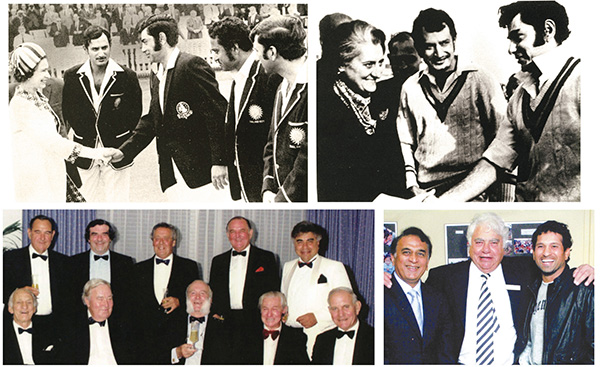
Clockwise from above left: Farokh Engineer being presented to the Queen at Lord’s in 1971;
greeting Prime Minister Indira Gandhi (1984);
with Indian cricketing legends Sunil Gavaskar (l) and Sachin Tendulkar;
(in white suit) at Lord’s Taverners dinner
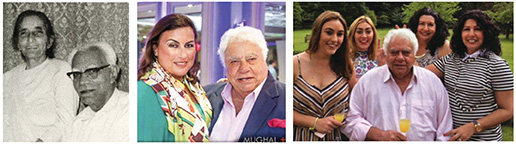
Above, from l: parents Minnie and Manecksha Engineer; with wife Julie;
with daughters (l-r) Minnie, Tina, Roxanne and Scarlett

Author Colin Evans
Even as a purely cricketing book, it disappoints. The thrill, the color, the suspense of Engineer’s many memorable innings is not captured. The writing style is pedestrian; the structuring of the chapters, rather confused. Engineer’s much talked about innings in the 1967 Madras test match when he nearly scored a century before lunch on the first day by hammering the dreaded West Indies’ pace attack of Wes Hall and Charlie Griffith (who had earlier smashed another Parsi cricketer, Nari Contractor’s skull with a bouncer) is narrated in a lackluster manner. While one does not expect from Evans the style and class of a Neville Cardus (English writer and critic) or John Arlott (English journalist, author and cricket commentator), one cannot help but feel that writing a book on cricket or being a biographer is not his forte. Contrast his writing with the famed Indian historian (including cricket), Ramachandra Guha, on the qualities required from a wicket-keeper ("the concentration of a heart surgeon, the reflexes of a fighter pilot, the guts of a boxer”).
There is something poignant in Engineer’s life story. Missing the century before lunch (some say, due to the envious batsman at the other end deliberately not scoring to prevent Engineer from facing the bowler); appointed as India captain and then dramatically removed minutes before the toss of the coin, leaving him shattered; dropped from the test team to accommodate a mediocre wicket-keeper who was the prince of some minor state; passed over by Lancashire for captaincy despite serving the side with great merit; losing a lifetime’s savings in a single night. The book does not even make an attempt to link these misfortunes. In the hands of a good cricket writer like Guha or Mihir Bose or Harsha Bhogle, Engineer’s life story would have been unputdownable.
Nor does this biography describe how Engineer was larger than life. Although his batting average of 31 in 46 test matches with only two centuries (82 dismissals as wicket-keeper) was passé, he captured the imagination of cricket crazy India for decades with his swagger, his exaggerated style of stumping, his devil-may-care attitude, his refusal to pander to selectors and cricket administrators in an era when selection was not on merit alone, his modelling for Brylcreem in an age when cricketers were not yet like Bollywood stars, his frequent night out with the boys after a hard day keeping wickets. As he himself says, he was born too early. Had he been playing in one dayers and T20 and IPL (Indian Premier League), he would have perhaps had a more scintillating career. But then life is all about dropped catches and missed stumpings, isn’t it?
Desai is a lawyer in private practice and a part-time writer. He considers himself an unsuccessful community activist.
◆ ◆ ◆
From the archive