
Books
Old classic on cricket
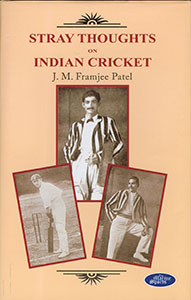
Stray Thoughts on Indian Cricket by J. M. Framjee Patel. First published in 1905. Reprinted in 2014 by The Marine Sports, 63A, Gokhale Road (North), Dadar, Bombay 400028. Pp: xvi+175. Price: Rs 595.
Reading this historical book on cricket made me feel nostalgic. My mind was transferred to 1905 when every cricketer was addressed as Mr and most of them wore caps, hats or "topis” on or off the field. At first the book is difficult to read because of old-style English but once you get your teeth into it, it becomes readable.
The book is introduced by Lord Harris, a person celebrated both in England and India in the late 1880s. He was perhaps the single most influential man to have been involved in cricket, as a cricketer and then as an administrator. He captained the second official England team to tour Australia in 1878-79. In 1880 he assembled and captained an England XI for the first ever Test in England against Australia. He was Governor of Bombay from 1890 to 1895, during which time he contributed richly to laying the foundation for the expansion of cricket in India.
Lord Harris writes, "I very gladly accept the compliment paid (to) me by my friend Mr Patel in asking me to write a Preface to his history of cricket in Bombay presidency... Mr Framjee Patel has proved himself a patron of cricket in its best sense, for by his own example in the field he encouraged the younger generation to play the game earnestly as a great educational medium, yet enjoyable as a pastime keenly for the single honor of success, and with good temper for the greater comfort for all concerned.”
The attractive book has photographs of Dr H. D. Kanga, Captain J. G. Greig and P. Baloo on the cover. The back cover is equally eye-catching with pictures of Lord Harris, the legendary Ranjitsinhji and Dr M. E. Pavri, a group of prominent Parsi cricketers, the Bombay XI, the second Parsi team to England in 1888, the first Presidency-Parsi teams of 1892 and a match being played on the Esplanade.
I thought I knew everything about Parsi cricket having written Aapri Cricket Hastovari (Our cricket, of course) in 1986 to celebrate the centenary of the first Indian team (made up entirely of Parsis) to England in 1886 followed by a play enacted in Sydney. Yes, we had actual cricket on the stage with the bearded Noshir Sachinwalla (alas, no more) in the role of Dr W. G. Grace bowling to a Parsi cricketer, Mr Morenas.
But after reading Patel’s Stray Thoughts on Indian Cricket I had to eat humble pie. This book is not just about Parsi cricket but includes the contributions of Europeans, Hindus, Muslims and the rest of Indians in detail. He starts with Parsis, the pioneers of cricket in India. It was because of cricket that Parsis came so close to the British rulers. Patel lists the innovators of Parsi cricket, starting with Ardeshir B. Patel.
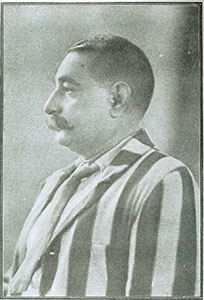
J. M. Framjee Patel: patron of cricket
"I, who was associated with him in his pioneering work, know how he put his heart and soul into it, although he never handled a bat... Pioneering work is ever slow and laborious,” Patel writes. In 1877 a match was organized between the Parsee Cricket Club and the Bombay Gymkhana which included prominent English cricketers. The Parsis were soundly beaten but this defeat inspired them to greater efforts.
Cricket riots were not uncommon 140 years ago. Patel narrates an ugly episode of fighting between sepoys and spectators resulting in many a black eye during a "Sahibs” versus Parsis match. Fortunately, no bayonets were used!
Governor of Bombay Sir Richard Temple was also full of praise for Parsi cricketers. He said, "Blue blood still runs in the veins of the descendents of Sorab and Rustom.” Many of the British deemed Parsi cricketers "pleasurable.”
There are chapters on Parsi cricket — especially its golden age which commenced in 1890 with a Zoroastrian flag fluttering during matches, Hindu cricket, the Presidency, school and college teams and the Authentics from Oxford University touring India in 1902-03.
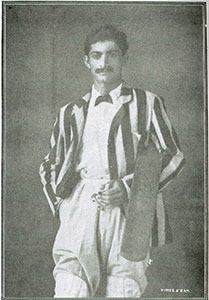
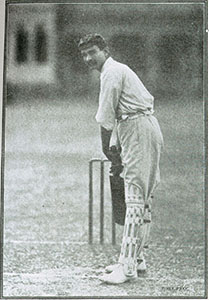
(Left): H. D. Kanga Photo: Shapoor Bhadwar;R. P. Meherhomji
After matches against the top-notch cricketers from Oxford, a poem was written on the early Indian cricketers: "In fielding nimble and in bowling strong,/In batting skillful, all their innings long,/Well-formed to catch, to run, to strike the ball,/The many points in cricket — good in all.”
The author believed that the origin of cricket is more Persian than Greek. I disagree with this view. Cricket’s origin is all English according to historians. However, Patel is on the ball when he writes, "The Parsi owes his cricket prosperity as much to the civilizing and influence of the British rule as to his own innate vigor and adaptability. He is a fine product of Persian pluck and English culture.”
Included in the book are thrilling matches involving Parsis and how once they were saved from defeat by praying for rains and storms. There is "bawa” humor too when a prolific Parsi batsman went to bat for the second time after changing his clothes to disguise himself but was caught in the act by the opposition! To quote the author, "They took hold of the man bodily and forcibly removed him from the pitch, amid the jeering and cheering of a motley throng.”
Also detailed is Dr Mehallasha Pavri’s feat of taking four wickets in four consecutive balls against Europeans from Secunderabad in 1891 which contributed to Parsis winning by 92 runs with only two minutes to spare.
The book is well illustrated with 40 group and individual photographs of great cricketers including Dr D. H. Patel, Pavri, K. M. Mistry, R. P. Meherhomji, P. D. and H. D. Kanga, Shapoor Bhedwar (who later became a famous photographer) and M. D. Balsara among others. There are funny caricatures of players to enliven the pages of this publication.
In the final chapter the author attempts to answer the question: "What is the practical good to be gained from the pursuit of manly games?” by writing, "Cricket is the best athletic food for the public.”
In India today very few watch serious cricket but tens of thousands flock to see meaningless IPL (Indian Premier League) "tamashas (fracas).” Surely, 110 years have made a difference but is it for the better or worse? This is another stray thought by the reviewer.
Theodore Braganza of The Marine Sports, Bombay, is to be congratulated for reprinting this old classic for the benefit of today’s cricket devotees and historians. It makes us think. Framjee Patel must be smiling with satisfaction from up above.
◆ ◆ ◆
From the archive