
Sports
Singularly unbeaten
Two early cricketers who played one Test each have left their mark on community sports
The two "ji”s of Indian cricket were unique cricketing characters. Both were good-looking Parsis, both played only one Test, remained unbeaten and their surnames ended with "ji.” One was a slow left arm spinner, the other a wicket-keeper and a dare devil batsman.
They were Rustomji Jamshedji Dorabji Jamshedji (1892-1976) and my uncle, the dashing debonair Kharshed Rustomji Meherhomji (1911-1982).
They were Rustomji Jamshedji Dorabji Jamshedji (1892-1976) and my uncle, the dashing debonair Kharshed Rustomji Meherhomji (1911-1982).
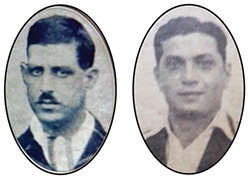
Rustomji Jamshedji (left) and Kharshed Meher-homji
Jamshedji was the third Parsi to play Test cricket. The first two were Sorabji (Soli) H. M. Colah and Phiroz (Piloo) E. Palia who were selected in the first ever Test match for India; against England at Lord’s in London in June 1932.
Jamshedji played only one Test, at Bombay Gymkhana in the first ever Test on Indian soil in 1933.
He was 41 years (y) and 27 days (d) old when he made his debut against England in that Test. He remains India’s oldest Test debutant even after 85 years. The second oldest Test debutant for India was Cotar Ramaswami (40 y and 39 d).
Jamshedji continued to play first-class cricket till he was 46. Only 29 of his matches (over 16 y from 1923 to 1939) were given first-class status. A tail-ender, he scored 291 runs at an average of 11.19 but shone out as a top-class spinner capturing 134 wickets at an excellent average of 22.12.
His bowling action reminded British writers of Hedley Verity, the legendary English spinner.
Wrote Wisden Cricketers’ Almanack in 1935, "There was nothing better in the match than the catch made by Jamshedji, the slow bowler, in dismissing (Leslie) Townsend, a very hard return (catch) being held beautifully.”
The only Indians to have played till over 40 years in age are Vinoo Mankad (last Test at 41 y, 300 d), Lala Amarnath (41 y, 92 d), C. K. Nayudu (40 y, 289 d), Sachin Tendulkar (40 y, 204 d), Ramaswami (40 y, 60 d) and Vijay Merchant (40 y, 21 d).
Jamshedji ("Jamsu” to his friends) remains the seventh oldest Test debutant in the world, after James Southerton from England (49 y, 119 d), Miran Bux from Pakistan (47 y, 284 d), Don Blackie from Australia (46 y, 253 d), Bert Ironmonger from Australia (46 y, 237 d), Nelson Betancourt from West Indies (42 y, 242 d) and Evelyn Rockley Wilson from England (41 y, 337 d).
Apart from Jamshedji, the only other Indian Test cricketers to be born in the 19th century were Nayudu (October 31, 1895) and Ramaswami (June 16, 1896). Ladha Ramji was born on February 10, 1900.
Jamshedji tossed the ball up to batsmen uninhibitedly. He made his first-class debut at 30 and struck immediately, routing Europeans in the 1922-23 Quadrangular semifinals: capturing seven for 85. In the final he took four for 61 and seven for 61.
He made his Test debut alongside Ramji, L. P. Jai, Merchant and Amarnath. He remained unbeaten in both innings, scoring four and one. He bowled only once in the Test, returning figures of 35-4-137-3. His victims included England’s quality batsmen Charles Barnett, Townsend and Bryan Valentine.
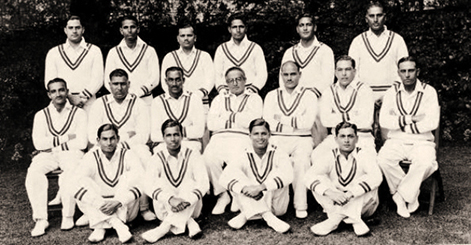
Meherhomji (front row, 1st from r) and Phiroz (Piloo) Palia (middle row, 2nd from right)
The son of a bank employee in Bombay, Jamshedji worked as a clerk in Bombay Dyeing, a job he continued with after his playing days. He passed away aged 83. He will be remembered as the first specialist spinner to play Test cricket for India.
To quote the best-selling cricket author of Spell-binding Spells, Anindya Dutta, "One could in fact say it is poetic justice that it was a Parsi (Jamshedji) who has the honor of being India’s first top class spinner, given that it was his community who first embraced the game in India and helped make it mainstream.”
Meherhomji, also played only one Test, against England at Manchester in 1936, and always bragged to me in good humor, "No bowler could get me out in Test cricket.”
This is how it happened. He was a reserve wicket-keeper and a dashing lower order batsman on that tour. Injury to the regular wicket-keeper D. D. Hindlekar gave him an opportunity to play his only Test. And he did not forget that magic moment till he died on February 10, 1982, aged 70.
As good-looking as Keith Miller and Imran Khan, Meherhomji had a delightful sense of humor. He was the life and soul of a dinner party despite a pronounced stammer. He remembered his only Test appearance fondly and frequently.
"We b-b-batted first and I came in to b-bat at number 10 with the score under 200 (at eight for 188),” he recalled. "Our c-c-captain ‘Vizzy’ (Maharajkumar of Vizianagram) was soon out and I was joined by fast bowler Mohammad Nissar. He s-s-slogged and was out for 13 and I remained zero not out. As I did not bat in the second innings and was never selected in a Test again, I retired with a Test batting average of ‘infinity!’ You might say that no b-b-b-bowler could get me out at Test level!”
Nephew of the stylish Parsi batsman Rustomji Pherozsha Meherhomji (1877-1943) who had toured England in 1911, Kharshed shed an unusual insight on England’s legendary batsman Wally Hammond. "D-d-don’t you believe that Hammond was w-weak on the leg side. We attacked his leg stump all the t-time and not one ball came to me behind the s-s-stumps. He on-drove, glanced and hooked our bowlers relentlessly as he scored a magnificent century (167).”
This Test is memorable as 588 runs were plundered on the second day which still remains a Test record 82 years later. The Test was drawn, the personal satisfaction for uncle Kharshed was accepting skipper ‘Gubby’ Allen’s catch and conceding only five byes in England’s massive total of eight declared for 571.
The two "ji”s combined brilliantly in the Bombay against the Marylebone Cricket Club (MCC) match on the Bombay Gymkhana grounds in December 1933. MCC batsmen R. J. Gregory and Verity were stumped Meherhomji, bowled Jamshedji. Jamshedji took three more wickets including those of master batsmen Barnett, skipper Doug Jardine and Morris Nichols. Jamshedji finished with five wickets and Meherhomji with two catches and two stumpings. Meherhomji had also top-scored for Bombay with 21 runs out of Bombay’s pathetic total of 87 all out.
In 30 first-class matches from 1933 to 1946, Meherhomji scored 656 runs at an average of 15.61 hitting two 50s; his highest score was 71, and he took 61 catches and stumped 10.
His moment to cherish was hitting the dreaded English fast bowler of the bodyline fame Harold Larwood for four fours in five balls. This was for Parsis against Europeans at Bombay Gymkhana in 1936. I asked about this when I had interviewed the legendary Larwood in Sydney in 1980 and he had replied with a smile, "One can’t remember being hit all over the park after so many years, can you?”
Earlier, Meherhomji had become the first player to do a wicket-keeper’s "catching” hat-trick. On December 1, 1931, he accepted three catches off three successive balls from Ramji. This was for Freelooters against Railways in Secunderabad in the semifinal of the Moin-ud-Dowlah Gold Cup.
Since then the wicket-keeper’s hat-trick catching has been achieved only three times, all in England; by George Dawkes for Derbyshire in 1958, by Robert Russell for Gloucestershire in 1986 and by Tony Frost for Warwickshire in 2003.
But it took 75 years before Meherhomji’s "catching” hat-trick was considered first-class. In 2006, Wisden Cricinfo recognized this match as first-class.
I can imagine him smiling from up above with that typical "I t-t-t-told you s-s-so” wink.
◆ ◆ ◆
From the archive