
Books
“Married to football!”
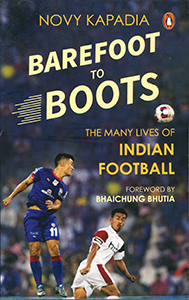
Barefoot to Boots: The Many Lives of Indian Football by Novy Kapadia. Published in 2017 by Penguin Random House India Private Limited, 7th Floor, Infinity Tower C, DLF Cyber City, Gurgaon 122002. Pp: xiv + 345. Price: Rs 399.
Indian football legend Bhaichung Bhutia in his foreword to this wonderful tome refers to author Novy Kapadia as "the grand old man of Indian Football.” Kapadia is undoubtedly grand in his knowledge, love and concern for Indian football but at 65 it is an exaggeration to call him an old man!
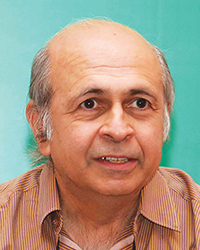 Still, his love affair with football spans nearly 60 years of watching, playing, managing, reporting, writing and commentating on what the legendary footballer Pele called the "beautiful game.”
While the Parsi community in India has of course been at the forefront of cricket, they have also been prominent in cycling, bodybuilding, track and field, aquatics, table tennis, tennis, hockey (in administration) and many other sports. But football is barren territory, save for Kapadia who is one of the doyens of the Capital’s sports press corps.
His second football book (his first, The Football Fanatic’s Essential Guide Book on the World Cup was reviewed by this writer for Parsiana), but first on Indian football, is not only an authoritative history but also semi-autobiographical and traces the author’s experience of growing up in Old Delhi watching football from the early 1960s when the Capital hosted famous tournaments like the DCM (Delhi Cloth Mills) Trophy and Durand Cup which attracted the cream of the country’s considerable talent.
The 1960s were in fact the glory days of Indian football, an era which saw it dubbed the ‘Brazil of Asia’ due to its skillful and artistic style of football, full of the flair and flamboyance so characteristic of the traditional Samba style.
That we have plummeted from Asian Games champions in 1962 — according to Kapadia, the pinnacle of achievement for Indian football — to our current position at being ranked number 105 in the FIFA (Fédération Internationale de Football Association) world rankings (at the time of writing) is a sad saga of the rise and fall of the game in India which Kapadia expertly charts.
It has been much worse, but there has been an improvement in our performance in the last couple of years and now football popularity is peaking after the highly successful staging of the first FIFA world tournament in India from October 6-28, 2017, the Under-17 World Cup championship which attracted record crowds (1,347,133 as per Wikipedia) and which was the occasion on which the book was released.
Still, his love affair with football spans nearly 60 years of watching, playing, managing, reporting, writing and commentating on what the legendary footballer Pele called the "beautiful game.”While the Parsi community in India has of course been at the forefront of cricket, they have also been prominent in cycling, bodybuilding, track and field, aquatics, table tennis, tennis, hockey (in administration) and many other sports. But football is barren territory, save for Kapadia who is one of the doyens of the Capital’s sports press corps.
His second football book (his first, The Football Fanatic’s Essential Guide Book on the World Cup was reviewed by this writer for Parsiana), but first on Indian football, is not only an authoritative history but also semi-autobiographical and traces the author’s experience of growing up in Old Delhi watching football from the early 1960s when the Capital hosted famous tournaments like the DCM (Delhi Cloth Mills) Trophy and Durand Cup which attracted the cream of the country’s considerable talent.
The 1960s were in fact the glory days of Indian football, an era which saw it dubbed the ‘Brazil of Asia’ due to its skillful and artistic style of football, full of the flair and flamboyance so characteristic of the traditional Samba style.
That we have plummeted from Asian Games champions in 1962 — according to Kapadia, the pinnacle of achievement for Indian football — to our current position at being ranked number 105 in the FIFA (Fédération Internationale de Football Association) world rankings (at the time of writing) is a sad saga of the rise and fall of the game in India which Kapadia expertly charts.
It has been much worse, but there has been an improvement in our performance in the last couple of years and now football popularity is peaking after the highly successful staging of the first FIFA world tournament in India from October 6-28, 2017, the Under-17 World Cup championship which attracted record crowds (1,347,133 as per Wikipedia) and which was the occasion on which the book was released.
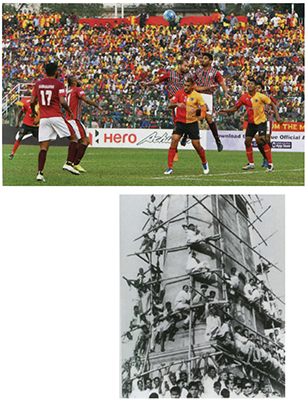
(Above) A Calcutta derby match (courtesy: Gautam Roy);
Fans clamber onto a scaffolding to watch a football match in Calcutta (courtesy: Mona Chowdhury);
(Top): Novy Kapadia
Most Indian football fans will be familiar with the achievements and legends of our game and much of this has already been covered in Jaydeep Basu’s excellent Stories of Indian Football.
Where Kapadia scores is in the evocative picture he paints of growing up in a middle-class Parsi family in Old Delhi where he longed and lived for the winter months when the football season would kick off at the Delhi Gate (now Ambedkar) stadium and for a pittance he could get to see the giants of Indian football in action in front of a full house.
My favorite anecdote is how in December 1965, 13-year-old Kapadia sneaked away to watch a match at the stadium even as the obsequies were being performed for his maternal grandmother who had passed away that morning. But instead of scolding the youngster on his return, his father and uncle as well as the late Ervad Darius Bagli — all football fans — took him aside to ask him the score!
 Just imagine — thousands of fans flocking to the Old Delhi railway station to welcome their heroes from Calcutta and Hyderabad and carrying them on their shoulders! Such scenes are unimaginable these days. Both football and hockey had a glorious history in India till they faded away and were subsumed by the fanaticism which surrounds cricket in our country.
 In an interview with a daily, Kapadia mentioned that he decided to write this book to overcome the grief of losing his beloved elder sister Bunny Page who bought him his first sports book with her first pay cheque and was a major inspiration in his life along with his parents, Minoo and Soona Kapadia.
The book has a prologue ("The Brazil of Asia”), an introduction and a section on "The Major Tournaments.” It is then neatly divided into three sections. Part I: "The Beautiful Game” with eight chapters on different regions of the country (Bengal, Kerala, Goa, etc) and their glorious football legacies; Part II: "Battles for Supremacy” which has two chapters, "Historic Clashes” with wonderful word-pictures of famous matches and "The Great Rivalry” which is devoted to matches between Calcutta giants: East Bengal and Mohun Bagan; and finally Part III: "The Hall of Fame” with profiles of the legends of Indian football by position (forwards, midfielders, defenders, goalkeepers and also legendary coaches).
There is a final chapter, "Looking Ahead,” where Kapadia takes a realistic look at the state of the game in India today where big money and professionalism have come in, but at a heavy price.
For me, one of the highlights is the collection of historic and hitherto unseen photographs, many from the personal collection of famous players for which the author has obviously taken great pains to gather.
In fact, as an author myself, what I most appreciate is that the book is a complete package: attractive cover and title, foreword by a famous player, unique photos, easy to refer to chapter-by-chapter text, list of abbreviations, notes, bibliography, and most importantly, an index. Every publisher should strive to emulate this format.
Famed cricket umpire Dickie Bird (a lifelong bachelor) would tell those who asked him why he was single: "I am married to cricket.” Kapadia came of age in the swinging ’60s but admits long hair, fashion and teenage romances all took a backseat to his passion for football. It would be no exaggeration therefore to say that the football aficionado is married to football! GUL FRAAZ EZEKIEL
New Delhi-based reviewer,Ezekiel, is a freelance sports journalist and author of numerous sports books.
◆ ◆ ◆
From the archive