
Sports
For keep's sake
Lancashire resident Farokh Engineer recalls his boyhood in Bombay and cricketing days for India, soon to be encapsulated in a biography
He was known to be cricket’s Mr Confident — the swashbuckling D’Artagnan among the four Parsi cricketing musketeers of the 1960s and 1970s — Polly Umrigar, Nari Contractor, Farokh Engineer and Rusi Surti. Wicketkeeper-batsman Farokh Engineer could dispatch, with equal felicity, the opposing team’s batsmen back to the pavilion with some nifty glove work, or put to the sword the opposition’s bowling with full-blooded shots which scorched the turf all the way to the boundary or flew away into the clouds!
Playing Test cricket for India from 1962 till he hung up his cricketing boots in 1976, Engineer was also the first Indian cricketer to have been offered professional contracts by four English counties — Worcestershire, Hampshire, Somerset and Lancashire, opting for Lancashire for whom he eventually played for 12 long and successful years. Living in Lancashire for over three decades, Engineer was recently nominated senior vice president of the Lancashire County Cricket Club, the first and only Asian, states his bio data, to be given this honor.
In Bombay in late 2003 as master of ceremonies for the CCI’s (Cricket Club of India) felicitation of great Indian performances at Lord’s and other functions, Engineer took Parsiana on a two-hour-long, freewheeling interview of his life and cricketing times. Seated on deep, cane chairs, cool sea breezes wafting over the vast circle of green at the Brabourne Stadium, Club members taking their evening constitutional hailed him warmly and cheerily: "Kèm, Farokh, kèm chè (how are you)? Avè soo béseené dhons maréch! (What yarns are you spinning now?)” "I love the Parsi humor,” he grins. "But you can’t print some of our (Parsi) jokes!”
The intervening years have seen Engineer put on many a pound, but lose none of the charm and conviviality which had the ladies in a tizzy! At 66, Engineer is one of international cricket’s elder statesmen, an entertaining after-dinner speaker, compere and commentator in the UK and overseas on radio and with Sky Sports, ESPN, Sony Max, the BBC, ITV, etc.
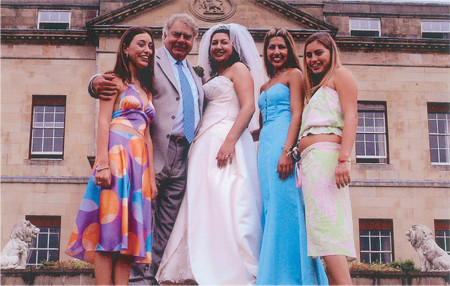
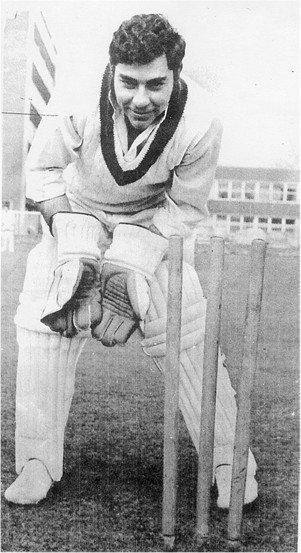
Engineer behind the stumps in Lancashire (top) and (above) with daughters Roxanne, Meenaz, Tina and Scarlett at Meenaz’s wedding
"I just love coming to India,” he says. "Any excuse, and I’m here! And every time I come I become sick because I overeat!” Engineer recalls with great affection his childhood home in Ahunavar Building opposite Dadar Parsi Gymkhana. "My dad Maneckshaw was a doctor with Tatas. He was quiet and soft-spoken, quite the opposite of me. I was a showoff from the start!” the naughty grin surfaces again. Mother Minnie was a good tennis player — she would play in a sari — and a violinist too. The Soonawallas — Rusi and Pilloo, Furdoon and Katy, Jamshed, Soli... — were neighbors and good friends who he still keeps up with, narrates Engineer. "I remember when I was about seven or eight years old, my mother was reluctant to send me on a school picnic as I was an adventurous boy, but Pilloo (then Gimi) assured her that she would look after me, not allow me to go swimming in the lake and bring me back safe and sound.”
Discipline came in the form of an aunt. "I wanted (knee length) shorts; the tailor was instructed to make Bermuda length — I looked like a Japanese general!” The horror of horrors was the birthday sagan: the ‘tilo’ which began at the nostril and finished in the hair, the big thwack of chokha (rice); and (for a small boy) the dreaded kiss! Then striped pyjamas as a present. "I never wore striped pyjamas! I liked to wear shorts while sleeping!”
Elder brother Darius, himself a good cricketer, was instrumental in furthering Farokh’s career. Seeing his excellent gathering, particularly on the leg side, he encouraged Farokh to take to wicketkeeping. Darius later passed away at a fairly young age.
"I had decided very early that I would be twice as good as my nearest competitor. For wicketkeeping, you have to have a natural ability, a flair, anticipation, sixth sense. You can make or improve a batsman. But wicketkeeping is a gift,” asserts Farokh. He recalls the big day he was picked to play for India. "My picture had been splashed all over the morning papers. I was waiting at Dadar station during the morning rush hour, bat and pads tucked under my arm, when the local rolled into the platform, the (then) third class overflowing as usual with commuters hanging on the footboards. As soon as they saw me, the ones near the door leapt out, shouting: ‘Jaagaa do, baaju karo (move, make space).’ I was swept in and there was a mad rush to sit next to me. It was a wonderful beginning!”
We played for the love and honor of the country, he declares, not for money which was a piffle anyway. His father and mother sacrificed a lot for him, he believes, and his only regret is that his mother hardly saw him play. Engineer was playing in a Ranji trophy tie in Saurashtra fairly early on in his career when a telegram arrived that he was urgently needed in Bombay as his mother had been hospitalized. By the time the day’s play ended, the flight had left but it was possible to catch a flight to Bombay from Ahmedabad which was three hours away. "The local Maharaja gave me a car. It was a left hand drive Cadillac and he instructed the driver to take me all the way to Bombay if need be. But the man was old and driving too slow!” Taking over the wheel, though he had no experience of a left hand drive before, Engineer zoomed towards Ahmedabad. "They were expecting me at the airport. The flight was full but many passengers offered to give me a seat so I got on.” Rushing to his mother’s bedside, he was crying — she passed away the next morning. And, Engineer says, he knew his first child would be a girl (which she was) and he named her Minnie (Meenaz).
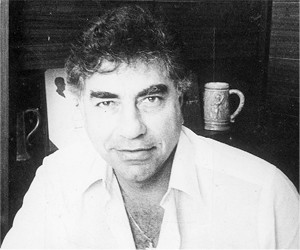
Engineer: for love and honor of the country
Among the cricketing accomplishments he most cherishes is the 94 he scored before lunch on the opening day against the West Indies in Madras in 1966-67, against bowlers like Lance Gibbs, Gary Sobers as well as Wesley Hall and Charlie Griffith thundering in for the kill! Not many people remember that, he rues, nor the 100 he got in 46 deliveries! The statistics say he played in 46 Tests, with two centuries and 16 half centuries, scoring 2,611 runs at an average of 31.08, took 66 catches and effected 16 stumpings. His first class career record stands at 13,436 runs at an average of 29.52, with 13 centuries, 703 catches and 121 stumpings, as per the figures provided by Surat’s Keki Doodhwala, a Ranji panel umpire and sports journalist. The Government of India honored Engineer with a Padma Shri in 1973.
Umrigar was my boyhood hero, Engineer recalls. "Nari, Rusi, Polly and I had so much fun together. We were in Kanpur once for a match and I received a telegram from a girl who wrote how fantastic I was and that she would be in Bombay at the airport to receive me when we arrived,” Engineer tells the story. Being, as he disarmingly puts it, "a bit of a rascal” who enjoyed "innocent flirting,” Engineer couldn’t wait to see who it was. But when they landed in Bombay, there was no one there fitting the description. "That was when I saw Nari, Rusi and Polly in a huddle and realized it was they who had sent me the telegram!”
One of cricket’s free spirits, Engineer was not bashful either about speaking his mind. "We were playing at Lords and Sunny (Sunil Gavaskar) and I had set up a good opening partnership. We were hammering the English bowlers. It had started to drizzle. As I charged down the pitch for a run, one of the big built English fast bowlers obstructed diminutive Gavaskar who came tumbling down. ‘Hey, why don’t you tackle someone your own size?’ I remember shouting at him,” Engineer relates. Those were the days before omniscient stump cameras brought the playfield into every far-flung home.
The first Indian cricketer, he says, to regularly endorse a commercial product, the "Brylcream boy” with the sleek black locks was paid around Rs 2,500 for his first ad! Cricket has become very commercialized, but, he says, "I’m happy for the players.” In this cricket crazy country, "loko chhapra par charaosé (people praise you to the skies)” and then they drag you down!
Giving him the jeebees is the "quota system” prevalent in Indian cricket. "I had been selected as the number one wicketkeeper batsman every time a World XI was chosen by eminent selectors like Sir Don Bradman, Sir Len Hutton and Sir Frank Worrell. To have had deputies like Alan Knott, Bob Taylor and Rodney Marsh was in itself a great achievement,” he asserts. Yet the Indian selectors dropped him from the team for a season! "I was petrified with politics in Indian cricket those days,” Engineer told G. Viswanath (The Sportstar, November 1, 2003). "There were one or two in the Indian Board then who had to be given a kick up their backsides for ruining Indian cricket. I was picked for the World XI and Clive Lloyd who lived two streets away from me (in Lancashire) kept on joking with me, saying, ‘thank God, one less headache for me (Engineer was not in the Indian squad for the West Indies tour in 1971)!’”
"I would like to see these guys (other wicketkeepers) keep to Bishen (Bedi), Prasanna, Chandra (Chandrashekhar) and Venkat (Venkataraghavan), all in their prime. To stand up to these four was something. The ball was doing different things all the time...” Engineer said to The Sportstar, adding "there’s (also) a real opportunity to show one’s skill against (Shane) Warne... But I wish I had more of Ramakant Desais and Kapil Devs to keep wicket to.” At the Adelaide Oval, Engineer relates, Bradman came to the dressing room and give him "the biggest roasting of my life for wearing rubber soled shoes” (and not spikes, which were not well made in India at that time). Sir Don made up for the chastisement by inviting Engineer home for dinner! "From that year onwards we developed a close friendship and every year one of the first Christmas cards I used to receive was from Sir Don and Lady Bradman... He wrote such a fantastic article for my benefit brochure...
"I think every aspiring Indian cricketer should have a stint in (English) county cricket... I just don’t know why Indian cricketers are not invited to start with. Sobers and I were the original invitees for Lancashire. Sobers could not make it and I recommended a young man called Clive Hubert Lloyd. We were roommates for 12 years and we have some great stories about each other.”
Engineer narrates that, as he worked for TELCO (now Tata Motors) before he moved to Lancashire, he had made it a point to show his Lancashire contract to both J. R. D. and Naval Tata. They gave him unqualified support, saying "this is more than 10 years’ salary... the house of Tatas will always have an opening for you.” This gave me a great sense of security, he stresses.
Playing one day cricket for Lancashire in the John Player Sunday League, The Gillette Cup and The Benson and Hedges Cup, Engineer’s success behind the stumps and whilst opening the innings contributed to the county’s good performance. Scheduled to hit the stands this summer is Engineer’s biography.
With a lovely house named The Far Pavilion in Mere (which means ‘lake,’ he explains) Cheshire, Engineer has run for many years his own retail textile business called Universal Textile Exports Limited. But business thandu chè (is slow), there’s not much in the retail textile trade these days, he declares. We are well off, he observes, but not "mega rich,” having lost a lot of money in the crash of the Bank of Credit and Commerce in England. English football icon David Beckham’s house is just five minutes away, he says.
With two daughters Minnie (Meenaz) and Tina from his first marriage to Shernavaz, Engineer has two daughters, Roxanne Bianca and Scarlett Zena with English wife Julie who was, he says, quite disappointed when she found out she wasn’t to be allowed to be a Zoroastrian.
The whole family, including Farokh’s half brother Dossabhai (his father married a second time after his mother’s demise) and sister Pervin Mehta got together at Meenaz’s wedding.
Participating in numerous cricket, golf and other fund raising activities both in the UK and overseas, Engineer has helped raise substantial sums for cancer research, multiple sclerosis, coronary units, etc. Sportsmen and celebrities have raised over a million pounds for the Royal National Institute for the Blind, states his bio data. Currently, he is patron of the Wallness Charity which raises funds for terminally ill children at the Bone Marrow Unit at the Royal Children’s Hospital, Manchester.
Running his gaze over Brabourne’s silent stands, Engineer muses: "This is one of my favorite places. I learnt cricket here as a youngster. No one taught us. We picked up things from our own mistakes. I’d love to be more in touch with youth, to give back to the game some of what I received from it.”
◆ ◆ ◆
From the archive