
Books
Engineering a memoir
Farokh Engineer — From the Far Pavilion by John Cantrell. Published in 2004 by Tempus Publishing Limited, The Mill, Brimscombe Port, Stroud, Gloucestershire GL5 2QG, UK. Website: www.tempus_publishing.com Pp: 191. Price: £ 20.
Flamboyant wicketkeeper-batsman Farokh Engineer played 46 Test matches for India. Living in Lancashire, however, since the late 1960s, Engineer’s life story is penned by Englishman John Cantrell who is, in his own words, Engineer’s "biographer, editor, advocate and admirer.”
Engineer, to a great extent, typifies the ‘international’ Parsi who bridges cultures with ease — the young and handsome ‘bawa’ from Bombay’s Dadar Parsi Colony whose derring-do with the bat and gloves earned him the India blazer; whose ability to adapt saw him play successfully for Lancashire in cold and wet England which has been the nemesis of many an Indian cricketer; the businessman travelling and running his own textile trade; equally at home in Bombay, Birmingham or Barbados.
In keeping with this image is the fact that former British Prime Minister John Major has written the Foreword, the first time ever, Engineer informs us, that a prime minister has written a foreword for any sports book. "Farokh Engineer is one of the great entertainers of cricket... He is the same off the field — buoyant and a bundle of fun...”
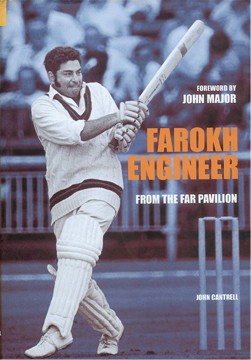
Described variously in the book as "a swashbuckler, a Parsi pirate... whose flashing cutlass was a bat,” a major force in Indian cricket who "converted the plot of green behind the stumps into a staging ground for his acrobatic leaps, warcry appeals and theatrical flourishes with the ball and gloves,” Cantrell takes us through 65 years of the player’s personal and professional life in India and overseas. Armed with an antiquated reel-to-reel tape recorder and microphone, Cantrell recorded the story while Engineer plied him with beer, curries and anecdotes!
Written as the book is with Parsi and non-Parsi readers in mind (given that Engineer has lived half his life in India, the other half in Lancashire), Cantrell’s explanation of why the Engineer family, like most Parsis and Indians, enjoy cricket is rather quaint. Cricket, he says, provides "gladiatorial encounters without bloodshed. It was essentially a civilized sport, sometimes demanding great patience, in which fate also played a significant role with what could be decisive tosses of the coin and changing pitch and weather conditions. It naturally appealed to gentle, civilized people who had not always been able to control their own destiny.”
What might particularly interest Indian readers is that though Engineer is a non-resident Indian, his heart by his own admission is still very much with the land of his birth. He keenly follows the present team’s triumphs and tragedies and empathizes with them. The stalwarts of his playing days — Polly Umrigar, Nari Contractor, Sunil Gavaskar, Ajit Wadekar... — as well as international stars like Clive Lloyd, Gary Sobers, Sir Donald Bradman... weave in and out of the narrative.
In a 14-year Test career for India (1961-1975), Engineer either opened or went lower down in the order, averaging 31.08, with two centuries (highest Test score 121) and 16 half centuries, took 66 catches and effected 16 stumpings — (see "For keep’s sake,” Parsiana, March 2004). With ebullient Engineer on the field, there was much unconventionality, rarely cautious calculation! The leather was meant to be clobbered, Fred Astaire feet dancing down the wicket. And this at a time when the Indians were known as "the whipping boys,” "the dull dogs” of international Test cricket. His own finest hour, he recalls, was when he thwacked the mighty West Indies, making 94 (out of a total of 125) before lunch on the first day of the third Test at Madras in January 1967, a whisker away from entering the record books as no Indian had so far scored a Test hundred before lunch and only three others, all Australians, had ever scored 100 before lunch on the first day. Just after the interval, he smashed a six to bring up his 100, being only the fourth Indian to score a Test century against the West Indies.
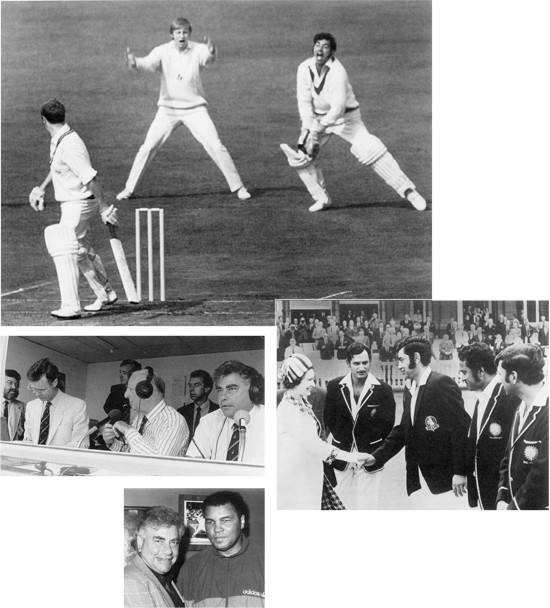
Clockwise from top: Engineer (right) in England; being introduced to Queen Elizabeth; with Mohammed Ali; on the air for the BBC
Heartbreak often arrived with the games of Russian roulette the Indian selectors played, with the "quota system” of the various zones, the maneuverings and machinations being additional, unseen bouncers for the players to parry! Engineer speaks of his stupefaction when he got to know that he had been dropped from the Indian team to tour the West Indies in 1970-71, at a time when Bradman, Sir Len Hutton and Sir Frank Worrell had made him their first choice wicketkeeper-batsman for a World XI.
When Engineer joined Lancashire in 1968, the county had not won a major cricketing honor since 1950, writes Cantrell. During Engineer’s eight seasons, their performance was considerably better, with their Indian import scoring 5,942 runs, with 429 catches and 35 stumpings in 175 first-class matches for the county of the red rose.
"Shoot these little kids”
It was in December 1958 that Engineer made his first class debut in Nagpur — for the Combined Universities side against the touring West Indies, the then Goliaths of cricket whose squad included Sobers, Rohan Kanhai and their ferocious frontline bowlers Roy Gilchrist and Wesley Hall who steamed in for the kill with "eyes bulging, teeth glinting and a crucifix swinging from his chest.” The Indian student team had neither protective padding nor helmets (at that time), the only visible protection was white cotton gloves with soft rubber spikes along the finger pieces! In the first innings, the Indians were wiped out for 49. Forced to follow on, the first three batsmen were seriously injured — one with a fractured collar bone, another with a blow to the head and a third with a fractured arm! The West Indians, eager to have the afternoon off, "wanted to shoot these little kids out as quickly as possible... But we were stubborn and I was the joint highest scorer (in the second innings) with 29 and altogether we scored 167. To me that 29 was like getting a hundred or a double century because the bowling was so tight,” narrates Engineer.
For his first Test match, against the touring Englishmen in November 1961 at the Brabourne Stadium in Bombay (where Farokh had as a kid often watched an international match perched on elder brother Darius’ shoulders, packed like sardines in an overflowing East Stand), Engineer was selected principally on his wicketkeeping skills. "I suppose I had a different approach to wicketkeeping... more on the offensive in the sense that I got involved a lot more in the game than previous wicketkeepers.” A wicketkeeper diving to take a catch was unheard of at that time! That was the job of first and second slip! As a batsman, Engineer was "a compulsive hooker” and at a practice session the day before, he went for a bouncer, mistimed it and the ball flew from the top edge straight onto his right eye! He reported next day with an eye the size of a balloon and was made to sit out the first Test!
On his way to the 22-yard strip of dirt in the second Test in volatile Kanpur, rookie Engineer was bombarded by the English bowler he was due to face with "the rudest words you can hope to hear, four-letter words... almost racist, certainly unprintable.” Puzzled and annoyed, Engineer almost gifted his wicket first ball, which was part of the bowler’s gameplan, till the non-striker and Engineer’s boyhood hero Umrigar, who was 12 years his senior, walked up to him and said, ‘Forget the screaming crowds, you need to buckle down here and restrain yourself a bit.’”
In these obscenely commercial times when an 18-year-old English footballer commands a price tag of £ 25 million to change clubs, when sport is a billion-dollar industry, it is of interest to read that there was a time when players gave their best for love of the sport and the honor of representing the country. Indian players received Rs 75 a day for Test matches in India; when Engineer toured England for the first time the daily allowance was £ 1! The foreign teams touring India "would stay in the best five star hotels and they used to go down to the bar drinking. We couldn’t afford it and we weren’t allowed alcoholic drinks in those days, especially during Test matches...”
Even Test cricketers needed a job and Engineer worked for the Tatas as a management trainee for Mercedes-Benz, his first salary being around Rs 1,000. The perk, howoever, was that the first class cricketer was "not really expected to do any serious work.” The average company life involved turning up at the office at 9.30 a.m. in a shirt and tie, signing in and then talking cricket with the bosses who were all keen on the game, followed by practice in the afternoons.
His first job in Lancashire for Hawker Siddeley was in complete contrast! "I had to leave my house at 6 a.m. every morning when it was often dark, cold and gloomy... if you were late you were pulled up... But I’m sure it was all great for my character.”
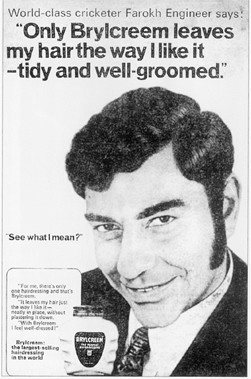
As the first Indian Test cricketer to advertise products, the face of the Brylcreem boy with his bushy eyebrows, thick locks and sideburns looked out of billboards, endorsing hairdressing and other products and providing good income.
Of particular interest to Indian readers are Engineer’s descriptions of his childhood and adolescence. In keeping with his Persian name Farokh (which according to the Parsiana Book of Iranian Names means auspicious/blessed/happy), Engineer joyfully narrates his youthful escapades — throwing ice cubes from his maternal grandmother’s sixth floor balcony on to people below; pounding the pavements of Dadar with other neighbors to catch the local chor (thief) who would occasionally suffer such a beating at the hands of his pursuers that he would plead to be handed over to the police! Obtaining his private pilot’s license from the Bombay Flying Club, Engineer’s reckless stunts ("I don’t know how I’m still alive today”) included taking his small, single engined aircraft into a steep dive, zooming under a bridge just high enough for a double-decker bus to go through and climbing up steeply again to avoid crashing into a college building!
The famous Soonawalla brothers — doctors Rusi, Furdoon, Jamshed and Soli — were Dadar neighbors, role models and good friends. It was they who introduced Engineer to the first steps of dancing, fortified by swigs of whisky to overcome nervousness! "I had quite a few girlfriends from a very young age... I was a rogue and girls like rogues, absolute swine I was... We would go to the cinema and hang around the streets... We just used to have the odd kiss and cuddle but that was it...”
Engineer dedicates his biography "in loving memory of my parents, Minnie and Manecksha, together with my brother Darius, to whom I owe everything, with deepest affection and gratitude.” Manecksha was a doctor with the Tatas. Farokh describes him as highly intelligent, "a very soft-spoken, mild-mannered man (‘Gosh, I’m extremely the opposite’).” Manecksha was a very good tennis player and a very good cricketer, at club standard. Minnie was something of an extrovert, an excellent tennis player who also played the piano and violin, coming as she did from a musical family which included famous conductor Zubin Mehta. Both parents were extremely supportive of Farokh’s cricketing talents, honed in the early days not in fancy cricket academies but on the playground opposite their home or on beaches and backstreets with trees and tin cans as stumps and a dilapidated bat of the Dadar Parsi Colony Sporting Club "that was patched up and hardly suitable for firewood.”
It was Darius who, seeing Farokh’s excellent legside stumpings, encouraged him to take to wicketkeeping. Dossy and Pervin, Manecksha’s children from his first marriage, were the other members of the Engineer family.
Minnie, unfortunately, did not live long enough to savor her son’s successes. She passed away in hospital after a brief illness with her hand on her son’s head, saying: "Don’t cry, son, I promise I will come back to you as your first daughter.” Minnie (Meenaz) and Tina are the children of Farokh’s first marriage to Sherry (Shernavaz) which sadly disintegrated during the 1970s. In 1987, Farokh married Lancashire girl Julie and they have two daughters, Roxanne and Scarlett. "All four of my daughters are very warm and affectionate... attractive and beautiful in every way. I’m extremely proud of them.”
Often the engineer of destruction of the opposition on the cricket field, Engineer is by his own admission so hopeless with mechanical or electronic gadgetry that whenever a TV channel appears unobtainable or an appliance fails to work, he hollers for wife or daughters to sort things out!
The memorabilia, not so much the mathematics (there is not a single separate table of statistics in the book), of cricket appeal to Engineer. He treasures the trophies — the pure silver bat, the golden glove he won, the signed cricket bats... And the memorable moments, frozen in time in the black and white photographs which dot the book, showing him with presidents and prime ministers, eminent sportsmen, fellow broadcasters and TV anchormen... Though he played in an era when one-day games had not taken a strong foothold, to Engineer a game was "a contest played in good spirit with ever an eye for the entertainment of the crowd.” To that extent, he was ahead of his times.
And as so few Parsi sportsmen have published the story of their life, Engineer’s biography may well be a record to remember. Hilla P. Guzder
◆ ◆ ◆
From the archive